Get you knee down in safety, in private.

I was mucking about in the garage last year working on the feasibility of setting up a rig to help riders with their positioning on the bike. Many want to get their knee down and are leaning far enough to do it, but don’t seem to be able to get into the right position when they are on track, even after we go through it with them in the paddock.

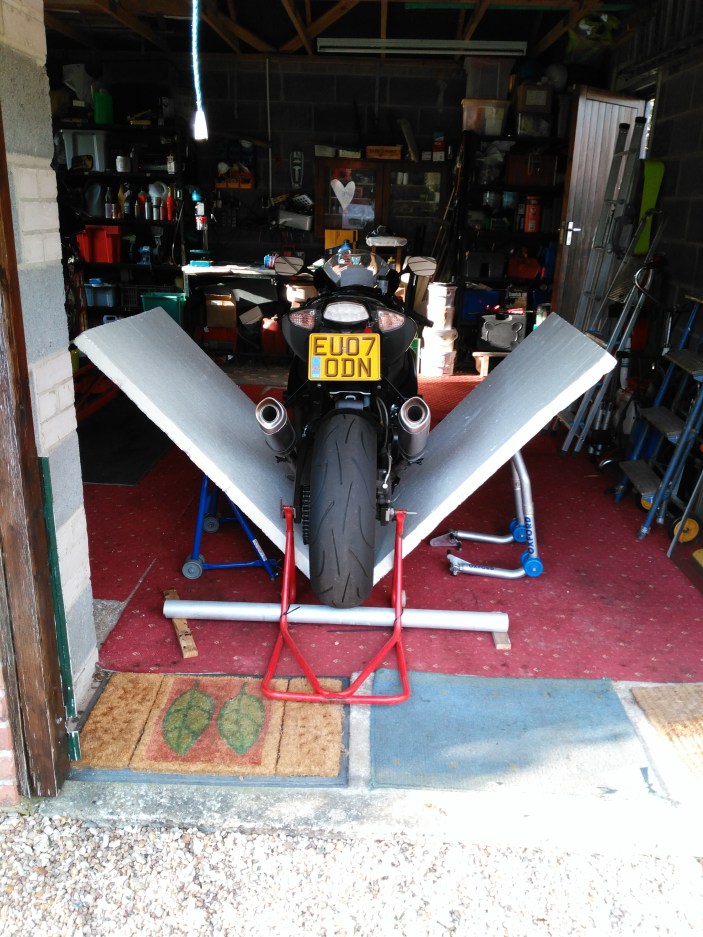
I’ve just found the photo of a lash up I put together in the garage at home, which anybody could do. Please read carefully below before you try and do the same.:-

Leaning rig

The idea was to bring the track up to the rider on both sides, so they could play around with their position on the bike, and practise moving from side to side getting used to where they should be. It is quite painful when you start as you’ll likely use muscles you haven’t used before.

The first problem is to secure the bike properly – which a normal rear paddock stand will not do – you’ll drop it in the garage which can be embarassing and painful. I used a stand with a rod though the rear axle, and then tie wrapped an aluminium tube across the back and wedged it. You might get away with tie wrapping normal padddock stand arms to your swing arm spools, but make sure it is stable before you do anything else and the stand is braced from left to right.

I used a sheet of 8′ x 4′ polystyrene I had lying around, cut in half to represent the track, but anything around 4 foot square and flat would do – chipboard etc.

I then wedged the sheets with a couple more paddock stands at 45 degrees to the bike, lining them up with the tyres at the bottom.

If you then sit on the bike (making sure its stable and won’t fall over when you hang off) you can fairly quickly work out where your body needs to be to get your knee down – and it’s far better than looking down when you are riding trying to see how far you are away – as some riders seem to try.

You will find you need to move your upper body across as well as your backside, and keep your pelvis at right angles to the bike, and put the ball of your inside foot on the peg.

You will hopefully find a position that feels comfortable and safe with you firmly wedged in place – usually with your outside arm against the petrol tank. You can then practise moving to and fro from your normal riding position and to the other side. If you practise this it should become second nature and will help you get those new muscles working. Next time on the track it should feel natural and comfortable.

I doubt whether this is a unique riding aid – just that they are usually hidden behind locked garage doors.

Hope this helps. Take care.

Feedback appreciated.


Mike Abbott ACU Coach #61220

British Superbike School.


How to avoid a Fatal Road Accident – drive into the vehicle in front!

Firstly most accidents (now called collisions or RTC’s) are mainly caused by road users not paying attention, with the exception of motorcycles >500cc where ‘loss of control’ is the main cause.
Many collisions are beyond an individual road user’s control, but there are actions we can take – if we are prepared – that maximise our chances of survival or minimise the risk of life changing injuries.
On (or rather off) a motorcycle it is ‘how you fall’ and crucially ‘what you hit‘ which determines the outcome – (see the late Dr John Hind’s last video). However ‘What you hit’ is an issue for all road users.
For anybody on two wheels, road furniture represents a very real unique danger, increasing your chances of dying by no less than 17 times, according to the World Health organisation. So you need at all times not only to be aware of other vehicles and the danger in particular of trucks, but also anything by the side of the road, including trees which are also potentially fatal to any road user.
Target fixation leads you to ride or drive into what you are seeking to avoid, so you need to look where you want to go, not where you don’t. Getting into routinely scanning and looking ahead helps you both plan your ride, and identify potential escape routes.
This full list of factors is called ‘Haddon’s Matrix’, but here we are just considering ‘The Event’, and its related ‘Agent‘ and ‘Environment‘, as we can’t change anything else when a collision is immediately likely, and environmental factors are what we are seeking to address.

We have to avoid rapid de-acceleration as we are surprisingly fragile. Although, according to the TRL, in a car we usually survive front and rear impacts from 30 mph, (but not from 40 mph), a side on impact can kill at < 20mph due to a lack of crumple zones. Clearly the situation is even worst when you come off a motorcycle or cycle where even 15 mph can be fatal if you hit something solid.
Also the nature of impacts are not usually always obvious. The impact and rate of de-acceleration is the delta (difference) between pre and post collision speed. If you run into another parked car of similar weight in your car, the impact is circa half the speed as the stationary vehicle will move, reducing a 60 mph impact into approximately 30 mph delta. One car at 60 mph = two cars at 30 mph (approx – as kinetic energy is 1.5 x mass x speed squared). This, although it seems a considerable impact, is probably survivable particularly due to front and rear crumple zones.
Riders and bikes are two separate masses – riders have only flesh and blood crumple zones – so none of the above really applies. Your personal weight will have minimal effect, so this is not an excuse to eat more pies. But in a prospective shunt from behind, on your bike you can maximise your chances by being either positioned to the right or left hand side of your lane and the vehicle in front, so the vehicle coming up behind could miss you, and you could also potentially move past the vehicle in front, and out of the way. Get in the habit when you stop at the back of a queue, to watch behind until the vehicle pulls up and acts as a shield.
Riding (or even driving) into the back of a 40 tonne truck at 40 mph would be close to a 40 mph delta and not likely survivable – so even for cars it is can be ‘what you hit’. Modern 4×4’s are safer due primarily to their weight – run into one of those at 2 tonne in your small car at 60 mph and your impact is nearer 40 mph – probably not survivable – their’s would be 20 mph and not significantly life threatening.
So if you are in your car at the tail end of a jam and you see a car behind that is not going to stop in time, you need to consider standing on the brakes or better still bizarrely drive into the car in front then brake! You have just doubled your mass and potentially in theory halved the impact – although you potentially put the occupants in the car behind in significantly greater danger. You still could also be crushed if your car’s shell deforms too much.
Would you have the presence of mind and time to spot potential collisions ahead of time and act appropriately – or are you just going to find you’ve suddenly sprouted wings? Or alternatively become a Buddhist and wait for another chance?

Review of 2016 Motorcycle Road Accidents – ‘Speed Awareness’ not working

‘Speed Kills’ – A Big Fib

The 2015 National Statistics on road collisions were published recently. Interesting reading.

Speed does not kill. It is only a ‘contributory factor’ in 16% of fatal accidents.

Regarding just fatalities, these are the top causes as reported by the police:-

Loss of Control                                                   32%

Failed to look properly                                   27%

Careless reckless or in a hurry                     20%

Exceeding the speed limit                            16%

Failed to judge others path or speed         14%

Poor turn or manoeuvre                                 14%

Driving too fast (but within limits)             12%


(DoT – RAS50007 2015)

These don’t add up to 100% as there can be more than 1 contributory factor, but clearly in 84% of fatal accidents, speeding was not a factor.

Regarding published trends for all collisions over the past 5 years, ‘loss of control’ has improved slightly probably due to vehicle developments, but ‘failing to look properly’, being ‘careless reckless or in a hurry’, or ‘making a poor turn or manoeuvre’ have all steadily increased. ‘Driving too fast for the conditions’ is stable at 7%, so no change there, and speeding’ for all collisions isn’t even in the top 10. (Table RAS50002).

We are simply not tackling the primary root causes of fatalities.

In response to an inappropriate focus on ‘speed’, many speed limits have been reduced, speed cameras installed costing £ millions all over the country, ‘safety camera’ partnerships abound.

‘Speed Awareness Courses’ arrived.

I was told at the recent Road Safety (AIRSO) Conference that more than half the drivers in the country have now done a Speed Awareness course for minor speed infractions. That’s circa 23 million courses at £90 a go, plus no doubt a healthy profit for the AA who deliver them. Drivers and riders have lost time off work and been fleeced collectively for an estimated £2 billion.

The focus has succeeded in reducing speed I think (as has it appears high fuel prices). Vehicles are noticeably driven in general more slowly than they were, but this seems to had had little to no effect, as it was never the main problem.

Strangely, those who are convicted of driving or riding significantly over the speed limit don’t have the option of a speed awareness course – which is just plain ‘nuts’, as these people clearly are likely to be the major continuing risk. Maybe this is the problem? My course was dominated by confused pensioners (my peer group) many of whom misunderstood how fast they could legally go, so they’ll probably go faster as a result. And we all no doubt spent the next few months looking for speed signs and cameras, as opposed to where we were going.

This is the 5 year rolling average change of KSI (fatalities and serious injuries) to smooth out peaks and troughs from the latest DoT report:-

untitled

Serious casualties have been decreasing significantly during the last 35  years, but are now static (marginal %age improvement), with improvement tailing off over the last 5 years. Look at just the fatalities (excluding serious life changing injuries):-

 untitled2

So in the last 5 years fatalities are about the same – very little improvement. The main explanation for any improvement is probably that cars are getting safer with airbags and ever stiffer crash test requirements. This seems to be confirmed as motorcycle fatalities are actually up 8% in 2015. Mile for mile you are now 57 times more likely to be killed on a motorcycle than in a car.

It could be argued that reduction in speeds has also improved the outcomes, and no doubt that is what the ‘speed lobby’ will claim, but there is no evidence that I have seen to support this. And it’s I believe likely to be far more effective tackling the primary causes of fatal collisions, rather than accepting the worsening situation and trying to minimise the impact (no pun intended).

You can’t argue that speed awareness is reducing the impact speed and severity of collisions, as the number of SKI’s is now static.

The blind focus on speeding to tackle fatalities has failed. Speeding related fatalities hit a low of 194 and 12% in 2012, but show an increasing trend, up to 244 and 16% in 2015. The situation is now significantly worse.

We are all very lucky to have world class emergency services who seem to have been steadily improving survival rates, which again may be a significant factor in reducing deaths.

There are also separate figures included this year from the NHS (not the police) and they show deaths and serious injury admissions from road collisions (MAIS3+) have remained largely unchanged for many years.

As the ‘Speed Awareness’ program has clearly failed, there is talk now of ‘zero tolerance’ for speeders, which is very unlikely to help either. The huge damage already done to the relationship with the police will suffer further. Before speed cameras the police applied common sense to speeders, usually only prosecuting when the speeding was dangerous, and lecturing drivers instead. I believe it worked.

12% of fatalities were actually caused by vehicles within the speed limit but still travelling too fast for the conditions.  And this is even after the reduction in speed limits on very many ‘high casualty’ routes, which I suspect has caught many if not most of the speed awareness attendees. There is no consistency in the application of speed limits which look almost random at times. We have some 30 mph dual carriageways and a 60 mph limit on most single track roads. Ridiculous.

22 million drivers and riders have been lectured on the evils of speeding, misled into believing that keeping within the speed limit is the single most important thing to do, and will help to keep them and others safe. What a misleading wasted opportunity of biblical proportions.

40% of fatalities – two and a half times more than the 16% who were speeding – were caused by a failure to look properly or the miss-judgement of another’s path or speed. Twice as many fatalities as speeding (32%) were caused by the driver/rider losing control. 20% were careless, reckless or in a hurry, 14% were making a poor manoeuver, and 13% were either drunk or drugged (Table RAS50007).

(NB The combination of both speed and losing control contribute to less than 1% of collisions).

The opportunity is there on ‘Speed Awareness Courses’ to present a truthful picture of what actually causes collisions and how to avoid them. Primarily we all need to take more care and pay far more attention, avoid distractions, concentrate.  The fact that you end up on a speed awareness course is because you weren’t paying proper attention!

The key factor of ‘reaction times’ is not stressed. TRL research shows reaction times at least double if you’re not paying attention, increasing stopping distances by 30 foot at 30mph, 60 feet at 60mph, and worse case can be 6 times longer if you can’t recognise a hazard for what it is. Drivers and riders also need to be taught properly how to control their vehicles as ‘loss of control’ is the primary cause of twice as many collisions as speeding, despite all the features on modern vehicles.

Standards of driving are noticeably poor. 55% of drivers fail their tests which is appalling (30% of motorcyclists fail) – so many poor drivers inevitably get through by chance eventually, which may also be a major factor. Training in general needs totally revamping to make it more effective. Vehicle control needs to be taught properly as does such skills as overtaking and driving on a motorway which amazingly are not covered.

There are doubtless often early warnings via minor collisions by which the insurance industry could identify those who need further training, before probably an inevitable ‘big one’.

We need to abandon the very misleading ‘Speed Kills’ strap line, focus on the need to pay attention, train road users properly and significantly increase the levels of traffic policing as RoSPA have recently proposed. Back to ‘Think’?

A new course is needed on ‘Collision Avoidance’ based on data and solid theory, not hysteria, on the cause of collisions, the dangers of losing control and how that can be avoided, and the importance of always paying attention stressed. This could be applied primarily to drivers and riders who have collisions and serious offenders, not marginal speeders who present at best a very low risk.

We have collectively allowed ourselves to be hijacked by the anti-speed lobby and misleading populist newspaper stories, and the Government taking an ineffective soft self-funded option rather than dealing properly with the root causes of road fatalities.

Does ABS on a Motorcycle really help?

We’ve had this discussion many times, and the answer as always seems to be ‘it depends’.

This blog was in response to Bruce Wilson (Ex-National Superstocks) from Motorcycle Sport and Leisure stating he couldn’t stop the ABS interfering last week on our track training day.

IMG_5197.jpg

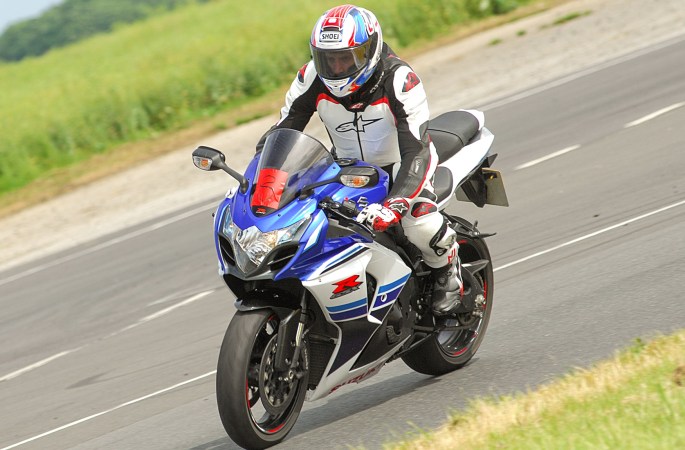
It was coming on just as he was about to turn and we wondered why, but with a bit of thought decided it must be a ’tilt’ parameter on the latest Suzuki GSXR1000. We know KTM have a tilt, pitch and lean sensor on their ‘cornering ABS’, which has had rave reviews.

Stage_MSC_734x306px_w734

For what is involved have a look at the Bosch website.

Normal ABS may well not work in a corner as the predominate force is radial, and a bit of braking can just exceed the available grip (Mohr’s Circle discussed before) and the tyre could slide sideways whilst still rotating and down you go.

Up to this point we had always said if the ABS comes on you’re not doing it right.

It is proven to work in a straight line to prevent wheels locking, but do you stop quicker? The answer is probably no looking at the bumf from Honda and Suzuki, who both state it does not mean you stop in a shorter distance. The question is why?

We think that simply grabbing the front brake brings the ABS on immediately and probably delays the weight transfer to the front wheel, which lengthens the stopping distance. And we now also appear to have the situation where rear wheel lift will set it off, when you can without it still be braking hard (for a bit longer).

So is it a good idea on a motorcycle? The answer is overall yes, particularly for less experienced riders, but it may lengthen you stopping distances for the skilled – and cornering ABS looks from the reviews simply amazing where a huge amount of skill and experience is needed braking whilst banked.

British Superbike School

Motorcycle Throttle Control – a Cautionary Tale

Firstly many thanks for Alan Bussell for allowing us to share this with you.

Allan is a very experienced biker and has done as much advanced training as he could pack in from the usual suspects on the roads and track, and was booked to come on one of our track training days for road riders on 30th June, after winning a competition in Motorcycle Monthly.

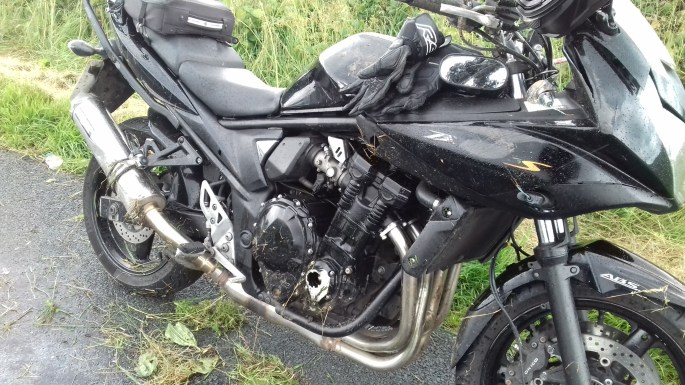
Sadly he’s just had an off and very luckily escaped with just a few bruises, but the bike is probably a write off. Could have been far worse – note a lack of trees and lamp posts. We’ve known that ‘loss of control’ is a major factor for some time in big bike injuries (>500cc) from the accident statistics.

Allan:-

‘This shows how easy it is to come off.  Gentle acceleration as I was moving out to overtake an elderly couple.  They’d seen me and had kindly pulled over for me to go (no need to because the road was empty). When overtaking I try to show the same respect (if not more) than what was shown to me so I go past without having the engine screaming.
Road2
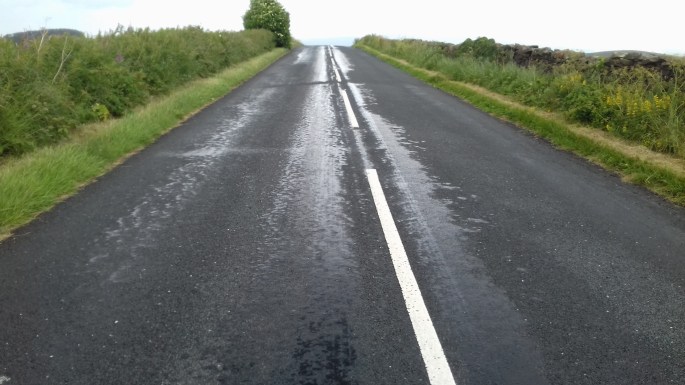
The conditions were obviously damp so gently does it but when you hit the slippery tar then any power going to the back wheel just spins up the back wheel and before you know it I’m sideways on motocross style then it bites when it hits the grippy stuff.  This is the result’. 


Side View

The problem with modern bikes is even tourers have very powerful engines and very light flywheels, so when the rear wheel loses traction, if the throttle has been opened wider than it needs to be, then the revs rise almost instantly. If the tyre does then find a grippy piece of tarmac it’s a complete lottery what happens next, depends on how far sideways you have got and in which direction, before some grip is found.

This is the classic ‘high-side’ if you are banked, but even a seemingly flat straight road can have enough camber to force the bike sideways. White lines are better than they were but can still be treacherous, and a badly maintained road where all the aggregate has worn off just leaving the tar can be like ice, particularly when wet.

It is worse in a higher gear as you get so little response from opening the throttle wider, so may not realise how far it is open, which is why you should always consider which gear to be in (and change down before taking).

Traction control should have kept Alan upright, but the advice is not only to open the throttle slowly and smoothly, but also never get it further open than you need, rolling it open steadily as the revs increase, ‘dragging’ if you like, the tacho needle around the dial.

Modern injection systems are ‘ride by wire’ with no direct connection between the twist grip and the throttle butterflies (which restrict the flow of incoming air and fuel – or a second set of butterflies controlled by the computer on older bikes). No matter how far you twist the throttle, at lower revs the butterflies won’t open much as the engine can’t digest any more fuel efficiently – until the revs rise and the engine management system then opens them more and more as the revs build until it reaches a point set by the twist grip, when the butterflies stay partially open dependent on how far you’ve turned the throttle.

So if the throttle is fully open at lower revs, if the rear wheel loses grip the engine will instantly hit the rev limiter – peak revs and peak power produced as the tyre tries to grip again. When the rider instinctively reacts and shuts the throttle the bike will likely be sideways when the tyre grips again, which often then throws the rider off.

So the advice is to use your gearbox and consider changing down before overtaking which means the bike is more responsive, twist the throttle gradually as the revs increase, so if you do lose traction then the engine revs will only rise so far, giving you a good chance of saving it.

Motorcycle Track Clothing

One piece leathers probably give riders the best protection, although good quality textile clothing should be good enough. Two piece suits, whether textile or leather, are better if either the top and bottom can be zipped together, or if the jacket has a robust crotch strap.

We don’t accept kevlar jeans, as we don’t know how good they will be.

Both textile and leather suits should have CE armour in elbows and knees as a minimum. Shoulders, back and hip protection should also be better. There are also chest protectors available. Check your jacket has a CE marked back protector and not a piece of thin foam. Consider fitting a CE protector in the pocket, or using a separate back protector.

The European standard is EN1621-2 (Level 1 for regular use and Level 2 for sport/track).

Some leather suits are made from very thin leather, could be sheepskin. The quality of the stitching is also vital. Leather is not automatically better.

Here is some interesting general information and advice from Byson Leathers http://www.bysonleather.co.uk/BYSON%20LEATHER%20AboutLeathers.htm


Braking from High Speed – Components

We’ve had some response regarding brake pads and discs, and whether these effect braking distances in any way, so here is a quick review of braking components.

Brake Pads

‘Softer’ pads with higher coefficients of friction require less lever effort for the same braking effect, but wear out quicker and can fade. Different construction of and materials used in pads can also effect the ‘feel’ during braking which is vital particularly on a track, and being able to sit the bike in it’s nose with one finger is great.

Make sure you buy a well known brand from a reputable source. I bought some ‘Armstrong Racing’ pads from Newark Auto Jumble some years ago, then went straight at the Esses at Donnington on a trackday. Very lucky to find the problem there, as I was off to the IOM on bike the following week. They were probably OK for normal road use, and of course may be OK now, but had I found the problem going down to the Creg on Mad Sunday…….

Brake Lines

Braided hoses, if not already fitted, can make a big difference as they don’t expand as much when pressurised, which makes the brakes feel sharper and uses marginally less lever movement. These do need to be properly made as they operate under high pressure. Most modern hoses are made to measure and swaged rather than you having to assemble your own fittings. Buying a bike fitted already with after market bolted hoses is always a risk that they have been assembled and torqued up properly. If in doubt change them. Again buy a major brand from a recognised supplier, and make sure they are certified correctly. See for example:-

http://www.helperformance.com/certification/

Master cylinders and calipers

The first bike we had which could stop with one finger, was an Aprilia Mille ‘Sound of Thunder’ bike, with the early Brembo racing radial calipers and master cylinder, which are now commonplace on top spec OE bikes. Absolutely amazing at the time. You can retrofit better master cylinders relatively easy (changing calipers usually mean changing forks, or some complicated bracketry for older bikes), but you need to be very careful to use the correct bore and displacement master cylinder, and adjust it correctly.

From experience, everything seems great tested statically, but if the master cylinder piston is not returning far enough, then the fluid cannot return to the reservoir , heats up and locks the front brake. Had this happen to a rider on a race bike with us a couple of years ago , as well as personally on an old TZ350 trying out a smaller bore master cylinder.

Brake discs

Also be very careful where you buy these safety critical parts. Here is a CB500 disc off a race bike where it has cracked and failed at Mallory – the rider was badly hurt.

IMG01910-20110716-1632

The same problem was found on a second bike the same day. These are non-floating cast iron, not the modern steel discs. However, steel discs can warp pushing the pads back, which you suddenly  discover when it takes two pumps to get the brake to work. The old thin fixed steel disc are very prone to this, so you need to make sure that pads are equally spaced and that the disc is not being bent when the brake is applied (another old TZ problem), which is why ‘floating discs’ were invented.

Some floating discs seem to wear the ‘spools’ very quickly, one side went recently on my GXR1000K7. You can here them ‘tinkling’  when you wheel the bike (some Italian bikes used to do this from new), but we cannot find what the service limits should be. You also sometimes get a ‘clonk’ initially when braking. If in doubt change them.

Modern sintered pads can wear out the discs quite quickly, so always check for bad scoring and minimum thickness (usually stamped on the disc).

Again buy OE or recognised brands from a reputable source.

Brake Fluid

Needs to be changed every two years on road bikes, more often for race bikes. Dot 4 is usually recommended, and there is a Dot 4 Racing with a higher boiling point for track bikes. The problem is you don’t know you have a problem until the fluid overheats and boils, as it absorbs water over time, and the brakes simply fail. There is also a new DOT 5.1 which has a longer life, not to be confused with DOT 5 which is silicone based and must not be mixed with any other brake fluid. DOT 5 doesn’t absorb water so has a long life, has a high boiling point, doesn’t act as a paint stripper, is better at very low temperatures, but is supposed to be more compressible making brakes spongy, and is not suitable for anti-lock systems.

Apparently some Harleys have DOT 5 fluid.

Always refer to your bikes handbook, only buy small bottles of fluid to top up and keep the caps on. For racing brake fluid, refer to the manufacturers advice for usage and frequency of changes.


What finally limits braking distances on a bike, is that braking forces much over 1 g have the back wheel in air, as the centre of gravity is so high, so braking harder flips the bike. This usually happens quite slowly, so riders have time to simply ease off the brakes.