The Fox’s Face – the ‘Traction Circle of Grip’ applied to motorcycles

(From Biral, Francesco & Lot, Roberto from 2009)

So what does it mean for riders?

The ‘Fox’s Ears’

It means that you can accelerate the hardest at 45 degrees of lean, which seems odd, but have to roll back the throttle as your lean angle decreases and the front of the machine starts to lift.

Riders need to be acutely aware of the dangers of ‘High Siding’.

The ‘Fox’s Nose’.

This also shows a rider can brake (briefly) at up to 1.5g when upright(ish). This is twice as hard as the Highway Code standard.

This is probably from top speed due to the drag on the rider and bike preventing it flipping over. 1g tips most bikes at lower speeds. You can also briefly brake harder as energy is dissipated rotating the bike during weight transfer.

The ‘Fox’s Jaw’

The ‘jaw’ show a linear relationship between lean angle and braking, up to the extremities of banking – red lines. So track riders can brake deep into corners using the front brake, gradually releasing it proportionally as the lean angle increases.

Riders need to be aware that grip levels on the road can vary considerably, and the dangers of a front wheel ‘wash out’ and ‘Low Siding’.

The DVSA advice, which should be taken, is for road riders to complete their braking before corners, and only use the rear brake in an emergency. Applying the front brake mid corner, as opposed to carrying it into the corner, flips the machine up. This will make it run wide, potentially through the scenery or into oncoming traffic.

However, with training and practice, road riders can be trained to carry the front brake into corners in an emergency, which can be a life saver. But braking into corners routinely just significantly diminishes your safety margin, and likely increases impact speeds.

It’s not sensible to ride on the road anywhere near the limits of grip. However, on a track, it’s necessary, with care, for fast lap times. You need to know where the limits are.


We tried applying the standard traction circle maths to motorcycles in 2015, looking to see what traction should be available for braking as the lean angle increased.

If you use Mohr’s Circle, you get what we called the ‘Cats Claw’ which is the shape of the calculated additional area of grip.

It didn’t look right, and showed far more grip when banked than was available in practice. The question was why?

We looked at Cossalters ‘Motorcycle Dynamics’ which shows an oval, which looked better, but not perfect. 1g on one axis for braking and accelerating, 1.6 g for the other when banked.

There was a recent post on LinkedIn from Mikko Bartolossi, a MotoGP Engineer, introducing a paper from Biral, Francesco & Lot, Roberto from 2009, showing an alternative traction circle for motorcycles.

https://www.researchgate.net/publication/267715875_An_interpretative_model_of_g-

It looks like a fox’s face!

The diagram shows the lateral and tangential g force acting on a motorcycle when cornering, and either braking or accelerating at the same time.

The left and right hand areas show the g force acting on the machine when it is banked. The braking force is shown on the lower half, and accelerating on the top half of the diagram.

The tip of the ‘fox’s nose’ shows that a rider can momentarily brake at around 1.5 g as long as the machine is nearly upright. This will be very briefly as the bike will flip forward otherwise, and is probably from top speed relying on wind drag to stop the bike from tipping fotwards. But shows how a high level of skill can reduce stopping distances. Most motorcycles will flip forward at 1g. (For E-Scooters it’s only 0.4 g). The Highway Code assumes 0.67g.

Riders need to be aware of the dangers of snatching the front brake and skidding and falling, or on machines without ABS. Also somersaulting, when can also occur with earlier ABS systems without pitch control

The red lines at the bottom show a linear relationship between lean angle and the maximum braking force that can be applied, when you’d probably expect the grip to diminish exponentially as the lean angle increases (Cat’s Claw).

This will be using mainly the front brake, as the rear brake will have little effect due to the weight transfer forwards, making a rear wheel skid very likely.

But what is even more interesting, are the ‘fox’s ears’. Accelerating on a motorcycle is limited to 0.9g not by tyre grip, but because the machine will flip over. This time backwards, not forwards as in hard braking.

It shows that motorcycles can be accelerated harder when banked, the peak shown at 45 degrees of lean. Why is this? It’s probably because the centre of mass is lower and to the inside of the corner, and the front of the machine is held down partly by the centrifugal force. The weight is transferred to the rear tyre from the front tyre at the same time, giving more grip at the rear.

This is where racers can gain an advantage, but for trackday and road riders this is where ‘Highsides’ happen. The rear tyre loses grip, slides sideways, then grips again when the rider instinctively snaps the throttle shut in response. The rider is usually thrown up into the air, often over the top of the machine.

We know traction control will not necessarily prevent this. It’s too quick and too brutal. However, modern bikes with Inertial Measurement Unit (IMU) are better and can sense tbe limit aporoaching.

Modern MotoGP and WSBK bikes have traction control, (BSB bikes don’t) so it very rarely happens now in world racing, but many older road going sports bikes also don’t.

This makes older sportsbikes quite difficult to ride safely, particularly as grip levels on the road, as opposed to a track, can vary considerably. There are also two generations of traction control for road bikes, the latest being IMU’s are ‘lean sensitive’ which makes them more effective and safer.

We know from experience at ‘The School’, that riders can still lose traction by accelerating too hard at extreme lean angles., even with traction control. However, the newer systems seems to prevent ‘high sides’ (so far), with the bike ‘low siding’ and the rider just slipping off the side of the machine.

The new Yamaha R9 and other top end bikes now have 6-axis IMUs (Inertial Management Unit) which makes them ‘lean sensitive’, so should be safer in this respect, although the Laws of Physics will eventually intervene at the extremes.

So a 10-year mystery solved, it’s not a ‘Cat’s Claw’, it’s a ‘Fox’s Face’.

Were now working with Prof Owen Williams on a 660 Aprilia fitted wirh a 9-Axis IMU. Next step?

Mike Abbott, British Superbike School

17th June 2025

Updated 16.8.25
The Potential Problems with ‘Advanced Motorcycle Training’

These are what I believe are the common issues with ‘Advanced Training’ from the unqualified and unlicenced, and the charity sector observers and tutors exceeding their roles, trying to provide training not assessments, ignoring official riding advice and standards, thinking they know better.

The source is probably, at least in part, old police ‘pursuit’ and ’emergency response’ practises – usually on a marked bike but could also be unmarked surveillance:-

  1. You will probably not receive any training to brake from high speed, so you need to master this before you go.
  2. The key thing is not to snatch the front brake lever, so you need to continually practise so you automatically just squeeze it in an emergency with increasing pressure.  Practice braking from higher speeds until it becomes automatic.
  3. Use both brakes and cover the front brake with your two inside fingers when you can. This should reduce your reaction time by around 1 second – 88 feet at 60 mph. The difference between stopping and a 40 mph, probably fatal impact. Use a phone App such as iAccel Lite with care.  The standard is 0.67 g average. I went though all my training and trainer training without anyone ever checking I could stop from high speed. 
  4. https://britishsuperbikeschool.com/2024/04/04/the-british-superbike-school-guide-to-emergency-braking-on-a-motorcycle/
  5. If you are presented with a two-way radio, walk away. This is in direct breach of DVSA standards. Radios should be one way only, for obvious safety reasons. The trainer would probably not have been trained in the correct instruction protocols to keep riders safe.
  6. If you are shown the ‘suicide swoop’, which I have by an ex-police rider  – overtaking an HGV on a LH bend – forget it. Unnecessary and very dangerous.
  7. If you’re shown ‘off siding’ – taking a LH corner from the RH gutter – forget it as above. These are two old ‘pursuit’ techniques. Never cross the centre line except when overtaking, and don’t cut corners.
  8. Be aware if you move out near the offside kerb to get a better view, you may not see RHS hazards, and emerging vehicles from your right will not be expecting you. You could also be in the blind zone of the vehicle in front, which could pull out.
  9. If you’ve been pressurised into overtaking at every opportunity – don’t. You shouldn’t be in a hurry. Only overtake when you are absolutely certain there are no hazards.
  10. Be very careful filtering. It’s not necessary and it’s hazardous. You may well be encouraged to do it at every opportunity. The training is usually to look for a gap ahead so you can get back in, but there’s no guarantee it will still be there when you get there, and you could be ‘hung out to dry’. Also, if there is a gap it’s often for another road user. This could be for a pedestrian to cross, a car to emerge etc. The gap is very unlikely to have been left for you.
  11. When filtering, treat every vehicle you pass as a separate overtake, and make sure there is the space to slot back in, in front of them.
  12. Only filter past stationary vehicles or vehicles travelling < 10 mph.
  13. Don’t filter up the inside between the traffic and the kerb. Drivers and others won’t expect it, and gutters are often full of debris.
  14. When filtering in between two lines of traffic, or when using a bus lane, be aware of hazards appearing from the RHS as well as the LHS.
  15. Don’t filter right up to the front. If you’re in between two lanes the RH driver may not see you and you may get squeezed on take off. You might also get some competition at the ‘traffic light Grand Prix’ as you will probably need to get immediately ahead to stay safe. This can be very dangerous. Look out for sports cars and hot hatches – (and anyone with his cap on backwards). Stop in a space one car back from the front.
  16. Be very careful filtering down the outside, particularly on narrow roads.
  17. Don’t filter up front by using the RH turn lane unless you are sure that you can get back in. Don’t go straight ahead from the RH turn lane. Other road users will expect you to turn right, and if there’s a RH traffic light filter, you’ll be blocking the lane. 
  18. I’ve been deliberately pushed into oncoming traffic when filtering, in one case over a double white line by an irate driver who thought I should stay behind him. Got very close to an HGV coming the other way. The drivers had all moved over to give me room. The driver in question did the same until I appeared. He then seemed to realise why everyone was doing it. He then pulled back out just as I was almost next to his car. Many years ago we had a driver opening his car door in front of a group of us, standing in the road trying to stop us passing him.
  19. The lesson is, even if you think a driver has moved over to let you past, you may be mistaken.
  20. Many police riders appear to have been taught ‘pursuit’, are hugely experienced, but they have one other big advantage over the rest of us – a marked bike. From my experience they still ride the same way on a civilian bike when training the public, although it’s usually white, and they often wear a police hi viz jacket with chequered stripes.
  21. Be very careful cornering. You may be following your trainer, and he could be going very quickly. He may be encouraging you to ride at the same pace, potentially taking you out of your comfort zone, leaving you very vulnerable to a panic induced crash.
  22. You may be encouraged to routinely  trail brake into corners using the front or rear brakes. If you have to brake into a corner then you have entered it too fast. It makes very little difference to your journey times, but increases your entry speed and uses up some of your safety margin. DVSA and Roadcraft advice is to brake before the corners for obvious safety reason. There is currently a widely publicised MCN video promoting front wheel trail braking into every corner by an ex-police rider from a well known training company. Ignore it.
  23. If you have to brake into or mid corner, DVSA and Roadcraft advice is to carefully apply the rear brake only. This is difficult and risky to practise on the road. However, you can with care, and you can also make sure that your foot is ready. You can also make sure you are using the rear brake regularly as you are stopping normally. Some riders never use it.
  24. Police riders have also done far more riding than almost all civilians, being on a bike most days, so are hugely experienced and have been very well and continuously trained over many years. They are used to riding at high speeds well above the speed limits. I’ve had a couple of ex-police riders come on the DVSA Enhanced Riders Scheme. They didn’t say they were ex-police, and were both surprised when I asked them when they left. They are easy to spot from their attitude and the way they ride – usually at circa 85 mph when they get the chance.
  25. Passing on their knowledge tends to be difficult for many police riders and others. Most are handicapped as they’ve never been taught how to train and pass on their knowledge properly. We used to have a number of police track coaches at The School. Not now. They are trained to be unemotional, impersonal, remote and aloof, so have to overcome this. A large part of the DVSA post-test trainer’s course is how to train using a well-established modern teaching method known as ‘client centred learning’.
  26. The ex-police and some civilian trainers will often check where the speed cameras will likely be before they plan your route. This info is publicly available from some forces, so they would not be overly concerned of being caught speeding. You should adhere to speed limits, so don’t be encouraged to speed.
  27. You may be encouraged to ride on motorways and dual carriageways at 85mph next to the centre barrier. There are some good reasons for this, but be aware that cameras on motorways are far more common, some mobile sitting on the bridges. Stick to or close to the speed limit – probably an indicated 75. You are probably at least as safe on the inside lane at 60 mph with the hard shoulder as an escape route.

Never do anything that you feel is unsafe. Ever. Ride away.

Improving Young Rider Safety: Urgent Actions Needed

Suggested Actions

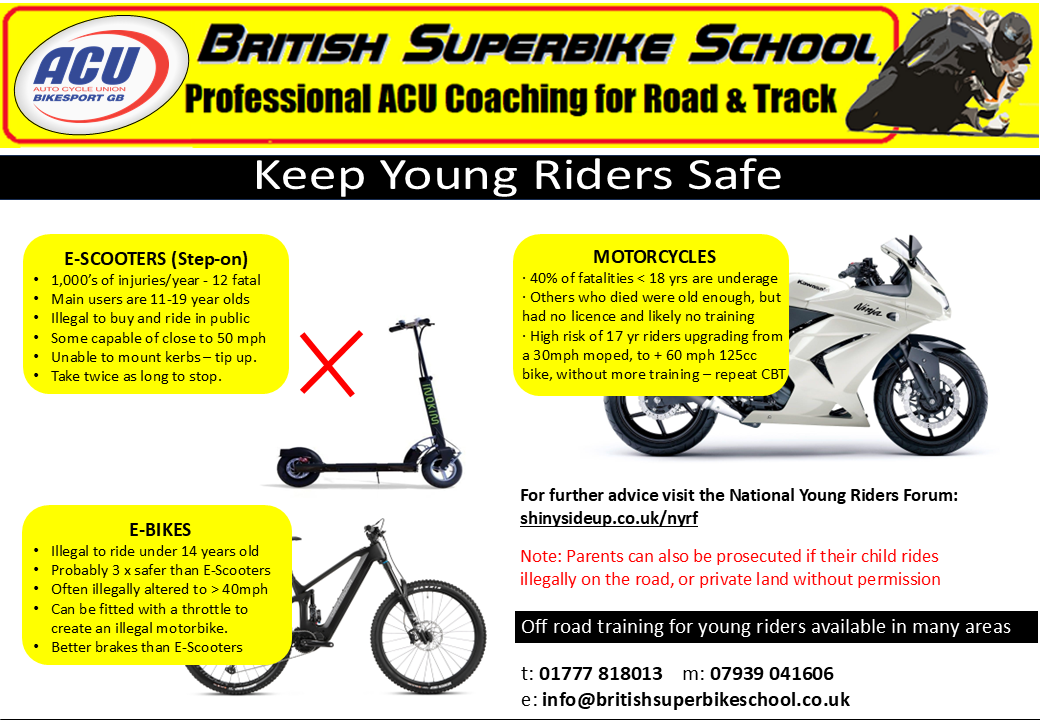
  1. Inform children and parents of the risks of riding E-Scooters. Explain the dangers of riding any PTW when underage or without a licence, and without proper training.
  2. Ban E-Scooters. Require any powered vehicle, wherever used, in public or on private land, to meet Highway Code stopping distances (0.7g) Include hoverboards, ball boards, unicycles etc.
  3. Encourage the use of E-Cycles for 14 years and above.
  4. Make ABS (anti-lock) brakes mandatory for all A1 (125cc) motorcycles
  5. Require riders to retake a CBT when upgrading from a moped to a 125c A1 motorbike.

The Problems

  • 40%, probably more, young motorcycle rider fatalities up to 18 years were riding illegally without any training.
  • 50% of KSIs up to 18 years were underage for the motorcycle they were riding.

This seems to be a well kept secret. You can confirm this if you use the government’s freely available accident database. We don’t know how many of the others didn’t have a licence. They probably received no training. Maybe another 10% or more? More than half the problem?

In 2022 there was only a single 16 year old rider fatality who was riding legally – (Probably).

Young rider Fatalities 2022 in detail

YOUNG RIDER FATALITIES 2014-2023

Over the past 10 years, we have seen an average of 1 death/year of a rider below 16 years. But the situation appears to be worsening.

There are an average of 3 deaths/year for riders aged 16. They were probably mostly riding illegally.

There are also 7 deaths/year for riders each year from 17 up to 20 years old, nearly 300 in total. There is no information available as to how many did not have a proper licence.

2014201520162017201820192020202120222023
< 160021000132
161533212362
17-2033382626282418293635

50cc A1 mopeds aren’t the major issue, but 125 cc A1 motorbikes are. They don’t need to have anti-lock brakes that larger capacity bikes now have to – which makes no sense.

Young riders are mainly a risk to themselves. They are simply demonized by The Press as ‘anti-social’. This view is taken rather than seeing them as children at serious risk.

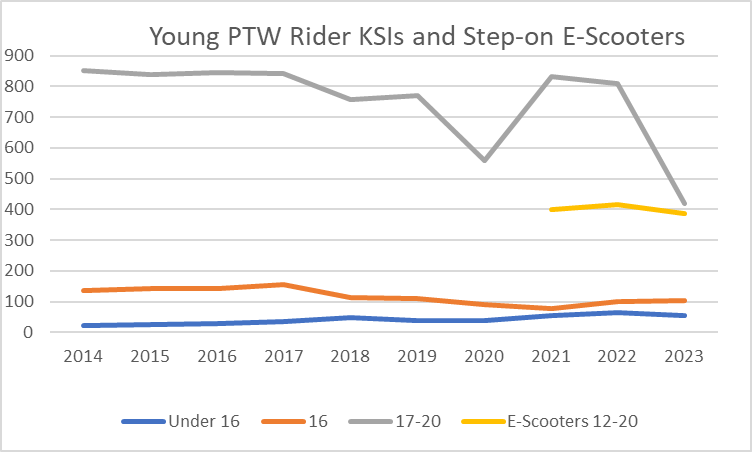
Young Rider KSI’s 2018 and 2022

Many young riders at 17 move from a 50cc 28 mph twist and go, to a geared 125cc motorbike. They can now easily ride at 60 mph with no extra training. Out they go onto A roads and the countryside at considerable personal risk. KSI’s now more than double.

The number of KSIs of underage riders, 16 and younger, is nearly static. In contrast, overall KSIs for this age group has declined by 25% over the last 4 years. But the underage problem appears to be unaffected.

E-Scooters

In 2022, 440 E-Scooter riders were seriously injured. The highest frequency was in the 10-19 years age group. Estimates suggest that about 150 young riders sustained serious injuries. These account for approximately one-third of all injuries. (Government E-Scooter Fact Sheet).

https://www.gov.uk/government/publications/national-evaluation-of-e-scooter-trials-report

NEW Hazard Shift?

E-Scooters look to have increased 16 years and younger young rider fatalities by >50%, and KSI’s by 400%.

E-Scooters apparently look set to be legalised.

The average E-Scooter rider age is 16 years, youngest 11 years or less.

There are probably now 1.5 million E-Scooters in the UK.

To date, 50 E-Scooter riders and 1 pedestrian have been killed. An unknown number, but probably at least 500/year seriously injured.

TRL research confirmed the poor braking on E-Scooters. The kerb height they can negotiate has had to be reduced. It has been lowered from the standard 10 cm to 3 cm. This puts riders at risk. And that they are unstable, generally poorly maintained needing constant brake adjustment, had steering faults and underinflated tyres.

For local Government rentals, the Dft doubled the braking distance standard for E-scooters. When all other vehicles would have stopped from 15 mph, an E-Scooter would still be doing 11 mph. Speed related fatalities start at 9 mph.

Link to E-Scooter Standards

You can buy an E-Scooter capable of close to 50 mph. Others are easy to tamper with to de-restrict. >40 mph is possible.

The obvious alternatives are E-Cycles. They are legal at 14 years and can stop to Highway Code standards. E-Cycles can also negotiate standard kerbs and use less energy. You have to pedal, which also helps fitness.

Mike Abbott, British Superbike School

Updated 24.7.25

Press release – ‘The Hidden Factor in Motorcycle Crashes’

‘Brake like a pro’ – Motorcycle Safety Campaign 2024

IN AN EMERGENCY

50% of riders skid and fall

(Forensic Crash Consultancy Ltd)

The problem has remained unidentified within the Government’s accident data of ‘contributory factors‘ probably within ‘loss of control,’ or simply not recorded.

These are the findings based on slide marks left on the road and the severity of the impact, based on the damage to vehicles and injuries to the rider, confirmed by traffic camera footage and GPS data from helmet cameras.

Riders falling and sliding down the road take far longer to come to a stop.

Published Research has also found that circa 50% of riders cannot even achieve Highway Code stopping distances.

(Axion Forensic)

The research also found that the difference between the best riders and an average rider braking from 60 mph, is the difference between stopping in time and a 30 mph impact, or a 40 mph probably fatal impact for the worst riders.

Research has also shown that the problem is not related to the level of rider experience.

Emergency Braking Performance of Motorcycle Riders. Huertas-Leyva, P., Nugent, M., Savino, G., Pierini, M., Baldanzini, N., & Rosalie, S. ( 2019.)

The situation is not helped by conflicting and misleading published advice from the DVSA and in Police Motorcycle Roadcraft, on emergency braking.

The conclusion has to be that we as a training industry are failing riders, and this must be urgently addressed.

In the meantime, riders can brake test themselves (with care) using a phone App such as iAccel Lite which is free. 0.67g is the Highway Code Standard, 0.8g is achievable with practice (with great care). Advice on braking is below, but if in any doubt please contact your local training organisation.

Riders need to practice repeatedly until the technique becomes embedded and automatic. In theory, this takes 200 repetitions to create the required ‘muscle memory‘, enabling maximum braking without conscious thought.

Riders on machines without ABS should never practise on their own, due to the risk of a skid and fall.

Racers and trackday riders should mostly already be ‘pre-programmed’ and capable of close to 1g.

Background

At the end of 2023, the MCIA called for a new motorcycle safety strategy. ‘Speeding’ and ‘Think Bike’ have been pursued for well over a decade, but motorcycle casualties haven’t reduced over the last few years.

Adhering to speed limits and being aware of hazards is only part of the problem. It’s also being able to brake in time. Having trained riders for 14 years, we know that many if not most, with training, can reduce their stopping distances significantly.

What we didn’t appreciate was the extent of the problem and the very serious implications for road safety.

For car drivers, stopping in an emergency just requires the driver to stamp on the brakes even when cornering, as almost all vehicles have ABS (anti-lock) brakes. ABS has only been compulsory since 2016 for motorcycles >125cc.

The problem has remained hidden as ‘failure to brake properly’ is not a ‘contributory factor’ in accident statistics.

A failure to brake in time could also be incorrectly classed as ‘Speeding‘, which in the 2022 accident stats shows as 10x more likely for riders than drivers. It could also be lost within ‘Failed to look properly‘ when the rider anticipated the collision but couldn’t stop in time, or within ‘Learner/inexperienced‘. In addition, 30% of collisions have no recorded contributory factors, up from 14% in 2013.

This is primarily because most motorcycles, except for some 2013 Kawasakis, don’t have ‘Event Data Recorders‘ whereas many cars do. However, extracted post-crash data from traffic cameras and rider’s helmet cameras confirms that many riders cannot stop properly.

If you compare the stopping distances from published US research from Axion Forensics, the best ‘Magazine Test Riders‘, can stop at half the distance than the worst road riders.

From 60 mph, this is the difference between stopping in time and a 40 mph probably fatal impact, as braking obeys a ‘square law’.

It is hoped that the Government, trainers, road safety organisations and charities will look at new initiatives to address this root cause, to raise awareness, encourage practise, and provide additional braking advice and training nationwide. The most vulnerable group is +17 years teenage riders who move from a 50cc ‘twist and go’ to a 60 mph 125c geared motorcycle, not required to have ABS with no additional training, but riders, parents and non-DVSA licenced trainers need to be aware of child protection issues.

It is also intended to encourage more research into the problem and to address the differing and contradictory advice from the DVSA and Police Roadcraft, on how to brake in an emergency.

Advice on Braking

Riders on ABS-equipped bikes simply need to have the confidence to apply both brakes firmly, which is often a problem due to current or previous experience on bicycles, when riders can skid and fall, or go over the handlebars.

Based on racing experience, research and theory, riders require a high degree of skill and practice to brake effectively.

  • Shut the throttle, apply the rear brake, sit up and lean back, all at the same time.
  • Reach forward and squeeze – do not snatch – the front brake with increasing pressure.
  • If the front wheel locks, release immediately and reapply.
  • If the rear wheel lifts, release some front brake pressure to stop the bike tipping forward.
  • Disengage the clutch as you come to a halt
  • When banked in a corner, just apply the rear brake.

The rear brake should be applied immediately, but on non ABS machines, may need to be steadily released again to avoid the rear wheel skidding.

Riders need to avoid snatching the front brake, instead squeezing the lever with increasing pressure, just enough to avoid locking the front wheel, but enough to transfer the weight as quickly as possible onto the front tyre, then slightly reducing the pressure as the bike slows to leave the rear tyre just lightly touching the road surface.

Riders also have to release the throttle, extend their fingers, grasp the front brake lever and pull, which is thought to extend reaction time for another 0.5 seconds or 44 feet @ 60 mph. So covering the front brake with your first two fingers is recommended, as is using the rear brake, which will be applied sooner as the rider just had to press their foot down.

Riders can also ‘trail brake’ into corners in an emergency, braking and steering at the same time, as racers do, but it requiries a high degree of skill, and very careful instruction which is best undertaken on a track.

Feedback is welcomed, and further posts and advice are planned.

For more information see:-

Motorcyclists – ‘Brake like a Pro’

Mike Abbott MBA, RoADAR (Dip), DVSA RPMT 800699, ACU Coach #62210

British Superbike School

Applewood

Old Hall Lane,

East Markham,

Newark

Notts NG22 ORF

Tel: 01777 818013

Mbl: 07939 041606

Web: www.britishsuperbikeschool.co.uk

Email: mike@britishsuperbikeschool.co.uk

Review of 2016 Motorcycle Road Accidents – ‘Speed Awareness’ not working

Motorcycle Track Clothing

One piece leathers probably give riders the best protection, although good quality textile clothing should be good enough. Two piece suits, whether textile or leather, are better if either the top and bottom can be zipped together, or if the jacket has a robust crotch strap.

We don’t accept kevlar jeans, as we don’t know how good they will be.

Both textile and leather suits should have CE armour in elbows and knees as a minimum. Shoulders, back and hip protection should also be better. There are also chest protectors available. Check your jacket has a CE marked back protector and not a piece of thin foam. Consider fitting a CE protector in the pocket, or using a separate back protector.

The European standard is EN1621-2 (Level 1 for regular use and Level 2 for sport/track).

Some leather suits are made from very thin leather, could be sheepskin. The quality of the stitching is also vital. Leather is not automatically better.

Here is some interesting general information and advice from Byson Leathers http://www.bysonleather.co.uk/BYSON%20LEATHER%20AboutLeathers.htm