Good to see data analytics being promoted, and the establishment of a new Road Safety Investigation Branch, who hopefully will be looking at ‘black box’ data.
Great to see training and testing being reviewed. Hopefully emergency braking from 60 mph will be included. According to DVSA figures it currently takes 24 years for 80% of riders to become competent, so room for improvement? Young riders are at very high risk.
It would be good to see technology address reaction times with auto closing or trigger throttles (and heel and toeing for cars etc). Could reduce impact speeds by 10-20 mph.
Good to see a Road Policing Review. Enforcement is next to non-existent so good to see this being addressed. Maybe using traffic cameras to warn drivers or riders of their behaviour?
Sad to see E-Scooters still being considered after >50 deaths and probably >1,000 serious injuries. 80% were avoidable as they are 5 x more hazardous than any other form of transport (TRL and WMG reports).
No recognition of young rider issues. 40% of fatalities <19 are underage, more won’t have a licence. Very steep learning curve.
National Guidelines and Lifelong Learning welcomed, and supporting THINK!
Interesting to see new Safety Performance Indicators (SPIs), however the obsession with ‘speeding’ continues, despite it being only a factor in 16% of collisions.
Speeding appears twice, as it’s an overall SPI as well as being specific to motorcycles.
‘Dangerous riding/driving’ is completely missing, despite being a recorded factor in 33% of collisions, twice as high as speeding.
The government’s current ‘hidden strategy’ for motorcycles is currently outlined on National Highway’s BikeTrek website, having employed unlicensed trainers from an unapproved company to encourage ‘Track to Road – Push your Performance’ riding (from their advertising), in flagrant breach of current official advice from the DVSA and NPCC via Roadcraft.
Hopefully this will now be taken down, commonsense will prevail, and the licensing of all commercial motorcycle trainers enforced to stop these and ‘emergency response’ and ‘pursuit’ behaviours from being continually passed on to the public.
Advanced motorcycle training is based on the book – Police Motorcycle Roadcraft – or is it?
Police Roadcraft for cars goes back to the 1930’s. It was written when there was no training or testing, you just went and bought a licence. Crashes were becoming a problem even with so few cars around.
Roadcraft for motorcycles arrived many years later in the 1970’s. Compulsory motorcycle training began in 1990.
The problem with Roadcraft is what isn’t in there. Although the latest version includes ‘Emergency Response’ riding, somewhat unwisely for public consumption, it is missing many of the actual tactics and maneouvres.
Probably just as well, but unfortunately the other stuff is continually passed on during advanced training.
These include ‘off siding’ – taking LH corners from the RH gutter; the ‘Suicide Swoop’ – overtaking vehicles around a LH corner; ‘making good progress’ – taking every opportunity to overtake (when you should never be in a hurry); going straight on from a RH turn lane; filtering up to the front of traffic queues as a routine; using cross hatched areas to overtake; going past ‘stop’ boards at road works when the lights are red etc. Some are Highway Code ‘should nots‘.
There are two basic rules for the public. Is it safe? But is it necessary?
If this wasn’t bad enough, ‘trail braking’ into corners has now been added rather publicly on National Highways BikeTek website via a video on Braking. This is standard racing practise, but really risky on the road, significantly reducing safety margins and increasing corner entry speeds.
It comes from road racing. Most racing crashes are due to trail braking. ABS, particularly earlier versions if fitted, may not save you from a skid and fall and will not prevent the bike running wide.
What is more worrying is that it is presented as being safer, showing a dangerous misunderstanding of the physics, which I think should be obvious to anyone. It also contradicts ‘Grip Trade Off’ from Roadcraft itself.
Is braking while cornering in any vehicle safer? Of course not. To be fair, you could be mistaken on a motorbike, as the suspension dips noticeably, but this is grip being used up not created. Bikes also ‘yaw’ when the front brake is used when banked, which requiries an even greater lean angle to counteract.
The front brake also sits the bike up, making it run wide, potentially into oncoming traffic or roadside obstacles.
RoSPA and the IAM discourage routinely braking in corners. You would fail any test if you did. But there are a number of independent advanced trainers and companies promoting it.
At the moment, absolutely anyone can set up themselves or even a large company providing advanced trainers, sometimes at eye watering prices. There are currently absolutely no barriers to entry.
They are probably acting unlawfully, as car, truck and bus trainers have to be DVSA licenced.
The situation is out of control. Having untrained, unlicenced motorcycle trainers will put riders at risk. No riding standards, no check testing, no complaints procedure, no oversight.
Do not be fooled by clever marketing, or assume ‘Police Class 1’ is a training qualification. It isn’t. It’s an out of date riding qualification. It’s now ‘Police Advanced’ but again it’s not a training qualification.
So we now have racing techniques in addition to the use of police ’emergency response’ and ‘pursuit’ tactics being promoted.
Fatalities were up no less than 14% in the latest 2025 figures. This isn’t helping, probably the reverse.
Time for The Law on commercial trainers to be enforced, and ‘advanced training’ to be made compliant with DVSA and Roadcraft advice?
As motorcyclists, the problem with young riders is something we are going to have to tackle ourselves. If we want anything to change.
I came across 5 young riders on a single day last week, probably all riding illegally. One had no headlight, 3 were wearing shorts and T-Shirts. Two had proper kit and were riding off-road bikes. Gave me a nod as they passed me on my E-MTB.
If I’d been on my KTM they may well have stopped for a chat.
I trained the Notts police off-road team many years ago, who were very successful in tackling the off-road riding problem. But that is not where the problems mainly are. It’s on road. Off road riding really is just a nuisance – mainly noise, and complaints from land owners. Tractors do far more damage.
So what can you do?
Firstly discourage your youngsters from riding a motorcycle if under 16 years, when they can do their CBT. An E-Cycle or E-MTB can be legally ridden from 14 years. Good chance to learn braking and handling skills – and the use of disc brakes and suspension movement.
They can race mini motos etc. and off-road, but it’s expensive. There are facilities in some areas where they can ride, but sadly they are rare. There is no national equivalent of ‘Young Drivers’. There should be.
Personally I’ve never had a problem talking to young riders. Never had any abuse.
Motorcyclists come from all walks of life, sharing a common interest. If you breakdown roadside the next biker along may well stop to help.
The Problem
In 2022, in the 14-16 young rider age group:-
115 KSIs in total
60 were underage
55 were riding 125cc machines illegally
In 2023, in the 17-20 year old group:-
36 young rider fatalities
50% higher than the 24 fatalities in 2019
Double the number from 2020, which at 18 fatalities, was probably affected by COVID 19.
The extent of the problem seems to be a well kept secret.
The Main Issues
Illegal E-Scooters.
Average rider age 16 years.
50 deaths all ages so far. >1,000 serious injuries.
Underage Riders
40% of fatalities. Many others probably had no licence. Proper training is vital.
Upgrading to a 125cc
The risk of upgrading from a 30 mph moped to a 125cc geared bike capable of 60 mph with no extra training.
No legal requirement for more training. The vast majority of KSI’s are on 125’s.
Emergency Braking.
The DVSA advice is wrong. Apply your rear brake immediately. Do not snatch the front brake lever, or stamp on the rear brake. Apply the brakes steadily. Practice.
Consider riding with two fingers on the front brake lever and clutch, and just squeeze both in an emergency. This should save you >1 sec and critically should reduce your impact speed by around 15 mph or maybe avoid an impact altogether. You’ll probably survive a 30 mph crash, but not at 40 mph.
A New Approach?
I started again, this time with pre-teen riders and Bikeability, who are supported by the Dft.
We already know that there is a serious problem with PTW braking, so I asked them how they teach braking to young cyclists.
Received an immediate response. Somebody cares.
They are taught to ride covering their brakes, how to brake progressively, and particularly to avoid snatching the front brake. Perfect.
So moving to a motorcycle, the skills are immediately transferable.
The question is then why are PTW riders not taught to cover their brakes, and why is PTW braking so poor?
Bikeability cover 44% of younger riders who should be more open to accepting advice before they become teenagers. Braking skills can be embedded more easily with younger riders creating ‘muscle memory’.
There is now also a ‘halfway house’ with E-Cycles from 14 years, which they also cover, many with disc brakes and front suspension, where they can experience weight transfer and the front suspension compressing when braking.
Motorcycles and cycles could be part of the National Curriculum, within Physics, centre of mass, friction, tipping, leaning, speed, gyroscopes, kinetic energy, braking distances etc. I think it helps when you have a practical example of the theory.
Regarding the essential difference between cycles and motorbikes, it is simply speed, and mastering throttle control which is straight forward.
What is vital to grasp, and to be taught, is that momentum obeys a ‘Square Law’. So it takes 16 x further to stop from a motorbike’s 60 mph as it does from a bicycle’s 15 mph.
The major danger is young riders jumping on motorcycles of 125cc and above, which can get to 60mph or more, without any training.
This approach discourages riders from entering corners at high speed and high lean angles. The aim is SIFO – ‘slow in fast out’.
You enter corners on a closed or light throttle. You are at a steady speed and a modest lean angle. You can turn tighter towards the apex when you see it’s safe.
When you can see a clear exit, turn tighter and briefly increase your lean angle to turn the bike. Pick the bike up again on a smooth, continuous throttle after the apex. This minimizes the chance of a slide or high side.
If you’ve misjudged the radius of the corner, or your entry speed, you can instantly just turn tighter earlier. You can also do this if you meet an unexpected hazard. Or just stay wide for longer if it’s safer. You have options and escape routes.
Use the rear brake if you need to. This will allow you to slow and turn even tighter, as a last resort, but it needs to be applied gently, and reduced as your lean angle increases.
Introduction
We are responding to the MCIA’s call for a new approach to motorcycle road safety. We have posted on ‘Braking‘ before. This seems to be the priority issue.
The second problem is ‘Cornering‘ on the roads. Riders can lose control on corner entry. They can also lose control mid corner and crash. On exit, the rear wheel can slide. This can cause a potential ‘High Side’ that throws the rider into the air. Alternatively, they might just run off the road.
66% of fatalities are on rural roads. 58% of crashes are reported as not occurring at junctions.
I started as a RoSPA volunteer civilian accessor for BikeSafe in Lincs. The police told me that they get over a dozen biker fatalities in Lincolnshire on corners every year. Not because riders were speeding, but that they were apparently unable to make the corner, panicking and crashing.
I’ve ridden on the road, cornering like this since I started racing in the early 90’s. When I did BikeSafe in 2008 I expected to be criticised for it. And again when I did my RoSPA training and their Advanced Instructor’s course. And again when I had my DVSA riding test to become a Post-Test Trainer. No one ever has. (My ACU Road Race Coaching assessment wasn’t a problem either).
I am sure many others ride like this. But many don’t, having trained over 500 road riders in the last few years.
The advice is ‘Slow in Fast Out’ – ‘SIFO’
Background
We organized a classroom session and an on-road training course on cornering in 2010. We had been delivering RoSPA ‘RideSafe’ courses for 2 years, subsidised by Notts CC.
Rupert Paul from BIKE magazine joined us, and gave the day an encouraging write up. The drawing below then appeared in his book ‘Pass the Bike Test and be a Better Rider‘.
This is ‘squaring off’, made popular by Noriyuki Haga 25 years ago. It’s also similar to Keith Code’s earlier ‘hook’ turn for track riders, which is more brutal. (Twist of the Wrist).
We’ve edited it to add the escape zones that this technique provides for riders, which are critical. These zones are available at any point through the corner.
In 2012 we moved to track-based training for cornering, as it was clearly safer, and started ‘The School’.
The Method
Finish your braking before the corner.
Select a lower gear before entering if appropriate.
Keep your foot just over the rear brake.
Set your speed so you can turn more tightly when you can see the road is clear.
Use a light or closed throttle.
Enter the corner on the outside of the bend for the best view – if it’s safe.
Look through the cornerand turn more tightly towards the apex, when you can see your exit line is clear.
Roll the throttle on smoothly afterthe apex, to pick the bike up
Take as much of your lane as is safe on exit.
You always have the yellow ‘escape zones’, at any time.
If you like leaning a bike, then this is your opportunity to do it safely. You can run as deep into the corner as you want. You can turn as late and as sharply as you want (within reason).
(You actually do this automatically by pushing on the inside bar – counter-steering).
Try and keep your head horizontal, but lean your body with the bike. It’s your eyes that contribute most to balance.
Accelerating on Exit
You need to be careful when applying the throttle on exit. A ‘High Side’ is more likely on the road due to a poor surface. You could run wide and off the road. Or into oncoming traffic even if you have traction control.
Always roll the throttle on steadily, as the revs build up. If you do lose traction, the bike will slide to the side. You should be able to correct it. You will snap the throttle shut automatically. The wheels should come back into line.
If you have the throttle pinned, the revs will rise instantly. This happens if the tyre loses grip. The revs may even hit the rev limiter as the engine climbs up the power curve. The bike will slew violently sideways. When you shut the throttle, the tyre will dig in, flipping you off the bike and into the air.
You could rely on traction control if your bike has it – but I wouldn’t. The danger is you’ll come to rely on it, and come unstuck on a bike that doesn’t have it. You’ll never learn to ride properly. On earlier bikes we’ve found it won’t necessarily stop a fall at high lean angles, but should prevent a ‘high side’.
If you have traction control, then on the road consider setting it at least one below the ‘race’ or the lowest setting. Like the ABS coming on, regard any activation as ‘rider error’.
Personally I never trust computers. When we went from analogue to digital in the last century, we were assured there would never be any errors…. It would either work or not.
God help us with AI (which is usually ‘machine learning’ – they’re not that bright).
Gear Selection
Consider changing gear before entering corners. Don’t be lazy.
Most rural corners are best taken in 4th gear on larger bikes, although you may need to go down to 2nd or even 1st just before a hairpin bend.
This gives you tighter control and a better drive out.
You can pull the clutch in and blip the throttle, matching the gear and revs with your road speed as you’re changing down. (Sequential down shifting). This makes life easier on the clutch and gearbox. It was also essential when racing, before slipper clutches, to avoid locking the rear wheel.
You don’t need to do this if you have a slipper clutch. But do it anyway as you need the skill to ride bikes that haven’t. And it saves wear on the clutch. In any event, always let the clutch out slowly to avoid locking the rear wheel.
You brake with your left two fingers and blip the throttle with two outside fingers.
It takes some practice to get right, but it is very satisfying. And makes some more noise for those of us with louder exhausts. (My old KTM also pops and bangs rather satisfyingly on the overrun).
It’s also ‘good practice’ to do this when you’re slowing at junctions too, if done properly. It assures that you’re always in the most appropriate gear.
Yes, I know you were told to ‘block change’ as you came to a halt. It’s simply easier, but poor practise.
You may need to accelerate briskly away from a hazard, which you can’t in a high gear at low speed.
Rear Brake
It is sensible to have your foot ready over the rear brake. Press steadily down if you want to reduce speed at any time in an emergency. This will also allow you turn even tighter if you need to. You’ll need to steadily release it as your lean angle increases to avoid skidding.
Bear in mind engine braking will also be working alongside the rear brake. A big twin or single with higher engine braking will have more effect. They will have more effect than a large 4-cylinder bike.
You should be able to brake quite firmly up to around 24 degrees of lean (0.4g grip). This will vary dependent on machine, tyres etc. Leaning further will need you to gradually release the rear brake, to avoid a lock up. This is rear brake only!
Using the rear brake also transfers some weight onto the front tyre, sharpening the steering and providing more front-end grip. This will also help to tighten the turn.
Front Brake
Avoid using the front brake in corners as it straightens the steering and stands the bike up. And a front wheel skid usually results in a fall. However, a rear wheel skid, can usually be recovered if the rider releases the brake.
You can use the front brake, but only in an emergency, leaving it on as you turn in. The bike will resist turning, and try to stand up, so you will likely run wide. Doing this routinely as racers do, puts riders at very high risk, due to faster corner entry speeds, a variable road surface, and no safety margin.
If you try using the front brake mid corner you will likely skid and fall, or the bike will stand up and run wide. The official advice is only use it if you have space to stand the bike up, brake and run wide. The problem applying the brake mid corner, as opposed to trailing it in, is the lack of weight and grip on the front tyre. So it needs a very gentle application and great care, or a skid and fall is very likely.
Using just the rear brake is safer.
Hopefully this method will avoid riders having to learn by experience (trial and error). It’s painful, usually involves visits to A&E, and lots of bits of broken coloured plastic – from experience.
This is the basis of cornering lines from our track training courses, on which the advice is based.
The advice is to consider using the green line.
The red line shows what happens when you turn in too early.
The yellow line tends to be the usual ‘fast riders’ line. The bike is at maximum lean for most of the corner. No room for error. No safety margin. You’re committed from the point of entry.
Cornering Issues
From experience, there are 4 main problems when cornering, which this method seeks to address:-
Misjudging entry speed – in too fast.
Turning in too early.
Taking RH corners leaning into the oncoming lane.
Failing to spot a hazard on the road surface, or having to avoid other mid corner hazards.
Misjudging Entry speed – intoo fast
Problems with corners often occur because riders misjudge their entry speed. They find the bend is longer, or tightens mid-corner. They try to brake and fall. Or simply panic and run wide.
There is a good section on judging entry speed using the ‘Limit point’ or ‘Vanishing point’ in Police Motorcycle Roadcraft. It is the furthest point of continuous tarmac you can see. A road hazard may be hidden in a dip. You might also be misled by looking at hedges, fences, telegraph poles, etc. You could wrongly assume they follow the road. Sometimes, they don’t.
There is one local junction where two riders I’ve trained ended up on the grass verge, luckily without falling. The hedge line is misleading, and the bend is on the brow of a hill at a junction.
The limit point starts to move around the corner as you approach it. With practice you can use this to judge the tightness of the bend and set your entry speed.
There is a tendency for some riders to want to go around corners as fast as they can. They assume that the faster they go in, the faster overall they will be. Wrong.
We see this on-track all the time.
We’ve nearly all been too enthusiastic at some time or another, or been caught out through not paying attention.
With this method you are already entering at a speed intending to turn in more tightly. You can do this when you can see the exit is clear. So a tightening bend, and most hazards, should be avoidable.
Turning too early
Turning in too early can lead to running wide on exit. It’s a problem both on road and track. It can also be a panic reaction when riders feel they are going too fast. Or due to a lack of confidence that the bike will turn in time.
The rider then cannot turn in as they are too close to the inside kerb. Or too close to the centre line on RH corners. Their view is also restricted.
As the bike gets to mid corner, it then starts to run wide, heading towards the scenery. Or across the centre line, possibly into oncoming traffic.
The rider now has to turn more sharply to stay in the lane. This is after they should have apexed and accelerated away. Dependent on speed, ability, luck and confidence, they may be unable to.
Leaning across the centre line on RH corners
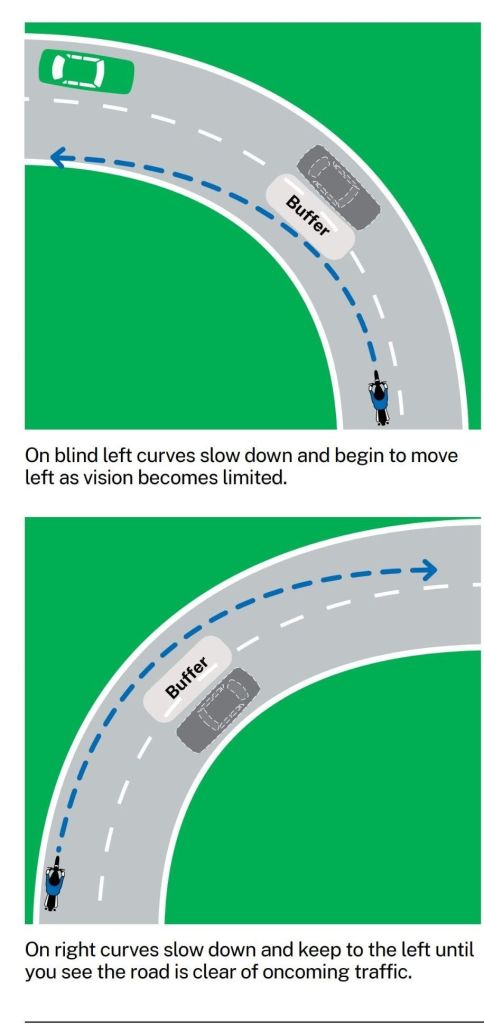
The suggested method allows you to lean over into the opposite lane only when you can see it’s clear. But it’s safer to keep all of you and your bike in your lane. Never cut corners by riding over the centre line. It’s too risky generally and tends to become a dangerous habit.
If you are leaning into the incoming lane and a vehicle suddenly appears, you will be at serious risk. You have to immediately bring the machine upright, and then lean it back over again. There may not be sufficient room on the road for this.
If the rider tries to turn the bars to the left away from the oncoming vehicle, which they may do in panic, the opposite will happen and the bike will turn tighter into the oncoming vehicle (counter-steering).
Even if the rider has avoided the vehicle, they are still left heading towards the scenery. This will usually require the rear brake to be applied. You then need to get the bike back over again.
The alternative, only when the bike is upright, is to apply the front brake smoothly. If there is enough space to stop.
Best keep within your lane?
Failing to see a Hazard
This can be a simple lack of attention. Or an unexpected hazard – pot hole, gravel, mud, diesel, oncoming vehicle cutting the corner, etc. etc.
Sometimes surface hazards are not obvious until you get close. A pedestrian or vehicle can also appear ‘from nowhere’. A horse may be just out of sight. A dog. A deer. A scaffold board from off a truck. An oncoming vehicle may cut the corner or run wide.The list is nearly endless.
It’s the ‘unexpected’ nature of the hazard that is often the root cause of crashes.
The suggested method should allow you to change course quickly to avoid hazards. You have options. Both ways. You will probably be in, or close to, the RH or LH car wheel track, which tend to be clear of debris. But you may have to avoid turning tighter towards the apex and stay wide if there is mud etc mid lane.
Or you may have to turn tighter earlier to avoid a hazard on your path. You are planning to turn tighter anyway.
Below are two illustrations from the New South Wales Riders Handbook regarding oncoming vehicles.
If you’re in the habit of entering corners as fast as you dare, you will have few options.
Leaning the Bike
Many riders are worried about leaning the bike, and the tyres losing grip and sliding.
On a fairly decent road surface, you can usually lean the bike to 45 degrees safely, with a 30% grip safety margin. 55 degrees is probably the limit for most bike and tyre combinations – (not cruisers which can deck out at 25 degrees).
In an emergency, you can probably lean the bike until something scrapes. This is usually the footrests, which are designed to hit first as a warning. They then fold up to prevent the wheels from being lifted off the ground. Many have ‘hero blobs’ under the footrests that scrape first. These can be replaced.
When you lean far over for the first time, many riders seem to confuse the suspension sinking under the centrifugal force, with the tyres sliding. We’ve often heard riders saying they ‘lost the rear’, when it was just the suspension compressing.
However, it’s not sensible to habitually ride at steep lean angles. 35 degrees is probably the maximum for the road, giving you a good safety margin.
If you’re not confident of leaning the bike, you are at high risk.
Don’t Panic
There are two usual mid corner panic reactions.
The first is to hit the brakes. If you snatch the front brake, you will likely skid and fall. Even if you have ABS, if you squeeze the front brake, then the bars will twist, sometimes violently. The bike will sit up and run wide.
If you stamp on the rear brake it will also likely skid and you may fall. However, with ABS or gentle pressure the bike slows allowing you to turn tighter at the same lean angle.
The second panic reaction is to think the bike is falling inwards or sliding, and the rider jerks the handlebars into the corner to bring the bike up. Again, you will run wide.
If you find yourself going too fast, or needing to turn tighter, just look where you want to go, not where you don’t. Press gently on the rear brake and push on the inner bar to counter-steer the bike into the corner. Practice this carefully until it becomes automatic in an emergency.
Official Guidance
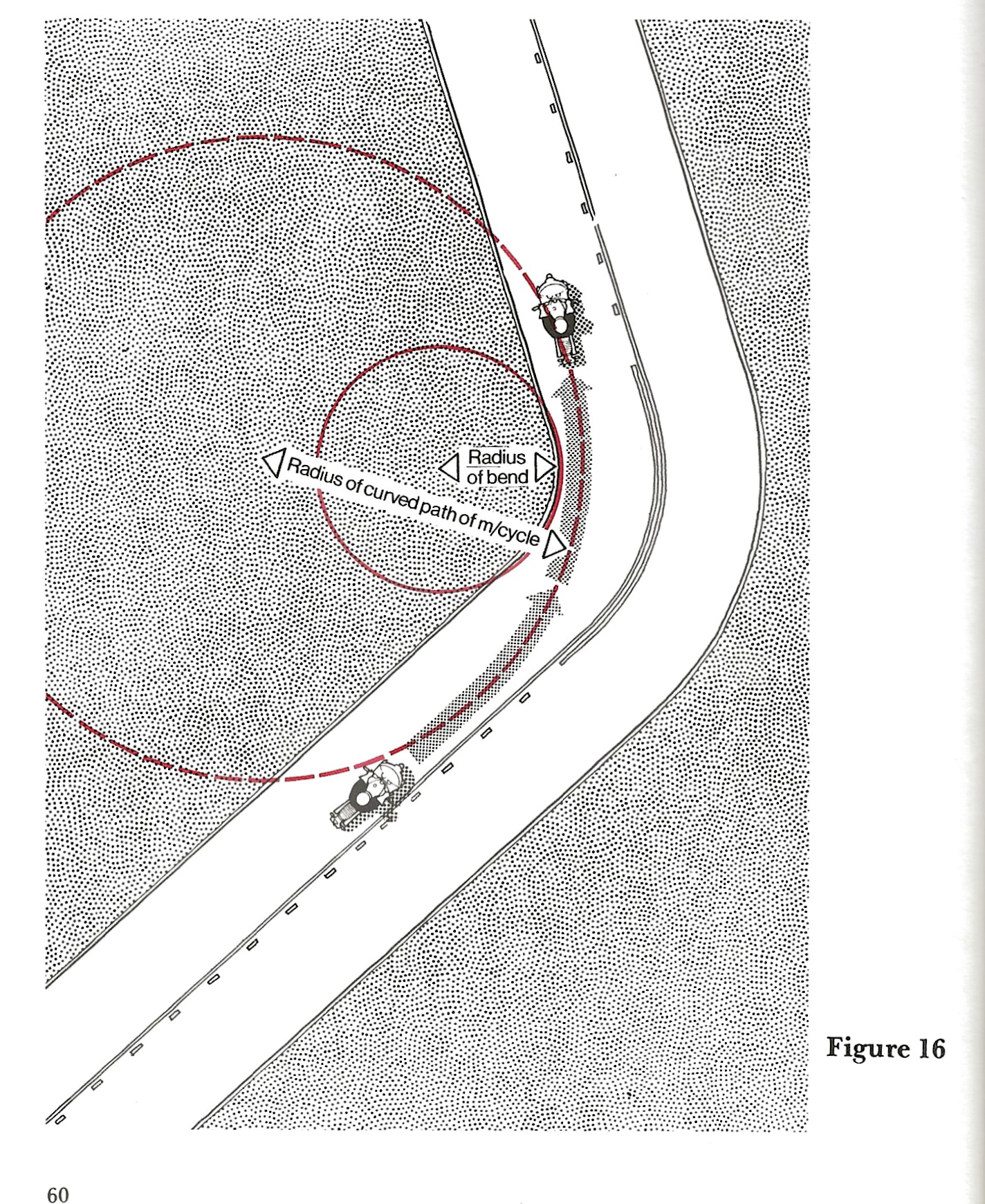
There is a lack of diagrams from the DVSA, or in the latest Police Motorcycle Roadcraft. In the 70’s version, this was simply the largest continuous radius back to the centre of the lane.
But look carefully, and you’ll see the danger if the bend is longer than you thought, or tightens. You’ll have to brake or run wide over the centre line, or through the scenery.
Maybe this was why it was dropped?
If you use the suggested method, you simply stay wide at a slower speed until you see the exit. Then turn tighter and accelerate away. Your maximum lean angle is for a short duration at the apex. Not all the way around the corner.
The main difference is the faster rate of turn just before the apex in our suggested later turn in. You can do this simply because frames are stiffer, steering geometry more radical. Tyres are far grippier and engines far more powerful. You can be back up to the speed limit in a second or two.
Maintaining higher corner speeds, which was the best route on older slower bikes when maintaining speed was the aim, is still used in the lower capacity racing classes.
An old DVSA videos shows the ‘Wall of Death’ line, around the outside of the corners, again leaving little room for error.
Check your Lean angle
You can check your lean angle using a phone App or a data logger. We use the KurvX system, which displays your maximum lean angle shortly after the corner. The display goes to red if you’ve leaned over 35 degrees.
You can then play back your route and back check your lean angles on corners, which are colour coded. Best to stay out of the red on the road.
This is a few steady laps at Cadwell Park, but it’s also useful to be able to check your road riding. Really useful feedback for training on road or track.
The problem has remained unidentified within the Government’s accident data of ‘contributory factors‘ probably within ‘loss of control,’ or simply not recorded.
These are the findings based on slide marks left on the road and the severity of the impact, based on the damage to vehicles and injuries to the rider, confirmed by traffic camera footage and GPS data from helmet cameras.
Riders falling and sliding down the road take far longer to come to a stop.
Published Research has also found that circa 50% of riders cannot even achieve Highway Code stopping distances.
The research also found that the difference between the best riders and an average rider braking from 60 mph, is the difference between stopping in time and a 30 mph impact, or a 40 mph probably fatal impact for the worst riders.
Research has also shown that the problem is not related to the level of rider experience.
The situation is not helped by conflicting and misleading published advice from the DVSA and in Police Motorcycle Roadcraft, on emergency braking.
The conclusion has to be that we as a training industry are failing riders, and this must be urgently addressed.
In the meantime, riders can brake test themselves (with care) using a phone App such as iAccel Lite which is free. 0.67g is the Highway Code Standard, 0.8g is achievable with practice (with great care). Advice on braking is below, but if in any doubt please contact your local training organisation.
Riders need to practice repeatedly until the technique becomes embedded and automatic. In theory, this takes 200 repetitions to create the required ‘muscle memory‘, enabling maximum braking without conscious thought.
Riders on machines without ABS should never practise on their own, due to the risk of a skid and fall.
Racers and trackday riders should mostly already be ‘pre-programmed’ and capable of close to 1g.
Background
At the end of 2023, the MCIA called for a new motorcycle safety strategy. ‘Speeding’ and ‘Think Bike’ have been pursued for well over a decade, but motorcycle casualties haven’t reduced over the last few years.
Adhering to speed limits and being aware of hazards is only part of the problem. It’s also being able to brake in time. Having trained riders for 14 years, we know that many if not most, with training, can reduce their stopping distances significantly.
What we didn’t appreciate was the extent of the problem and the very serious implications for road safety.
For car drivers, stopping in an emergency just requires the driver to stamp on the brakes even when cornering, as almost all vehicles have ABS (anti-lock) brakes. ABS has only been compulsory since 2016 for motorcycles >125cc.
The problem has remained hidden as ‘failure to brake properly’ is not a ‘contributory factor’ in accident statistics.
A failure to brake in time could also be incorrectly classed as ‘Speeding‘, which in the 2022 accident stats shows as 10x more likely for riders than drivers. It could also be lost within ‘Failed to look properly‘ when the rider anticipated the collision but couldn’t stop in time, or within ‘Learner/inexperienced‘. In addition, 30% of collisions have no recorded contributory factors, up from 14% in 2013.
This is primarily because most motorcycles, except for some 2013 Kawasakis, don’t have ‘Event Data Recorders‘ whereas many cars do. However, extracted post-crash data from traffic cameras and rider’s helmet cameras confirms that many riders cannot stop properly.
If you compare the stopping distances from published US research from Axion Forensics, the best ‘Magazine TestRiders‘, can stop at half the distance than the worst road riders.
From 60 mph, this is the difference between stopping in time and a 40 mph probably fatal impact, as braking obeys a ‘square law’.
It is hoped that the Government, trainers, road safety organisations and charities will look at new initiatives to address this root cause, to raise awareness, encourage practise, and provide additional braking advice and training nationwide. The most vulnerable group is +17 years teenage riders who move from a 50cc ‘twist and go’ to a 60 mph 125c geared motorcycle, not required to have ABS with no additional training, but riders, parents and non-DVSA licenced trainers need to be aware of child protection issues.
It is also intended to encourage more research into the problem and to address the differing and contradictory advice from the DVSA and Police Roadcraft, on how to brake in an emergency.
Advice on Braking
Riders on ABS-equipped bikes simply need to have the confidence to apply both brakes firmly, which is often a problem due to current or previous experience on bicycles, when riders can skid and fall, or go over the handlebars.
Based on racing experience, research and theory, riders require a high degree of skill and practice to brake effectively.
Shut the throttle, apply the rear brake, sit up and lean back, all at the same time.
Reach forward and squeeze – do not snatch – the front brake with increasing pressure.
If the front wheel locks, release immediately and reapply.
If the rear wheel lifts, release some front brake pressure to stop the bike tipping forward.
Disengage the clutch as you come to a halt
When banked in a corner, just apply the rear brake.
The rear brake should be applied immediately, but on non ABS machines, may need to be steadily released again to avoid the rear wheel skidding.
Riders need to avoid snatching the front brake, instead squeezing the lever with increasing pressure, just enough to avoid locking the front wheel, but enough to transfer the weight as quickly as possible onto the front tyre, then slightly reducing the pressure as the bike slows to leave the rear tyre just lightly touching the road surface.
Riders also have to release the throttle, extend their fingers, grasp the front brake lever and pull, which is thought to extend reaction time for another 0.5 seconds or 44 feet @ 60 mph. So covering the front brake with your first two fingers is recommended, as is using the rear brake, which will be applied sooner as the rider just had to press their foot down.
Riders can also ‘trail brake’ into corners in an emergency, braking and steering at the same time, as racers do, but it requiries a high degree of skill, and very careful instruction which is best undertaken on a track.
Feedback is welcomed, and further posts and advice are planned.
In response to the call, below are some suggestions for a new strategy for motorcycle casualty reduction.
Motorcycle Braking and Cornering
Riding Test to include:-
emergency braking from 60 mph (currently 30 mph).
cornering on rural roads
banking a motorcycle to at least 30 degrees on corners
Riders to be trained to:-
brake safely into and around corners in an emergency.
to countersteer.
Ensure riders are aware of ‘target fixation’ and ‘you go where you are looking‘.
Current DVSA advice on emergency braking to apply front brake before the rear to be reviewed and changed to applying both brakes at same time.
New suggested cornering lines to be published, with a wide entry and late apex for increased safety.
Linked ABS to be mandatory for all PTWs over 50cc, specifically including 125cc which are currently exempt, as these are the PTWs that riders learn to ride on.
A maximum tyre age – suggest 10 years – for motorcycles to be enforced at MOT.
Safety Campaigns
Focus to move away from speeding – to braking, reaction times, paying proper attention, and duty of care.
New focus on thoughtless, careless and reckless driving and riding, advising of the illusion of safety in vehicles, and the consequences of collisions for vehicle occupants and riders, particularly above 30 mph, using case studies.
Car drivers to be made aware that occupants can be killed by a side impact from a motorcycle at a junction.
Motorcycle riders to be made aware of the dangers of cornering on rural roads.
‘Know the Dangers’ presentation on T junctions to be promoted more effectively.
Oil and diesel leaks from vehicles, overfilling, leaking caps and poor maintenance.
Further research by Professor Alex Stedmon on road markings to be pursued.
Pre-emptive Interventions
High risk drivers and riders to be identified via effective road policing and the use of traffic cameras.
All collisions, even minor, to be reported to the police.
Insurance companies to be required to advise the police of any reported collisions.
‘Crash Awareness’ courses for drivers and riders involved in any collision.
Compulsory retraining and assessments for identified high risk or convicted drivers or riders.
Reintroduction of ‘RIDE’ safety courses nationwide for motorcyclists.
E-Scooters and E-PTWs
E-Scooters to be banned and replaced with E-Cycles (or similar self powered PTW with footrests or footboards instead of pedals) which can meet Highway Code braking standards and negotiate kerbs etc. safely.
Any PTW (or powered single, 3 or 4-wheeler) to be required to meet reasonable safety standards, even for use on private land, particularly braking. This to include currently ‘Ball boards’, ‘Hover boards’, ‘Powered Unicycles’ and ‘Powered Skate Boards’ etc.
New Road Accesses
The Law to be changed to require approval for any new access to the road network, not just to classified roads.
Planning permissions, where these involve safety issues including minimum driveway widths, turning areas, visibility splays and surfacing to be rigidly enforced by local councils, and by the Justice system.
Traffic Enforcement
Illegal parking with 10 metres of road junctions to be enforced.
Training
‘Down Training’ (sitting next to Nellie) for learner trainers to be replaced with a professional vocational course and qualification, including appropriate theory.
Change the Law so that anyone training riders commercially on the public highway, including post-test, must be licenced by the DVSA under current arrangements
Post Test and Young Rider Motorcycle classroom theory training workshops to be promoted and delivered nationwide. (‘SharpRider’ and ‘Twang’ previously designed and delivered for local Road Safety partnerships are available FOC to use nationwide).
Motorcycle Safety Equipment
CE approved neck braces to be investigated for all motorcycle riders.
The Intention is to publish further posts on the above subjects to provide more detail, and provoke further discussion.
I hope that this response will spark a useful debate which will result in a new agreed more effective and rational strategy to reduce motorcycle fatalities and serious injuries.
The ideas are based on over 50 years of riding and racing motorcycles, 14 years experience of working with the local Road Safety Partnerships, the Police, Fire Service BikeSafe, RoSPA, IAM, the DVSA and ACU, fellow trainers and coaches, assessing and training over 2,000 motorcycle riders on road and track, and is also based on published road safety data.
I am also a time-served automotive engineer (Ford), a qualified FE Teacher, and have an MBA which has given me a basic understanding of psychology.
Mike Abbott MBA, RoADAR (Dip), DVSA RPMT 800699, ACU Coach #62210






 British Superbike School