The problem has remained unidentified within the Government’s accident data of ‘contributory factors‘ probably within ‘loss of control,’ or simply not recorded.
These are the findings based on slide marks left on the road and the severity of the impact, based on the damage to vehicles and injuries to the rider, confirmed by traffic camera footage and GPS data from helmet cameras.
Riders falling and sliding down the road take far longer to come to a stop.
Published Research has also found that circa 50% of riders cannot even achieve Highway Code stopping distances.
The research also found that the difference between the best riders and an average rider braking from 60 mph, is the difference between stopping in time and a 30 mph impact, or a 40 mph probably fatal impact for the worst riders.
Research has also shown that the problem is not related to the level of rider experience.
The situation is not helped by conflicting and misleading published advice from the DVSA and in Police Motorcycle Roadcraft, on emergency braking.
The conclusion has to be that we as a training industry are failing riders, and this must be urgently addressed.
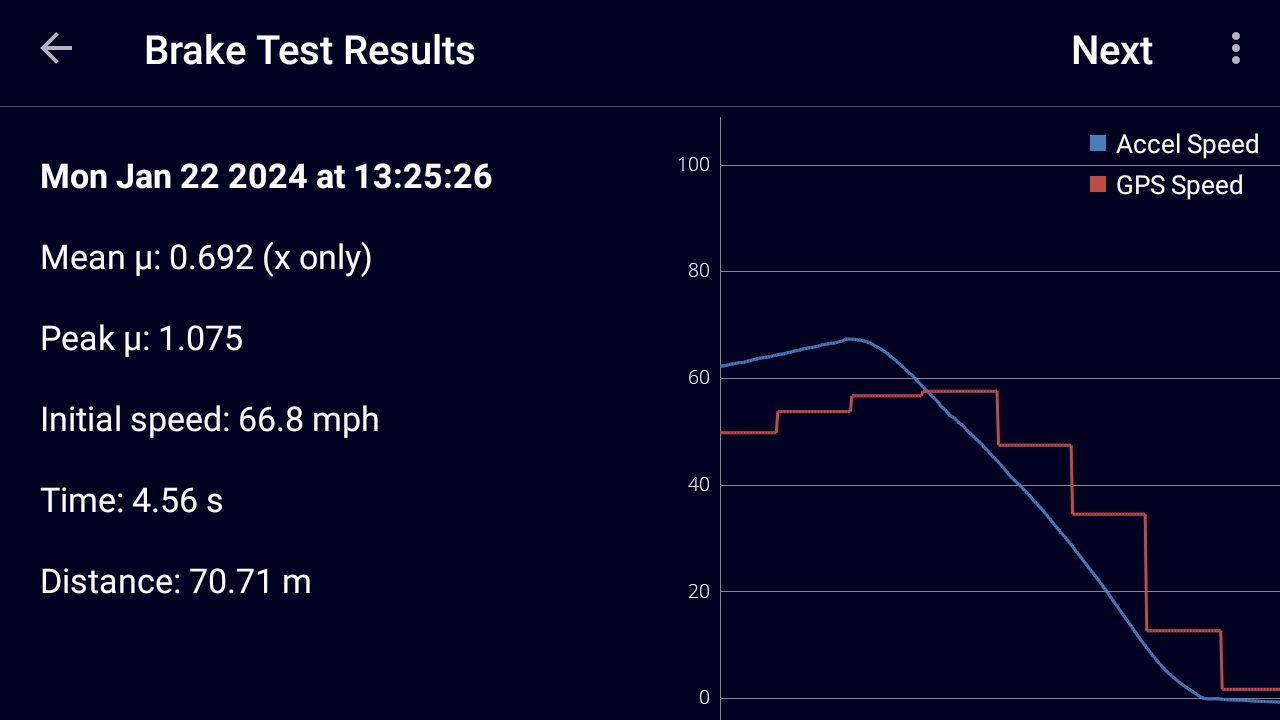
In the meantime, riders can brake test themselves (with care) using a phone App such as iAccel Lite which is free. 0.67g is the Highway Code Standard, 0.8g is achievable with practice (with great care). Advice on braking is below, but if in any doubt please contact your local training organisation.
Riders need to practice repeatedly until the technique becomes embedded and automatic. In theory, this takes 200 repetitions to create the required ‘muscle memory‘, enabling maximum braking without conscious thought.
Riders on machines without ABS should never practise on their own, due to the risk of a skid and fall.
Racers and trackday riders should mostly already be ‘pre-programmed’ and capable of close to 1g.
Background
At the end of 2023, the MCIA called for a new motorcycle safety strategy. ‘Speeding’ and ‘Think Bike’ have been pursued for well over a decade, but motorcycle casualties haven’t reduced over the last few years.
Adhering to speed limits and being aware of hazards is only part of the problem. It’s also being able to brake in time. Having trained riders for 14 years, we know that many if not most, with training, can reduce their stopping distances significantly.
What we didn’t appreciate was the extent of the problem and the very serious implications for road safety.
For car drivers, stopping in an emergency just requires the driver to stamp on the brakes even when cornering, as almost all vehicles have ABS (anti-lock) brakes. ABS has only been compulsory since 2016 for motorcycles >125cc.
The problem has remained hidden as ‘failure to brake properly’ is not a ‘contributory factor’ in accident statistics.
A failure to brake in time could also be incorrectly classed as ‘Speeding‘, which in the 2022 accident stats shows as 10x more likely for riders than drivers. It could also be lost within ‘Failed to look properly‘ when the rider anticipated the collision but couldn’t stop in time, or within ‘Learner/inexperienced‘. In addition, 30% of collisions have no recorded contributory factors, up from 14% in 2013.
This is primarily because most motorcycles, except for some 2013 Kawasakis, don’t have ‘Event Data Recorders‘ whereas many cars do. However, extracted post-crash data from traffic cameras and rider’s helmet cameras confirms that many riders cannot stop properly.
If you compare the stopping distances from published US research from Axion Forensics, the best ‘Magazine TestRiders‘, can stop at half the distance than the worst road riders.
From 60 mph, this is the difference between stopping in time and a 40 mph probably fatal impact, as braking obeys a ‘square law’.
It is hoped that the Government, trainers, road safety organisations and charities will look at new initiatives to address this root cause, to raise awareness, encourage practise, and provide additional braking advice and training nationwide. The most vulnerable group is +17 years teenage riders who move from a 50cc ‘twist and go’ to a 60 mph 125c geared motorcycle, not required to have ABS with no additional training, but riders, parents and non-DVSA licenced trainers need to be aware of child protection issues.
It is also intended to encourage more research into the problem and to address the differing and contradictory advice from the DVSA and Police Roadcraft, on how to brake in an emergency.
Advice on Braking
Riders on ABS-equipped bikes simply need to have the confidence to apply both brakes firmly, which is often a problem due to current or previous experience on bicycles, when riders can skid and fall, or go over the handlebars.
Based on racing experience, research and theory, riders require a high degree of skill and practice to brake effectively.
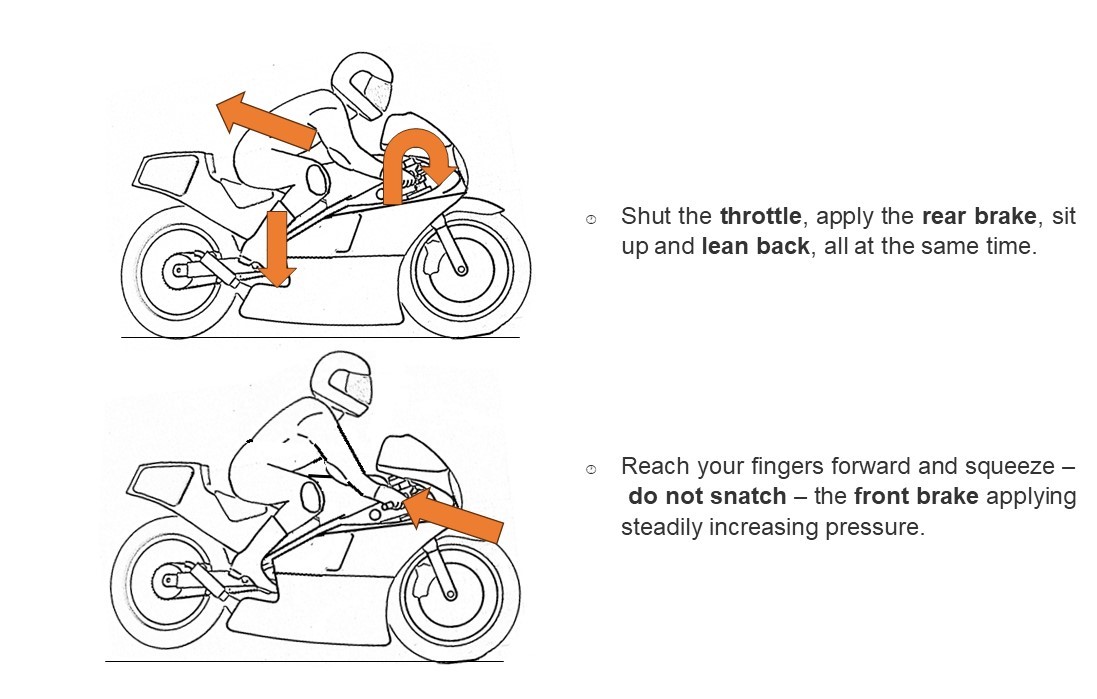
Shut the throttle, apply the rear brake, sit up and lean back, all at the same time.
Reach forward and squeeze – do not snatch – the front brake with increasing pressure.
If the front wheel locks, release immediately and reapply.
If the rear wheel lifts, release some front brake pressure to stop the bike tipping forward.
Disengage the clutch as you come to a halt
When banked in a corner, just apply the rear brake.
The rear brake should be applied immediately, but on non ABS machines, may need to be steadily released again to avoid the rear wheel skidding.
Riders need to avoid snatching the front brake, instead squeezing the lever with increasing pressure, just enough to avoid locking the front wheel, but enough to transfer the weight as quickly as possible onto the front tyre, then slightly reducing the pressure as the bike slows to leave the rear tyre just lightly touching the road surface.
Riders also have to release the throttle, extend their fingers, grasp the front brake lever and pull, which is thought to extend reaction time for another 0.5 seconds or 44 feet @ 60 mph. So covering the front brake with your first two fingers is recommended, as is using the rear brake, which will be applied sooner as the rider just had to press their foot down.
Riders can also ‘trail brake’ into corners in an emergency, braking and steering at the same time, as racers do, but it requiries a high degree of skill, and very careful instruction which is best undertaken on a track.
Feedback is welcomed, and further posts and advice are planned.
Current DVSA advice on emergency braking to apply front brake before the rear to be reviewed and changed to applying both brakes at same time
ABS to be mandatory for all PTWs over 50cc, specifically including 125cc which are currently exempt, as these are the PTWs that riders learn to ride on.
Further posts will be forthcoming on the other proposals. In particular:- cornering, trail braking, pre-emptive interventions, trainer training, new risk awareness campaigns, and the control of new road accesses. A previous post covered E-Scooters and E-Bikes.
recommendations on Emergency straight-line braking
This is based on findings over a decade of training, that very few riders can brake effectively in an emergency, from speeds above 30 mph.
New and existing riders to be trained properly in high speed emergency braking in a straight line.
This requires firstly identifying what ‘best practise‘ is, and revising and improving existing official publications – notably ‘Police Motorcycle Roadcraft’ and ‘Riding – the Essential Skills’ in which the advice conflicts. Both publications are also currently considered to be misleading. Advice should be based on research and the science.
Additional trainer training is probably required to support this. This could be problematical as there are currently no legal restrictions on the provision of post-test or advanced training to other riders commercially, which is another issue that could be addressed.
Existing riders, many of whom are reluctant to pursue ‘advanced‘ or ‘enhanced‘ training, to be targetted by a revised ‘RIDE’ course, as an alternative to prosecution for any collision, (which should be pursued more enthusiastically), and/or following prosecution for any riding offence including ‘speeding’. And preferably in advance of a collision, via effective road policing which is close to non-existence locally, or by using CCTV and video footage from dash cams etc.
A publicity campaign advising best practise should be considered.
1. Riding test to include Emergency braking from 60 mph (currently 30 mph).
The prime road safety strategy for the past few years has been to get road users to THINK! and also address ‘Speeding’, which has had apparently little effect on collisions, despite most road users visibly going more slowly than they did. It’s also convenient as it requires very little resources, and is more than covered by the revenue through prosecutions and ‘Speed Awareness’ courses. However, regarding collisions, speeding is only one of 4 major factors, which also include;-
Hazard Awareness (paying proper attention)
Reaction Time
And critically, regarding motorcycles, being able to brake effectively in the shortest possible distance, as almost all other vehicles have anti-lock brakes and don’t tip over under heavy braking. (Bicycles, E-Cycles and E-Scooters have the same issues, but clearly this won’t be picked up by speed cameras).
An opportunity of biblical proportions, bearing in mind the many millions who have attended a speed awareness course, is being missed to tackle the other issues, primarily ‘paying proper attention’ because if they were, then they would not have been on the course in the first place. That these are focussed on marginal speeders, not those speeding excessively, makes no sense. Speed cameras and camera vans are quite easy to spot.
Many, maybe most motorcycle riders from experience, cannot stop effectively from higher speeds. Additional independent research is urgently needed to confirm this.
There is no obvious easy way of recognising the failure to apply the brakes and reduce speed effectively as a contributory factor in most collisions, so it is probably a significant hidden factor which remains unidentified and unaddressed. The second cause when the rider skids and falls prior to the collision will be recognised, as it would result in evidence of sliding on road, bike and rider, and a different impact. Presumably failing to brake properly can also remain unidentified within ‘Loss of Control‘ which is a major factor, or ‘Inexperienced rider‘, or ‘Riding too fast for the conditions’.
A large number of collisions also have no determined contributory factors.
Unlike a modern car or truck, a motorcycle requires training, skill and practise to be able to stop to even meet Highway Code braking standards.
Car drivers are used to just stamping on the brakes in an emergency, as almost every car or truck now has anti-lock brakes (ABS), whereas only new, or some earlier motorcycles over 125cc, have ABS.
A sports car on soft grippy tyres can stop at close to half the distances as outlined in the Highway Code. A motorcycle cannot.
Cyclists have often skidded and fallen, or gone over the handlebars after applying the front brake, so many moving to motorcycling then avoid using the front brake firmly, or for some riders, at all.
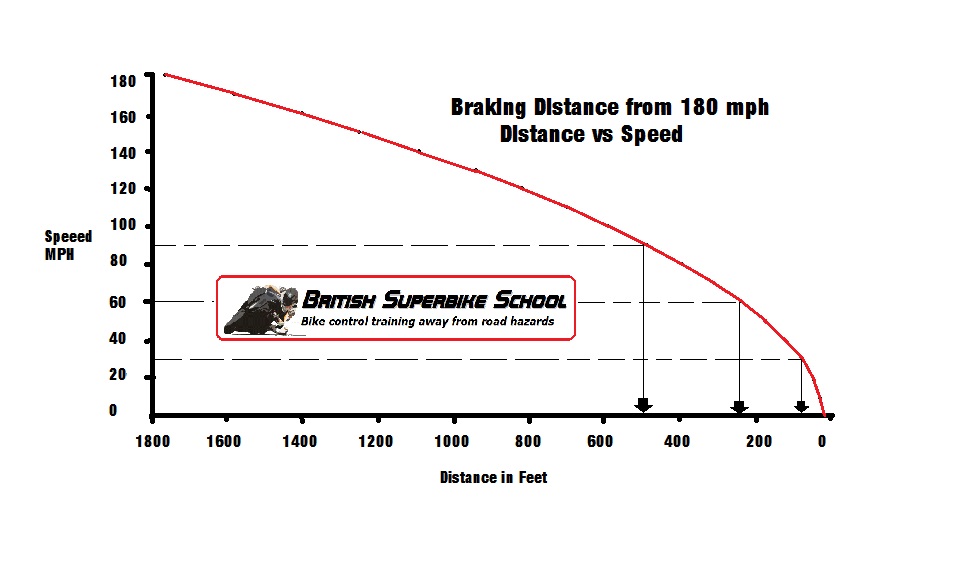
Braking from 30 mph only takes about 1.5 seconds, so feels almost instant. Braking from 70 mph takes over 3 seconds, is more physical and potentially more frightening and challenging. The equivalent of doing a ‘handstand’.
Speed of impact clearly effects the level of injury, so losing at much speed as quickly as possible is key to reducing KSI’s.
A 30 mph impact is probably survivable, a 40 mph impact, probably not.
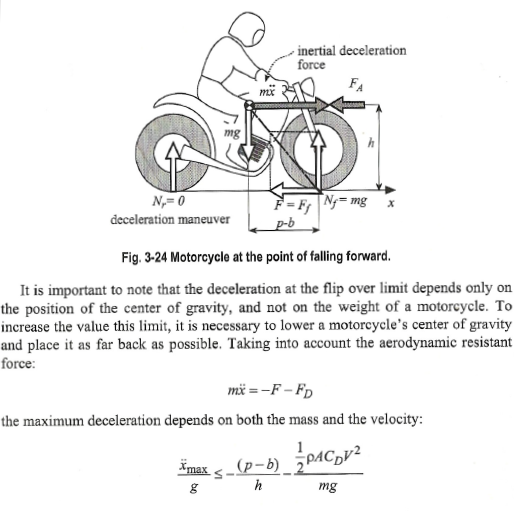
Motorcycles cannot stop as quickly as cars, as the limiting factor is not tyre grip but the motorcycle tipping forward, with the maximum retardation available just on the point of tipping.
(From John Bradley’s, ‘The RacIng Motorcycle’)
(From ‘Motorcycle Dynamics’ by Vittore Cossalter)
This theory needs to be confirmed and officially developed into ‘best practise’, although it broadly supports the opinions expressed below.
Riders therefore need to be trained in the correct technique, recognise what is happening when they brake, and ensure they have the confidence to apply the brakes properly. It is ‘a balancing act’.
Many riders are reluctant to use the front brake properly, or sometimes at all. This is usually due to prior experience riding bicycles, where it is easy to go over the handlebars with hard front-wheel braking. This tendency is far less on a motorcycle due to the lower centre of mass due to the engine etc. and happens far more more slowly, giving the motorcycle rider time to react, and it tends to happen more at lower speeds as the rider comes to a halt.
Many riders also appear to be unaware of how quickly they can actually brake, particularly in wet conditions. Modern tyres have far more grip than many older riders believe. As long as you apply the brakes more carefully initially, there is still sufficient grip to get the rear wheel off the ground on wet roads (equivalent to 1g) – tipping forward is still the limiting factor.
The front wheel is also very easy to lock without ABS if the front brake lever is snatched, (the effect is like the magician who pulls a table cloth from a laid table) and can nowadays be achieved with just one or two fingers on the front brake lever.
This usually results in an instant fall, although it can be released and reapplied, but again needs knowledge and practice.
Once a rider is off the bike and sliding down the road, speed is only lost in the friction between the rider and the road surface. The outcome of an impact at ground level is likely to be worse, and there is a risk of being run over by following vehicles who are often closer than the required 2-second distance as they can see easily past the rider.
The rear wheel is also easily locked, but a skid is usually controllable, although the overall braking distance will be lengthed.
Motorcycles with ABS have a system which prevents wheels locking and skids, but if the ABS is triggered it may increase potential stopping distances. However, it is probably better for new and inexperienced riders, on a bike fitted with ABS, to simply apply the brakes as hard as they can.
‘An ABS does not necessarily shorten your stopping distance, but does allow you to keep steering control and drive your vehicle more effectively.‘
So it is still more effective to apply the brakes correctly, even on a motorcycle fitted with ABS.
‘ABS is demonstrated to reduce stopping distances and to improve stability under all braking conditions, but such features are not enough to guarantee a good braking performance in emergency events if the riders have not the skills to utilize the full braking power of the motorcycle’.
There is a debate, on-line, as to whether ABS actually shortens stopping distances, but it probably depends on the level of rider skill, which needs to be very high to beat an ABS system.
The advice is that if you do trigger the ABS with the front brake, that you have probably ‘snatched’ the front brake lever too hard initially, as once the weight has transferred to the front wheel it should only lock due to a poor road surface.
Triggering the rear wheel ABS is again due to either stamping on the rear brake, or failing to release it as the weight transfers forwards
As it states in Police Motorycle Roadcraft ‘‘If you activate the ABS ask yourself why? Are you taking greater risks. Do you need to improve your technique?“. The advice is, however, if the ABS activates do not release the brakes. Riders need to be aware of the pulsing sensation, but not to react to it. It could be mistaken for faulty brakes.
Many riders also have more than one motorcycle, with older sportsbikes being very popular, which don’t have ABS. All riders should be able to stop without the ABS being activated, although it is an invaluable safety aid, particularly for the inexperienced or unexpected slippery roads. ABS is also a useful training aid for riders to experience the point at which the tyre loses grip, without risk of skidding or falling.
The proposed correct technique for braking in a straight line is to immediately apply both brakes firmly but smoothly, with front brake lever pressure increasing while the weight transfers forwards, and the pressure on the rear brake steadily released to avoid locking the rear wheel as it unloads and potentially skids. The front brake to only be released if the front wheel locks and skids, or if the rear wheel lifts off the ground (which riders can be trained to recognise).
Braking from high speed places high loads on the rider’s arms and neck, as they are thrown forward. It requires riders to grip the fuel tank with their knees and rely on their arms to stop them sliding forwards, and/or on the rear of the fuel tank stopping a slide forward.
The commonplace untrained reaction in an emergency is often to panic, intially snatching the front brake and stamping on the rear, potentially instantly locking the front and/or rear wheels. An unexpected front wheel skid with usually result in a fall. Skidding tyres significantly increase stopping distances. Alternatively, many riders can fail to apply the front brake hard enough, for fear of skidding or going over the handlebars. With a little training and practise we have found that most rider’s stopping distances can be reduced significantly, which can be critical in avoiding a collision or reducing the speed of impact.
Riders very rarely, if ever, practise emergency braking, with the first time for many usually being out of necessity.
It also appears that many riders are unaware of the relationship between speed and stopping distance, which is particularly noticeable at higher speeds on a race track as we have also found, even though it is included in DVSA advice. Most road riders speeding at say 90 mph, probably don’t appreciate it will take them twice as long to stop as it does from 60 mph.
The faster they are riding, the more critical the ability to stop effectively is.
The extent that the failure to brake effectively is a cause or contributory factor in collisions is not identified at all, and is probably in most instances unknown. However, experience in post test training riders indicated this is likely a major contributory factor, particularly as it has been found that motorcyclists are more likely to be speeding.
The only obvious ways this can be confirmed as an issue, is to formally research rider braking to confirm our findings.
High speed braking should also be addressed during any advanced or post-test training, which could also be mandatory for post collision riders. From personal experience, I completed my advanced training, and post test instructor training without ever having been required to complete an emergency stop from high speed.
The existing NRRAC RIDE courses now appears to be online, and when they were in person, the training workshops were not delivered nationally, and do not seem to address rider competence, mainly behavioural problems. https://www.drivetech.co.uk/police-referred-courses/course/ride/
The course could be redesigned to also address rider competence, either in response to potential police prosecutions, or post collisions.
2. Current DVSA advice on emergency braking to apply front brake before the rear to be reviewed and changed to applying both brakes at same time
There is an issue at the moment with long standing advice from the DVSA to apply the front brake before the rear in an emergency, which marginally increases stopping distances, and has a disproportionate effect on riders who are reluctant to use the front brake, or some bikes with dual brakes, or those with a low centre of mass (cruisers).
Roadcraft alternatively tells riders to use both brakes in an emergency. Also ‘As the machine slows, gradually release the pressure on the front brake, and increase the pressure on the rear brake’. This does not seem to make any sense, as releasing the front brake will likely increase stopping distances, and increasing the pressure on the rear will likely simply lock the rear wheel. If the rider is braking hard, the rear wheel will have very little if any weight on it. This maybe a legacy issue from a few decades ago when tyre grip was poorer.
There is an argument for releasing the pressure on the front brake, not as a routine, but only in the event of a skid, or if the rear wheel has left the ground to prevent the rider tipping forward over the handlebars, which happens comparatively slowly compared to a bicycle.
All published advice needs to be supported by evidence and the physics.
There is also the clear need to address retraining and upskilling existing riders, which requires properly trained trainers, many of whom may need retraining, and there is also the current problem of reaching unqualified unlicenced commercial trainers, many ex-police.
As most riders would not voluntarily attend advanced or post-test training, this could be made mandatory for any rider involved in a collision etc.
3. Linked ABS to be mandatory for all PTWs over 50cc, specifically including 125cc which are currently exempt, as these are the PTWs that riders learn to ride on.
Only new or a few earlier motorcycles over 125cc have ABS. It is an invaluable safety aid, particularly for the inexperienced or unexpected slippery roads. ABS is also a useful training aid for riders to experience the point at which the tyre loses grip, without risk of losing control, skidding or falling.
As most 125cc motorbikes can achieve at least 60 mph, it is difficult to understand the failure to ensure that they too now are mandated to have ABS from new.
In response to the call, below are some suggestions for a new strategy for motorcycle casualty reduction.
Motorcycle Braking and Cornering
Riding Test to include:-
emergency braking from 60 mph (currently 30 mph).
cornering on rural roads
banking a motorcycle to at least 30 degrees on corners
Riders to be trained to:-
brake safely into and around corners in an emergency.
to countersteer.
Ensure riders are aware of ‘target fixation’ and ‘you go where you are looking‘.
Current DVSA advice on emergency braking to apply front brake before the rear to be reviewed and changed to applying both brakes at same time.
New suggested cornering lines to be published, with a wide entry and late apex for increased safety.
Linked ABS to be mandatory for all PTWs over 50cc, specifically including 125cc which are currently exempt, as these are the PTWs that riders learn to ride on.
A maximum tyre age – suggest 10 years – for motorcycles to be enforced at MOT.
Safety Campaigns
Focus to move away from speeding – to braking, reaction times, paying proper attention, and duty of care.
New focus on thoughtless, careless and reckless driving and riding, advising of the illusion of safety in vehicles, and the consequences of collisions for vehicle occupants and riders, particularly above 30 mph, using case studies.
Car drivers to be made aware that occupants can be killed by a side impact from a motorcycle at a junction.
Motorcycle riders to be made aware of the dangers of cornering on rural roads.
‘Know the Dangers’ presentation on T junctions to be promoted more effectively.
Oil and diesel leaks from vehicles, overfilling, leaking caps and poor maintenance.
Further research by Professor Alex Stedmon on road markings to be pursued.
Pre-emptive Interventions
High risk drivers and riders to be identified via effective road policing and the use of traffic cameras.
All collisions, even minor, to be reported to the police.
Insurance companies to be required to advise the police of any reported collisions.
‘Crash Awareness’ courses for drivers and riders involved in any collision.
Compulsory retraining and assessments for identified high risk or convicted drivers or riders.
Reintroduction of ‘RIDE’ safety courses nationwide for motorcyclists.
E-Scooters and E-PTWs
E-Scooters to be banned and replaced with E-Cycles (or similar self powered PTW with footrests or footboards instead of pedals) which can meet Highway Code braking standards and negotiate kerbs etc. safely.
Any PTW (or powered single, 3 or 4-wheeler) to be required to meet reasonable safety standards, even for use on private land, particularly braking. This to include currently ‘Ball boards’, ‘Hover boards’, ‘Powered Unicycles’ and ‘Powered Skate Boards’ etc.
New Road Accesses
The Law to be changed to require approval for any new access to the road network, not just to classified roads.
Planning permissions, where these involve safety issues including minimum driveway widths, turning areas, visibility splays and surfacing to be rigidly enforced by local councils, and by the Justice system.
Traffic Enforcement
Illegal parking with 10 metres of road junctions to be enforced.
Training
‘Down Training’ (sitting next to Nellie) for learner trainers to be replaced with a professional vocational course and qualification, including appropriate theory.
Change the Law so that anyone training riders commercially on the public highway, including post-test, must be licenced by the DVSA under current arrangements
Post Test and Young Rider Motorcycle classroom theory training workshops to be promoted and delivered nationwide. (‘SharpRider’ and ‘Twang’ previously designed and delivered for local Road Safety partnerships are available FOC to use nationwide).
Motorcycle Safety Equipment
CE approved neck braces to be investigated for all motorcycle riders.
The Intention is to publish further posts on the above subjects to provide more detail, and provoke further discussion.
I hope that this response will spark a useful debate which will result in a new agreed more effective and rational strategy to reduce motorcycle fatalities and serious injuries.
The ideas are based on over 50 years of riding and racing motorcycles, 14 years experience of working with the local Road Safety Partnerships, the Police, Fire Service BikeSafe, RoSPA, IAM, the DVSA and ACU, fellow trainers and coaches, assessing and training over 2,000 motorcycle riders on road and track, and is also based on published road safety data.
I am also a time-served automotive engineer (Ford), a qualified FE Teacher, and have an MBA which has given me a basic understanding of psychology.
Mike Abbott MBA, RoADAR (Dip), DVSA RPMT 800699, ACU Coach #62210
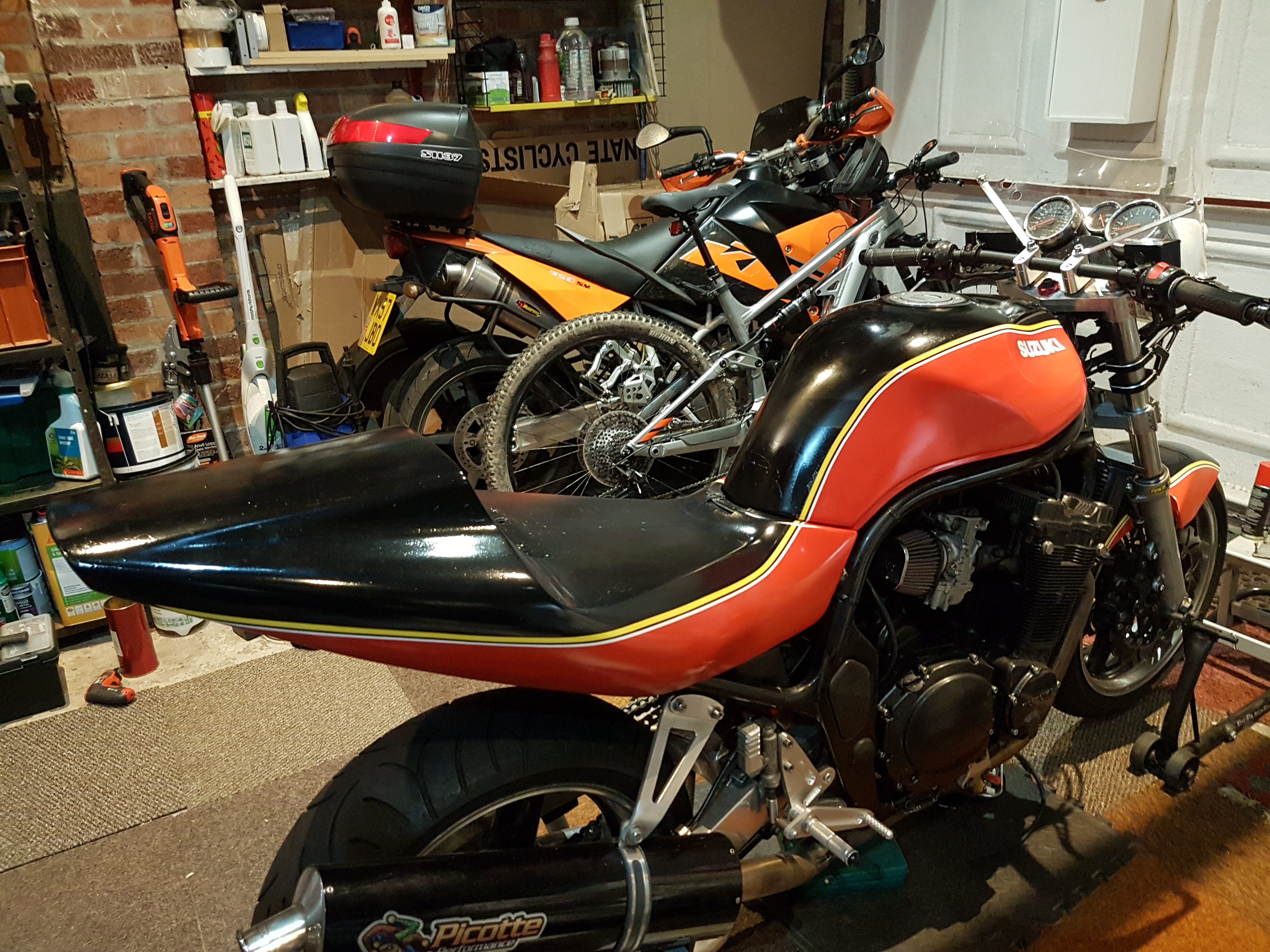
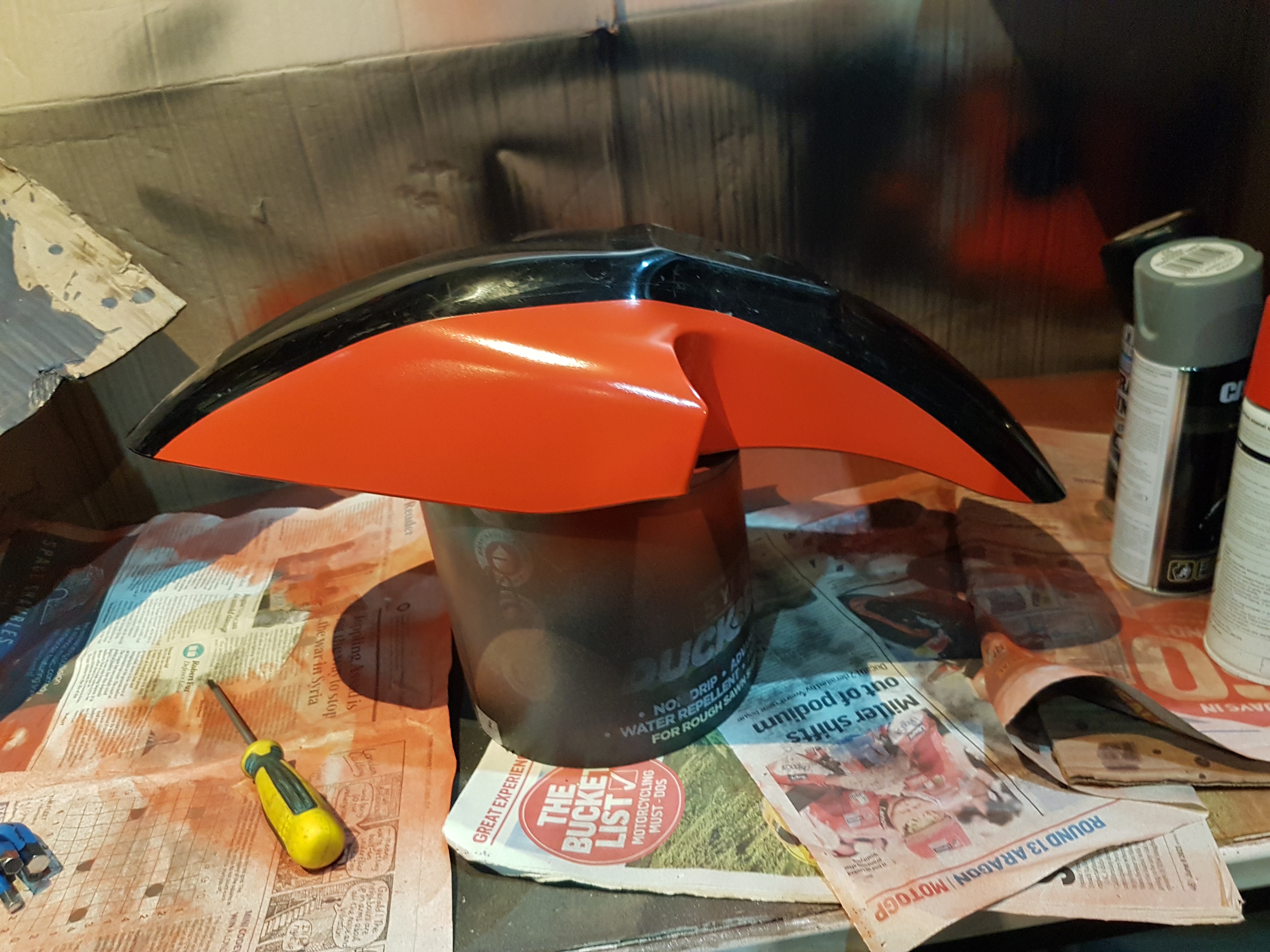
This is the progress so far on the bodywork. The colour scheme is period Suzuki red/black with yellow and white pin striping, in line with the original concept.
I’ve used rattle cans, which are far better than they used to be, with just a bit or ‘orange peel’ to polish off.
A proper professional paint job would be £100’s, which would undoubtedly be better and probably sensible on a newish bike.
However, many years ago one of my mates hand painted a car, and made a great job of it (after much polishing).
If you look carefully at many even new cars, the paintwork is far from perfect (I used to manage a 1st Tier supplier of painted body parts). If you’re being very picky.
You have to wait 15 mins in between coats to get the paint to cure properly and quickly, and use good quality masking tape to get sharp lines.
This time of year you need to heat the workshop to avoid blooming, in particular heat the parts being painted.
Preparation is also key.
I’m very much an amateur painter, so if concerned get advice from someone with more experience.
After the decals, all the parts are being clear laquered to protect them, and improve the finish.
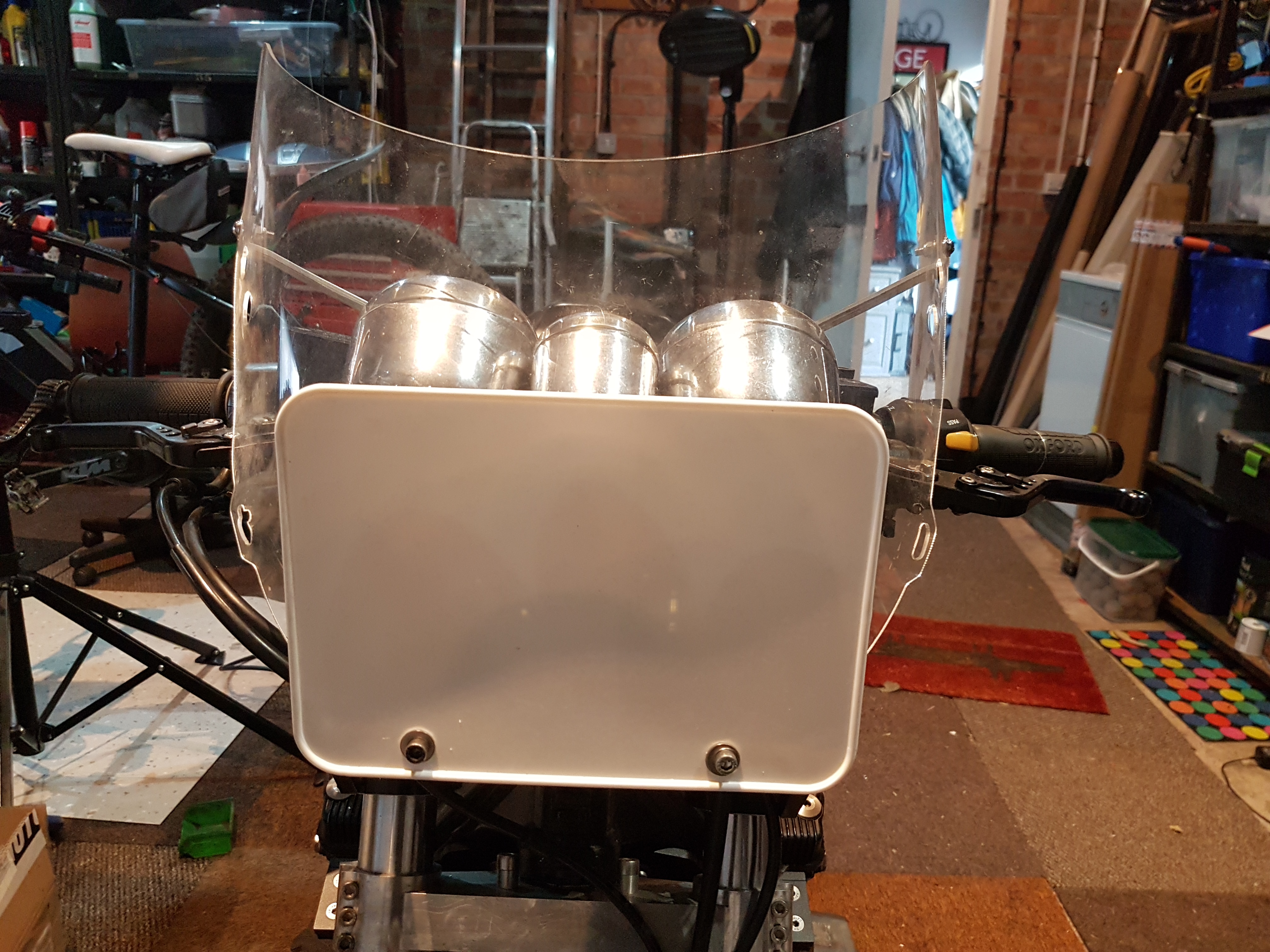
The white area for a race number doesn’t meet ACU regulations, as it’s not upright, flat or deep enough, it’s just for the look.
If you’re building a race bike, you’ll need to fit a bikini fairing or number boards either side of the seat etc for the race numbers.
I’ve fitted a front number plate, with a race screen fitted behind it, which should make it a bit easier on the arms and neck at high speed, which you can see above
I’ve used stick on pinstriping, but I think if I did it again, I’m now confident to be able to paint them on, having watched an episode of Henry Cole’s programme Shed and Buried, which included a professional paint shop, and how to do it properly using paint layers.
You just need top quality thin masking tape, mine was intended for modelling.
We were recently looking at specific risks to young motorcyclists for the National Young Riders Forum. I have a friend who is now a Consultant Surgeon, but spent much of his early career in the NHS in A&E.
I asked him about typical motorcycle injuries and for advice.
His main concern were fatalities and serious life changing spinal injuries, basically because most other injuries he could fix.
I then started looking at neck braces, and was given an airvest with an inflatable collar, which I’ve been wearing.
Many racers and trackday riders are now starting to wear them, with one of our young stars Joe Woodward inadvertently testing his out several times without injury
My latest helmet came with a separate inflatable collar which looks like a pillow for aircraft passengers, and no instructions.
We’re now starting to see more designs coming onto the market, but not all are CE approved.
Doing some more research, I found this piece of research below from Imperial College. Worryingly, it appears some collars can actually increase the risk of neck injuries, so take care when buying a brace.
MX neck braces have been around for a while and there is evidence of how effective they can be, it’s probably the new collars for road or track riders that need to be properly assessed.
Imperial Collge Research into neck braces for motorcyclists.
‘The results show that using such devices may increase the neck forces and the stress level in the cervical spine and consequently can increase the risk of neck injury. The results show that the design of such devices requires better understanding of mechanisms of neck injury mitigation.‘
This was originally an attempt at creating a Suzuki XR69 from a Bandit. However, it was discovered that it would have required major surgery to get the seat to fit, and having bought a complete XR69 body kit, the fairing is far too low and narrow.
Could have cut the fairing in half, leaving just the top and bottom, but decided not to. I suppose you could cut it into 2 halves and widen it, but it might look a bit odd.
An orginal XR69 looks like this – if you haven’t seen one.
Below is another great bike based on a Bandit in Classic Team Suzuki blue, but without a fairing and high bars. Looks like a SRAD seat? Smart colour scheme. Looked a better way to go.
A great attempt below with the fairing problem overcome by removing bottom half.
I can’t find a track bandit with a full fairing, although later 1250 road Bandits had one, and Pyramid Plastics do lower touring panels for road bikes.
You can get cockpit fairings, but it was decided to go with just a Bandit race seat, straight bars and a number board, more Wes Cooley than Mick Grant, but in the red and black Suzuki colours.
May look at fitting a belly pan later – can’t find a race one at the moment.
Expert advice from Spike at Ragged Racing if you want a full fairing on a Bandit:-
Harris F1 fairing is pretty much the same dimensions as an XR69, since Harris copied the bike. Seen a few Bandit/XR69s, but it’s the height that really throws it. You have to have the clip-ons very low for any of the full fairings.
I must admit, I am a fan of a more naked look… and the XR69 replica thing has been done to death! I noticed you had the Yoshimura half fairing in your article [No12 bike], which is essentially a Harris F1 to with holes in it. Skidmarx have just bought BB Plastics moulds, and have that…
And alternative, would be to ‘copy’ the Team Force bikes that bellypan came from, which is a well know European endurance bike. This is a top derived from the 1979 XR69, so has that ‘proper’ Suzuki look. The seat is a slightly altered Nico Bakker. I have Christian Hames’ mould for this, and can produce a fairing with or without headlight cut-out. Obviously this is a Harris chassis, but it’d work as well on a Bandit, with just a bit of light surgery on the subframe.
Firstly, cycles were recently found to be 3 x safer than E-scooters, so E-cycles look to be much safer so could simply and easily replace E-scooters.
But if pedalling is seen as putting riders off, then the simplist and probably safest solution is to remove the pedals etc from existing hired out E-Bikes, and fit footrests or footboards and a throttle – which although currently illegal, are freely available.
Failling that, here’s some ideas for new E-scooters:-
Electric – obviously – current E-scooter drivetrains would fit.
Being seated and a longer wheel base make them far less likely to tip up, and should halve the current Dft braking distance standard, back to Highway Code standards.
Larger wheels to better deal with potholes, kerbs etc. Should be able to safely mount a 4 inch kerb (current standard is 30mm), so will need larger wheels probably 16inches in diameter including pnuematic tyres. Better grip overall.
Battery mounted horizontally between the wheels.
Disc brakes.
Could have suspension added which would be nice, more comfortable and probably safer.
Could be made a bit more stylish, but I think the grunge look is great, although a bright colour would be better for visibility.
‘Monkey bikes’ could also be produced with electric motors, but would be more expensive…
…..or there are some small electric ‘step throughs’ already on the market, but would probably need restricting to 15mph for riders without motorcycle licences.
12 people killed last year, > 1300 injured, >400 seriously, although these figures are thought to be significantly understated.
Something should be done.
All these options would still allow local councils to rent out small electric PTWs at a eye watering profit margin, whilst significantly reducing the risk to riders.
The new Cannondale looks perfect, great for carrying your groceries, but a bit expensive at £5,000.
Finishing off the braking system, it’s now got wavey discs which I think were around in the period. Thought of updating the brakes, but the 6 pot calipers I don’t think were any better, and Suzuki went back to 4 pots with 8 individual pads on the later GSXRs which are too late.
Don’t think you can upgrade without spending silly money, although modern radial brakes are far better, the Brembos on my Aprilia RSV were astonishing at the time. I think they came later.
The rear brake master cylinder has an integral reservoir I haven’t seen before. Not sure what to do yet as you can’t see the fluid level – race bikes usually just have a clear tube. Anyone else seen one of these?
Anyway the fluid front and back will be changed before it’s tested, and not just the master cylinders (which is a well known trade short cut).
I’ve sourced a S/H race seat off Ebay, although you can buy them locally from A16 race parts, along with belly pans.
It’s going to be a red and black scheme as the XR69’s were, not the current Suzuki Classic blue.
The idea was to turn a 1200 Bandit into an XR69 race replica, however having bought a full body kit only the mudguards fitted.
So for now, it’s a project to turn it into a classic track bike. They came out in 1997.
I’ve sourced a Bandit race seat and started work.
First thing is the front brakes which have been taken off and checked all piston are moving freely. Mounting bolts were all different, so have been replaced with titanium Pro Bolts.
I’m sourcing some new pads, which will be a known brand from a proper supplier, having bought some at an auotjumble for my ZXR750 some years ago and subsequently couldn’t stop at a trackday at Donnington – at the end of the main straight.
I was off to the IOM the following week, so would otherwise had probably found out at the bottom of the Creg on Mad Sunday.
The best way to negotiate corners is to use the ‘vanishing’ or ‘limit point’ to judge entry speed (see Police Motorcycle Roadcraft). Works equally well on track.
On the road you complete your braking before the turn and apply a steady light throttle through the corner.
On the track you carry your braking into the corner gradually releasing the brakes as the lean angle increases, before apexing and accelerating away.
On the road you stay in the saddle, on the track you slide off inside onto your inner thigh and also move the top of your body across. This keeps the motorcycle more upright so the suspension works better.
Lean angle required depends on rate of turn which is a combination of speed and the radius of the corner – not just speed.
Road bikes can lean up to 45 degrees safely given a reasonable and dry road surface, race bikes can lean up to 60 degrees with soft track tyres.