Braking from High Speed – Reaction times

We came across this piece of research from the Transport Research Laboratory which appears to have gone under the radar, which we present on our road training courses. Our previous paper on braking a motorcycle (or car) from high speed used the TRL 0.7 second standard reaction time to hazards, but this research shows how much this can vary on circumstance.

There are two factors as to whether you can avoid a collision or minimise the impact speed:-

a. How quickly you can react

b. How quickly you can stop (which we covered in the earlier post) or swerve.

These figures (see below) were reaction times using a simulator in different scenarios.

1. Cars and pedestrians emerging.

Average reaction time at 0.85 is actually a bit greater than that currently used in Highway Code stopping distances.

2. A vehicle braking ahead.

This at an average 1.3 seconds is nearly twice the figure used in Highway Code stopping distances, and the ‘two second rule’ leaves you with a 0.7 second gap in which to brake (or 70 feet at 70 mph). It is also clear that most driver and riders amazingly don’t expect the vehicle ahead to brake suddenly, as from observation they ride/drive far too close and would often simply hit the vehicle in front without even beginning to brake.

3. A vehicle ahead veering off the road and knocking down an overhead motorway gantry.

This I think we can all agree is ‘unexpected’, but reaction time is surprisingly only slightly longer than a vehicle braking in front.

4. A stationary vehicle in front the centre of the lane

This is the real concern as clearly riders/drivers see a vehicle ahead and don’t realise for some while that it is stationary, taking on average nearly 4 seconds to brake or 5 seconds to swerve. A massive 400-500 feet to react at 70 mph. This can also apply in any situation where you do not immediately recognise a hazardous situation, which is why ‘hazard perception’ is such an issue and part of any licencing test, as is planning ahead.

This is known by the emergency services which is why you will see emergency vehicles now always parked across the road or diagonally, to indicate they are stationary.

Also included is the effects of fatigue on reaction times, which is very noticeable, adding more than a second in all circumstances. So if you’re tired a 2 seconds separation distance from a vehicle ahead is nowhere near enough.

So what are the conclusions?

1. Always leave a good gap ahead – 2 seconds is clearly not enough – particularly at high speed.

2. Pay attention!

3. Don’t drive when tired. Stop and get a coffee – a large cup from Costa (other providers are available) not only kept me wide awake riding home the other day, but for half the night.

Again most braking actually occurs in the last few feet, so the earlier you react has a disproportionate effect on  the lowering the speed of any impact or avoiding one (which is better).

Mike Abbott, British Superbike School 25.11.15

Braking a motorcycle with a Pillion Passenger

This article is in response to an interesting question on Twitter from BikeSafe Glos, to an earlier blog on tyre grip, as to whether the extra tyre grip from the weight of a pillion would reduce stopping distances?

The short simple theoretical answer is it makes no difference. The physics is as follows:-

The kinetic energy of bike and rider(s) = m times v squared / divided by 2, where m = Mass (Weight) and v = Speed.

The braking force = umgd, where u = coefficient of friction between tyre and road, m = Mass, g = gravity, and d = distance.

When braking, the two equations are equal, so ‘Mass’ cancels out as it’s a multiplier for both sides. So (in theory) weight on its own makes no difference to stopping distances.

The additional grip via the passenger’s weight is balanced out by the increased momentum of the additional rider. This does however seem counter intuitive from experience, so there may be other factors.

The rider often has to cope with the extra weight of the pillion passenger pressing on him or her, which has to be held back via the rider’s arms, legs and crutch against the tank (usually) which can be ‘eye watering’ – for blokes anyway.

What limits stopping distances is also the position of the centre of gravity of bike and rider(s), as modern bikes can flip over forwards like a pedal cycle. This limits braking to about 1 g – where cars can do much better (Formula One cars can stop at >5 g with downforce) with a far lower centre of gravity.

However, having a pillion shifts the centre of gravity backwards potentially allowing a faster rate of de-acceleration without flipping. Sportsbike pillions sit higher, so the effect is less than with other types of motorcycle.

img457

Pillion braking 2

Illustrations from Motorcycle Dynamics by Vittorre Cossalter .

I’ve taken out the effects of wind drag on braking (and no we’re not on commission).

The red line shows the effect of the shift in the centre of gravity rearwards and slightly upwards, as the included angle decreases, meaning that de-acceleration can be greater without flipping. When the angle is 45 degrees the maximum de-acceleration would be 1 g, whereas tyre grip can result in up to >1.3 g, so the location of the centre of gravity is key.

So in theory having a pillion would reduce stopping distances, everything else being equal, but is the theory actually achievable? Front suspension can bottom out with the extra weight transferred forward, the bike becomes less stable as trail reduces further, so it is advisable to change the suspension settings as recommended by the manufacturer for a pillion and luggage if necessary. Some bikes are too likely sprung, like the early AprIlia RSV’S, even for solo riding, so aftermarket suspension mods might help, but always go to a reputable company.

As an aside, is also probably worth pointing out that accident first responders will go looking for a pillion if they find a crashed bike had its rear footrests down, particularly sportsbike crashes in rural locations.

Motorcycle Tyres and Grip – some myths dispelled

There are a few myths surrounding bike tyres and grip, and for sure the tyre companies are not going to give anything away.

The first is that the bigger the contact patch area then the higher the grip. Area surprisingly has nothing in theory to do with grip!

Why – because grip is simply weight x coefficient of friction.

The formula for friction (grip) is     Fr = μN

  • Fr is the force on the tyre caused by cornering, and brakes or accelerating. When this exceeds μN – the tyre slides away.
  • μ is the coefficient of friction between the tyre and road.
  • N is the force pushing the tyre directly down onto the road, which is mostly equal to the bike and rider’s combined weight. (This varies a bit with undulations in the road and suspension movement, which is why a well set up bike handles much better – but you will likely potentially lose grip over bumps which is obvious to most riders).

The inevitable question is then why do we have such wide tyres? The answer is threefold we believe – to have a carcass that can take the torque from the engine, braking or cornering forces ; to dissipate heat; to reduce wear so softer grippier compounds can be made to last.

Rear tyres are wider as they have to cope with a higher sustained loads than a front tyre. You accelerate hard as you can all the way down the straight, but only brake usually for the last couple of hundred metres when almost all the load will be on the front. The maximum load is limited, as bikes can flip when braking and loop when accelerating (unlike cars).  However cornering speed is mainly dependent on tyre grip, which is the obvious payback for having grippier tyres, and hence the development of dual compound tyres with softer shoulders. Hope this makes sense.

Old bikes with far lower power had similar sized tyres front and back, and really skinny ones if anyone has ever seen a 50cc Kreidler close up.

Tyre Grip - Mohr's Circle

Mohr’s Circle in it’s simplest form shows the theory of tyre grip. You use grip up on cornering, and also when braking or accelerating at the same time, but as long as the combined forces stay inside the circle you have grip, outside the circle you don’t. Clearly in this example the red arrow showing the effect of a high lean angle where the cornering force is nearly at the edge, so any serious braking or accelerating and the tyre will slide. With good modern tyres, the grip ends between 50 and 60 degrees of lean (assuming you have the ground clearance and more with race slicks), but Mohr’s theory does indicate that you can accelerate and brake quite hard at medium lean angles, but this ability reduces quickly as you get towards the limit.

A second myth is that you get more grip at 45 degrees than you do upright. You don’t, as above grip is coefficient of friction x weight, and weight is a constant (bike and rider). It might feel as if you have more grip, but that is just the horizontal forces compressing the suspension at high lean angles (which some riders also confuse with tyre slip).

The third myth is ‘standing it up onto the fat part of the tyre’ when coming out of corners, it’s just that the more upright you can get the more grip is available to accelerate rather than corner. This technique requires an initial slower exit as a trade off with getting on the gas a bit harder and earlier.

Tyres are designed to slip (drift not slide) before they let go, which is where rider feel comes in. Slip angles are typically up to about 6 degrees in ‘normal’ riding, and either tyre or both can drift sideways in the same way a car oversteers or understeers. You need a lot of experience and confidence to get this far, and it would be only sensible on a track. Watch closely how Josh Brooks often rides when he is really on it.

Tyres also distort significantly under load, looking kidney shaped at high lean angles, or ‘s’ shaped when cornering and braking or accelerating, with a steep temperature gradient from front to back of contact patch, which can also move forwards and backwards as the tyres distort, slowing the steering marginally, and ‘shortening’ the effective wheelbase.

There is more information in Motorcycle Dynamics by Vittore Cossalter ISBN-13: 978-1430308614, which you can get on Amazon and elsewhere. Chapter 2 is on tyres. Great book – but heavy on the maths.

It is usually safer to just use the rear brake if you need to slow on corners, as this stabilises the bike and is recoverable if you lock the rear wheel. In theory the front brake would be more effective, but it can sit the bike up and make you run wide, and if you lock it when leant over you’ll very likely drop it, so needs a higher degree of skill and practise, which is risky on the road.

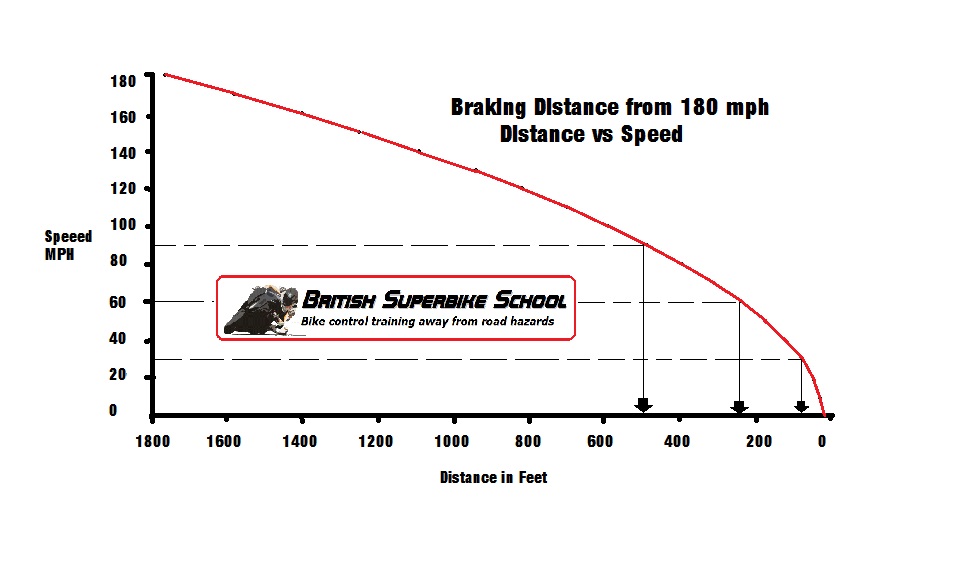
Motorcycle Braking Distances from High Speed.

Braking from high speed is very different from braking from road legal speeds.

It is quite difficult at first to judge braking distances. We were supporting a sponsored day at RAF Waddington a couple of years ago, and the first two riders both went straight on at the end of the main straight (which was a mile or so long down the runway). They were nowhere near to getting stopped in time.

Braking follows a ‘square law’. Twice the speed = 4 times the stopping distance, so stopping from 60 mph takes 180 feet (using the usual parameters but ignoring reaction time), from 120 mph takes 720 feet, and on the same basis a whopping 1620 feet from 180 mph. Reaction time at this speed at an average 0.7 seconds equals another 200 feet on its own, and it still takes time on a track from deciding to brake, and pulling on the lever – it’s not instant.

Also braking hard from high speed requires a degree of control to keep the bike straight.

Modern bikes using track tyres can do better, but it means the forces on your body will exceed 1 g – i.e. worse than performing a handstand. We noticed James Ellison’s BSB Kawasaki had a carbon fibre ‘nose’ on the back of the tank to get wedged behind.  Many modern bikes have cut outs for rider’s legs so you can hang off before a corner and get your thigh wedged behind the tank to take some weight off your arms.

Stomp grips are a good idea and also help when cornering. Club racers used to stick seat foam on the back of the tank before these were invented. Modern ‘tank pads’ can be a bit slippy, although some are made in soft rubber.

Road riders can grip the tank with their knees to take some of their weight off their arms. Even braking hard from 70 mph takes a fair bit of upper body strength, and many trackday riders wear themselves out early on by braking hard at every corner, rather then working on higher corner speeds and corner exit.

Braking distances are worked out using the formula (Newton’s Law) :-

braking equation

Where:

d = distance in feet

v = speed in feet/sec

u = Coefficient of friction between tyre and road (0.7 as used in the Highway Code – which is conservative)

g = force of gravity or 32ft/sec/sec

Braking graph 5

We’ve also added 0.7 seconds thinking (reaction) time which again is an average figure – you still need time to react to braking markers even on the track, so you need to anticipate where to start braking.

Judging braking distances on the road at high speed can be difficult and very easy to underestimate, which often gets sportsbike riders into trouble. You would probably survive a 30 mph impact, probably not a 40 mph one, so the margin is very small in terms of being able to slow in time.

Road or track you need to be looking well ahead.