Tackling Young Motorcycle Rider Safety Issues

As motorcyclists, the problem with young riders is something we are going to have to tackle ourselves. If we want anything to change.

I came across 5 young riders on a single day last week, probably all riding illegally. One had no headlight, 3 were wearing shorts and T-Shirts. Two had proper kit and were riding off-road bikes. Gave me a nod as they passed me on my E-MTB.

If I’d been on my KTM they may well have stopped for a chat.

I trained the Notts police off-road team many years ago, who were very successful in tackling the off-road riding problem. But that is not where the problems mainly are. It’s on road. Off road riding really is just a nuisance – mainly noise, and complaints from land owners. Tractors do far more damage.

So what can you do?

Firstly discourage your youngsters from riding a motorcycle if under 16 years, when they can do their CBT. An E-Cycle or E-MTB can be legally ridden from 14 years. Good chance to learn braking and handling skills – and the use of disc brakes and suspension movement.

They can race mini motos etc. and off-road, but it’s expensive. There are facilities in some areas where they can ride, but sadly they are rare. There is no national equivalent of ‘Young Drivers’. There should be.

Personally I’ve never had a problem talking to young riders. Never had any abuse.

Motorcyclists come from all walks of life, sharing a common interest. If you breakdown roadside the next biker along may well stop to help.

The Problem

In 2022, in the 14-16 young rider age group:-

  • 115 KSIs in total
  • 60 were underage
  • 55 were riding 125cc machines illegally

In 2023, in the 17-20 year old group:-

  • 36 young rider fatalities
  • 50% higher than the 24 fatalities in 2019
  • Double the number from 2020, which at 18 fatalities, was probably affected by COVID 19.

The extent of the problem seems to be a well kept secret.

The Main Issues

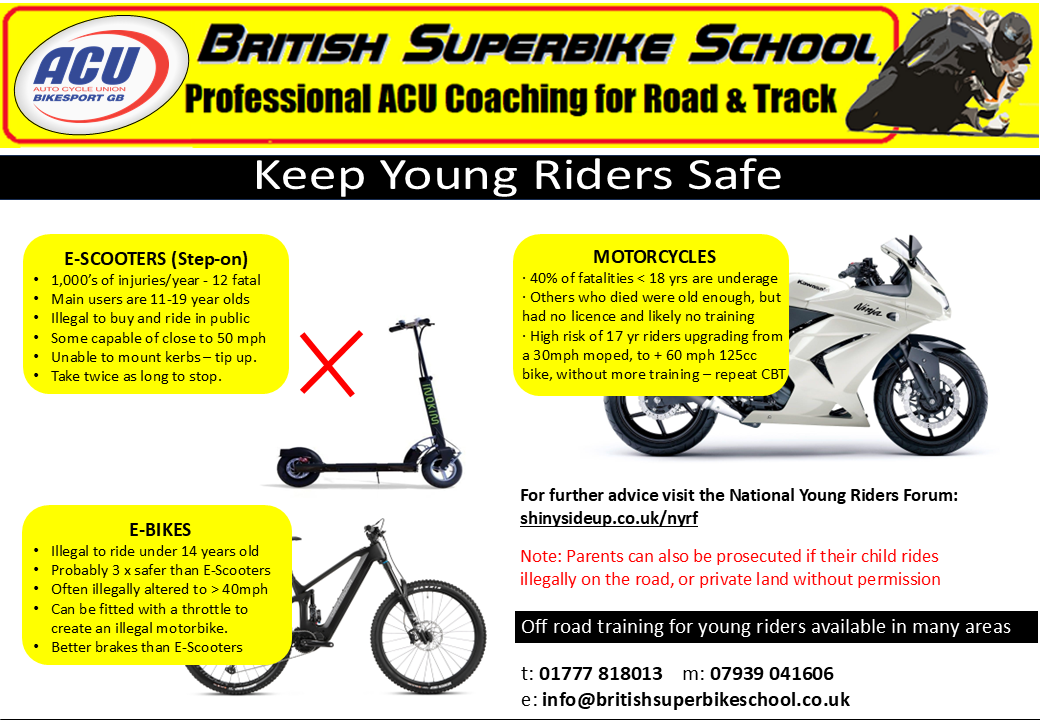
Illegal E-Scooters.

  • Average rider age 16 years.
  • 50 deaths all ages so far. >1,000 serious injuries. 

Underage Riders

  • 40% of fatalities. Many others probably had no licence. Proper training is vital.

Upgrading to a 125cc

The risk of upgrading from a 30 mph moped to a 125cc geared bike capable of 60 mph with no extra training.

No legal requirement for more training. The vast majority of KSI’s are on 125’s.

Emergency Braking.

The DVSA advice is wrong. Apply your rear brake immediately. Do not snatch the front brake lever, or stamp on the rear brake. Apply the brakes steadily. Practice.

Consider riding with two fingers on the front brake lever and clutch, and just squeeze both in an emergency. This should save you >1 sec and critically should reduce your impact speed by around 15 mph or maybe avoid an impact altogether. You’ll probably survive a 30 mph crash, but not at 40 mph.

A New Approach?

I started again, this time with pre-teen riders and Bikeability, who are supported by the Dft.

We already know that there is a serious problem with PTW braking, so I asked them how they teach braking to young cyclists.

Received an immediate response. Somebody cares.

They are taught to ride covering their brakes, how to brake progressively, and particularly to avoid snatching the front brake. Perfect.

So moving to a motorcycle, the skills are immediately transferable.

The question is then why are PTW riders not taught to cover their brakes, and why is PTW braking so poor?

Bikeability cover 44% of younger riders who should be more open to accepting advice before they become teenagers. Braking skills can be embedded more easily with younger riders creating ‘muscle memory’.

There is now also a ‘halfway house’ with E-Cycles from 14 years, which they also cover, many with disc brakes and front suspension, where they can experience weight transfer and the front suspension compressing when braking.

Motorcycles and cycles could be part of the National Curriculum, within Physics, centre of mass, friction, tipping, leaning, speed, gyroscopes, kinetic energy, braking distances etc. I think it helps when you have a practical example of the theory.

Regarding the essential difference between cycles and motorbikes, it is simply speed, and mastering throttle control which is straight forward.

What is vital to grasp, and to be taught, is that momentum obeys a ‘Square Law’. So it takes 16 x further to stop from a motorbike’s 60 mph as it does from a bicycle’s 15 mph.

The major danger is young riders jumping on motorcycles of 125cc and above, which can get to 60mph or more, without any training.

Let’s all hope that the message gets across.

https://www.bikeability.org.uk/about/

Why is the accident rate so high for new motorcycle riders?

The truth is no one currently knows exactly how experience makes riders safer, although some things seem obvious.

Riders probably mainly learn either by crashing, or having near misses. Trial and error.

I crashed a dozen times in my first year of riding, but apart from racing, only twice since – both at very low speed on slippery surfaces.

Motorcycle training didn’t exist at the time. My parents generation didn’t even have a licence test.

I learned that scraping the floorboards on my Lambretta lifted the wheels off the ground, more so with a pillion (sorry Graham).

I learned that a car moving over when I was trying to overtake was not necessarily to let me pass (He was ‘swan necking’ and turned right). I got prosecuted for ‘lack of care and attention’ via A&E. (Sorry Andy – pillion).

I learned cars and trucks often didn’t see me, and pulled out it front of me.

I found wet roads had far less grip than dry.

I found out what ‘black ice’ was and where it often formed, and how slippery snow was when compacted, but fresh snow was better.

I found out oil and diesel were also slippery and where you might find them (petrol station forecourts and nearby roundabouts).

I also found mud on the road was particularly slippery too, and where farmers and construction companies often left it. This was a surprise as I’d taught myself, with the help of my sister’s boyfriend Tony Dyer, by riding around waste land next to Southend Airport on an old 98cc James. Mud was better when it was deeper!

(The police and wealthy land owners largely prevent the current generation of youngsters learning how to control a motorbike this way, away from road hazards. Mike Hailwood (who) learned the same way, so did Casey Stoner and many other top riders).

The Notts police have a 12 man team on dirt bikes, a helicopter and patrol cars. You’d think they’d be better deployed elsewhere like city centres tackling anti social riding, the out of control gig economy, private E-Scooters etc etc. No one bothered me, and clearly noise wasn’t an issue, but continually smelling of aircraft fuel was.

I found out tractor drivers couldn’t apparently see or hear, and were generally oblivious.

I found gravel in places, that was also very slippery, but figured out why and where – mostly. I also found out it can be difficult to recognise on some surfaces, again recently.

I discovered white lines were like ice when wet, drain covers were always slippery as was overbanding (thin lines of tarmac on joints)

I found leaves were slippery too in the autumn.

I found out my brakes were better than my bicycle, and I also now didn’t go over the handlebars if I braked as hard as I could.

I found the rear brake worked better than the front, and a rear skid didn’t mean a fall although a front skid did. (Old drum brakes).

I also found that stamping on the rear brake or snatching at the front, often caused a skid.

I found out some of my mates were lunatics. The wheelie on a 50cc Honda along the top of a double brick wall outside Leigh-on Sea Community Centre wasn’t big or clever, was it Phil? Spectacular – I’ll give you that. A helmet might have been a good idea (not compulsory then). Just a broken arm was quite lucky.

I then learned, after my licence test, that my Triumph Tiger 110 could corner far quicker, went twice as fast, but that the throttle could jam wide open. But I never dropped it.

I found out I could do a ton-up fly past of the Blinking Owl on the A127. And by following another rider, if you got it wrong coming through Raleigh Cutting just before the cafe, and went over a sequence of drain covers, you could end up running wide, across the Esso station forecourt, and through a nice white fence.

I saw a few riders panic and crash on rural bends when I was following them, or they were following me, but I didn’t. I just leaned the bike further.

Interestingly, when I returned to riding 15 years later, I learned quickly to cope with more than twice the power, a bike capable of 140 mph that would both wheelspin, wheelie and do stoppies, but didn’t seem to like corners (Kawasaki GPZ1100 A3).

There followed a selection of sports bikes of ever increasing speed and power, until commonsence finally prevailed after 3 weeks riding an adventure bike around New Zealand. I bought a KTM 950SM in 2007 which I still have. (I still do trackdays on classic bikes).

I seemed to have learned not to panic somehow, and to instinctively brake or swerve before I’ve realised what is happening. I found out that this is called ‘muscle memory’ but it isn’t, it’s learned instinctive reactions without conscious thought.

And how to brake really hard and steer consciously in what seems to be what I call ‘slow time’ to avoid a collision. I guess it’s the effect of adrenaline?

I’ve dropped it twice at zero miles/hr, on an oil slick on the roundabout over the M1 Junction 29, and last year on gravel in a car park whilst putting it on the side stand.

I’ve had some crashes racing.  Two bad ones. I locked the front going into Sears at Snetterton on an unfamiliar bike with better brakes, and had a corker when my TZ350 seized flat out going into the Esses at Mallory (before the chicane was put in and the tyre wall moved back).

Not all learn by trial and error, some mates and other riders continue to have the same collisions. Some only have one crash. If they survive, many don’t ride again.

Some continue to generally crash regularly.

But most simply seem to ride more carefully.

Research shows that the chances of a crash diminish by 40% every time experience doubles, in the early years.

Research has also found ‘advanced’ post-test training is ineffective, riders just go faster, ride more, and have different types of crashes. They are also more likely to blame others, which is unhelpful. It’s all far too late and far too ‘clever’, (as a RoSPA instructor).

The problem is also that crash reporting systems are so poor, despite ‘black boxes’ in many new vehicles. So root causes of crashes are guessed.

The current system is performed by the police, who appear to focus on blame and prosecutions rather than prevention.

BikeSafe is, I believe, mainly a PR exercise as they say it’s ‘not training’. I could explain why but it would take too long and doesn’t make any sense. Any biker likes a ride out – even better if you’re getting paid and on a company bike. But go anyway, you’ve nothing to lose and it’s cheap, and you will learn some good stuff from receiving something that’s ‘not training’. (It is really). And you’ll find police riders are generally a great bunch in this setting.

Back to crashes. We don’t know how experienced riders were, only how old, so we can’t match the type of crashes with experience.

We don’t even know if they had a licence or any training. This is a factor in over a third of fatal crashes in Sweden, and even higher in the US where this factor is reported.

40% of young rider fatalities in the UK are underage. Many others won’t have a licence. So no training is probably 50% of the problem, but could be up to 80%? (Pareto’s Principle).

This is where we all really need to focus, learners, young and newly qualified riders, but everyone needs to be critically aware of the child protection issues from both sides.

Improving Young Rider Safety: Urgent Actions Needed

Suggested Actions

  1. Inform children and parents of the risks of riding E-Scooters. Explain the dangers of riding any PTW when underage or without a licence, and without proper training.
  2. Ban E-Scooters. Require any powered vehicle, wherever used, in public or on private land, to meet Highway Code stopping distances (0.7g) Include hoverboards, ball boards, unicycles etc.
  3. Encourage the use of E-Cycles for 14 years and above.
  4. Make ABS (anti-lock) brakes mandatory for all A1 (125cc) motorcycles
  5. Require riders to retake a CBT when upgrading from a moped to a 125c A1 motorbike.

The Problems

  • 40%, probably more, young motorcycle rider fatalities up to 18 years were riding illegally without any training.
  • 50% of KSIs up to 18 years were underage for the motorcycle they were riding.

This seems to be a well kept secret. You can confirm this if you use the government’s freely available accident database. We don’t know how many of the others didn’t have a licence. They probably received no training. Maybe another 10% or more? More than half the problem?

In 2022 there was only a single 16 year old rider fatality who was riding legally – (Probably).

Young rider Fatalities 2022 in detail

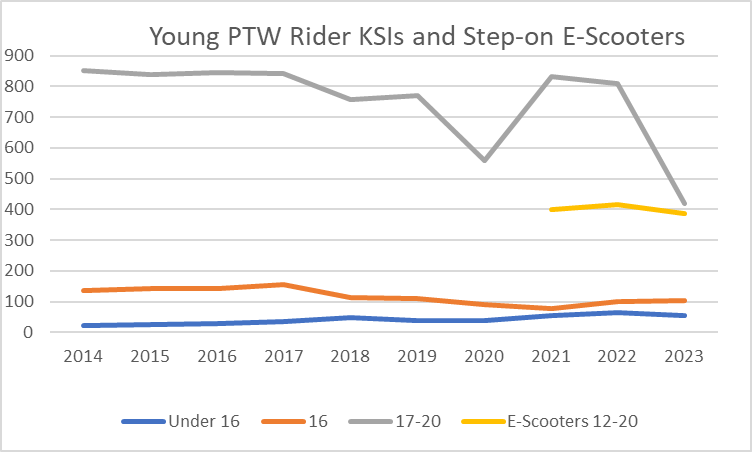
YOUNG RIDER FATALITIES 2014-2023

Over the past 10 years, we have seen an average of 1 death/year of a rider below 16 years. But the situation appears to be worsening.

There are an average of 3 deaths/year for riders aged 16. They were probably mostly riding illegally.

There are also 7 deaths/year for riders each year from 17 up to 20 years old, nearly 300 in total. There is no information available as to how many did not have a proper licence.

2014201520162017201820192020202120222023
< 160021000132
161533212362
17-2033382626282418293635

50cc A1 mopeds aren’t the major issue, but 125 cc A1 motorbikes are. They don’t need to have anti-lock brakes that larger capacity bikes now have to – which makes no sense.

Young riders are mainly a risk to themselves. They are simply demonized by The Press as ‘anti-social’. This view is taken rather than seeing them as children at serious risk.

Young Rider KSI’s 2018 and 2022

Many young riders at 17 move from a 50cc 28 mph twist and go, to a geared 125cc motorbike. They can now easily ride at 60 mph with no extra training. Out they go onto A roads and the countryside at considerable personal risk. KSI’s now more than double.

The number of KSIs of underage riders, 16 and younger, is nearly static. In contrast, overall KSIs for this age group has declined by 25% over the last 4 years. But the underage problem appears to be unaffected.

E-Scooters

In 2022, 440 E-Scooter riders were seriously injured. The highest frequency was in the 10-19 years age group. Estimates suggest that about 150 young riders sustained serious injuries. These account for approximately one-third of all injuries. (Government E-Scooter Fact Sheet).

https://www.gov.uk/government/publications/national-evaluation-of-e-scooter-trials-report

NEW Hazard Shift?

E-Scooters look to have increased 16 years and younger young rider fatalities by >50%, and KSI’s by 400%.

E-Scooters apparently look set to be legalised.

The average E-Scooter rider age is 16 years, youngest 11 years or less.

There are probably now 1.5 million E-Scooters in the UK.

To date, 50 E-Scooter riders and 1 pedestrian have been killed. An unknown number, but probably at least 500/year seriously injured.

TRL research confirmed the poor braking on E-Scooters. The kerb height they can negotiate has had to be reduced. It has been lowered from the standard 10 cm to 3 cm. This puts riders at risk. And that they are unstable, generally poorly maintained needing constant brake adjustment, had steering faults and underinflated tyres.

For local Government rentals, the Dft doubled the braking distance standard for E-scooters. When all other vehicles would have stopped from 15 mph, an E-Scooter would still be doing 11 mph. Speed related fatalities start at 9 mph.

Link to E-Scooter Standards

You can buy an E-Scooter capable of close to 50 mph. Others are easy to tamper with to de-restrict. >40 mph is possible.

The obvious alternatives are E-Cycles. They are legal at 14 years and can stop to Highway Code standards. E-Cycles can also negotiate standard kerbs and use less energy. You have to pedal, which also helps fitness.

Mike Abbott, British Superbike School

Updated 24.7.25