Good to see data analytics being promoted, and the establishment of a new Road Safety Investigation Branch, who hopefully will be looking at ‘black box’ data.
Great to see training and testing being reviewed. Hopefully emergency braking from 60 mph will be included. According to DVSA figures it currently takes 24 years for 80% of riders to become competent, so room for improvement? Young riders are at very high risk.
It would be good to see technology address reaction times with auto closing or trigger throttles (and heel and toeing for cars etc). Could reduce impact speeds by 10-20 mph.
Good to see a Road Policing Review. Enforcement is next to non-existent so good to see this being addressed. Maybe using traffic cameras to warn drivers or riders of their behaviour?
Sad to see E-Scooters still being considered after >50 deaths and probably >1,000 serious injuries. 80% were avoidable as they are 5 x more hazardous than any other form of transport (TRL and WMG reports).
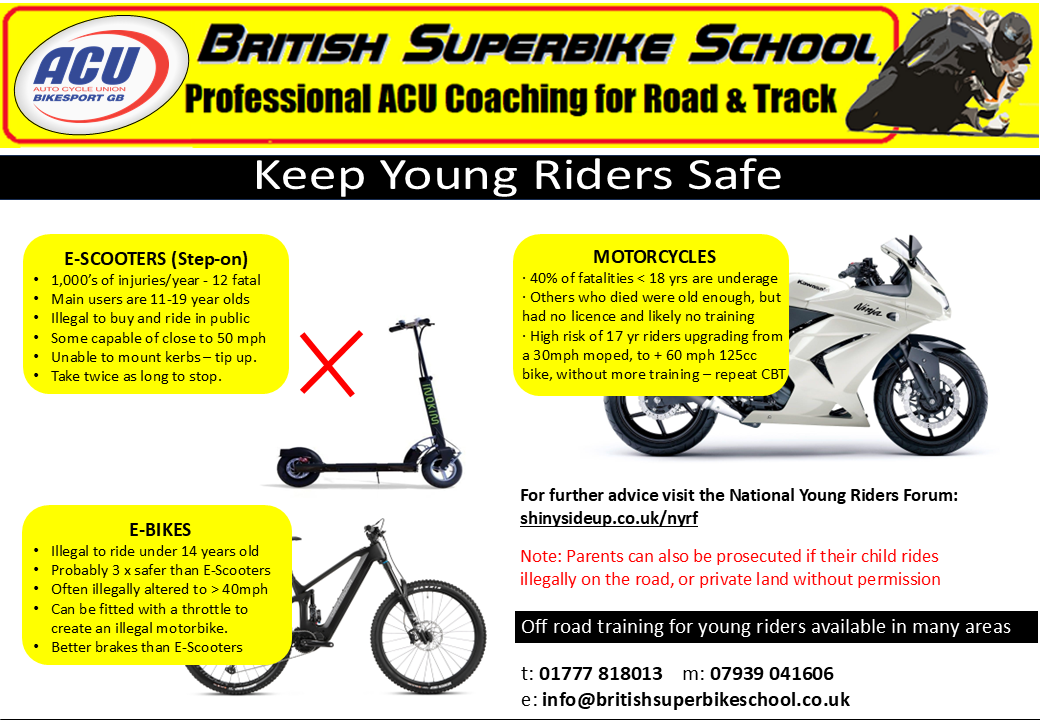
No recognition of young rider issues. 40% of fatalities <19 are underage, more won’t have a licence. Very steep learning curve.
National Guidelines and Lifelong Learning welcomed, and supporting THINK!
Interesting to see new Safety Performance Indicators (SPIs), however the obsession with ‘speeding’ continues, despite it being only a factor in 16% of collisions.
Speeding appears twice, as it’s an overall SPI as well as being specific to motorcycles.
‘Dangerous riding/driving’ is completely missing, despite being a recorded factor in 33% of collisions, twice as high as speeding.
The government’s current ‘hidden strategy’ for motorcycles is currently outlined on National Highway’s BikeTrek website, having employed unlicensed trainers from an unapproved company to encourage ‘Track to Road – Push your Performance’ riding (from their advertising), in flagrant breach of current official advice from the DVSA and NPCC via Roadcraft.
Hopefully this will now be taken down, commonsense will prevail, and the licensing of all commercial motorcycle trainers enforced to stop these and ‘emergency response’ and ‘pursuit’ behaviours from being continually passed on to the public.
Advanced motorcycle training is based on the book – Police Motorcycle Roadcraft – or is it?
Police Roadcraft for cars goes back to the 1930’s. It was written when there was no training or testing, you just went and bought a licence. Crashes were becoming a problem even with so few cars around.
Roadcraft for motorcycles arrived many years later in the 1970’s. Compulsory motorcycle training began in 1990.
The problem with Roadcraft is what isn’t in there. Although the latest version includes ‘Emergency Response’ riding, somewhat unwisely for public consumption, it is missing many of the actual tactics and maneouvres.
Probably just as well, but unfortunately the other stuff is continually passed on during advanced training.
These include ‘off siding’ – taking LH corners from the RH gutter; the ‘Suicide Swoop’ – overtaking vehicles around a LH corner; ‘making good progress’ – taking every opportunity to overtake (when you should never be in a hurry); going straight on from a RH turn lane; filtering up to the front of traffic queues as a routine; using cross hatched areas to overtake; going past ‘stop’ boards at road works when the lights are red etc. Some are Highway Code ‘should nots‘.
There are two basic rules for the public. Is it safe? But is it necessary?
If this wasn’t bad enough, ‘trail braking’ into corners has now been added rather publicly on National Highways BikeTek website via a video on Braking. This is standard racing practise, but really risky on the road, significantly reducing safety margins and increasing corner entry speeds.
It comes from road racing. Most racing crashes are due to trail braking. ABS, particularly earlier versions if fitted, may not save you from a skid and fall and will not prevent the bike running wide.
What is more worrying is that it is presented as being safer, showing a dangerous misunderstanding of the physics, which I think should be obvious to anyone. It also contradicts ‘Grip Trade Off’ from Roadcraft itself.
Is braking while cornering in any vehicle safer? Of course not. To be fair, you could be mistaken on a motorbike, as the suspension dips noticeably, but this is grip being used up not created. Bikes also ‘yaw’ when the front brake is used when banked, which requiries an even greater lean angle to counteract.
The front brake also sits the bike up, making it run wide, potentially into oncoming traffic or roadside obstacles.
RoSPA and the IAM discourage routinely braking in corners. You would fail any test if you did. But there are a number of independent advanced trainers and companies promoting it.
At the moment, absolutely anyone can set up themselves or even a large company providing advanced trainers, sometimes at eye watering prices. There are currently absolutely no barriers to entry.
They are probably acting unlawfully, as car, truck and bus trainers have to be DVSA licenced.
The situation is out of control. Having untrained, unlicenced motorcycle trainers will put riders at risk. No riding standards, no check testing, no complaints procedure, no oversight.
Do not be fooled by clever marketing, or assume ‘Police Class 1’ is a training qualification. It isn’t. It’s an out of date riding qualification. It’s now ‘Police Advanced’ but again it’s not a training qualification.
So we now have racing techniques in addition to the use of police ’emergency response’ and ‘pursuit’ tactics being promoted.
Fatalities were up no less than 14% in the latest 2025 figures. This isn’t helping, probably the reverse.
Time for The Law on commercial trainers to be enforced, and ‘advanced training’ to be made compliant with DVSA and Roadcraft advice?
What do riders learn by experience – trial and error?
What is not learned by experience, for which additional training is needed?
Summary
The background is a 8% increase in PTW KSI’s last year, and a recent 50% increase in young rider KSI’s. It’s currently aĺl going the wrong way.
There was a 14% increase in fatalities from 2024-25.
The DVSA data below indicates that it currently takes around 25 years, on average, for 80% of riders to master riding a motorcycle competently.
Far too long?
In order:- ‘Cornering‘, ‘Planning‘, ‘Defensive Riding‘, ‘Use of Speed‘ and ‘Overtaking – were found as the major rider shortcomings
‘Braking‘ and ‘Filtering‘ also stand out as particular extra training needs.
We now know what additional training is needed, and where current learner training and testing is falling short.
The Enhanced Rider Scheme looks to be effective, well managed and subject to continuous improvement.
In contrast, no benefits were found from current ‘Advanced’ training. (Agilisys).
Government action should be considered to make DVSA ERS licensed training far more available in the interests of public safety. This could easily be achieved by making DVSA trainer licensing compulsory for all commercial trainers. This would ensure, that the training is properly and safely conducted, and focused on the priorities.
The charities working in the sector, with volunteers, should also all be working to the same official standards.
History
The DVSA Enhanced Rider Scheme (ERS) was launched in 2006. It was to provide additional safety training for licence holders, particularly those returning to riding in later years.
Up to 1989 the examiner stood by the roadside, so it is only after this date that examiners followed riders on their test.
Compulsory Basic Training (CBT) was not introduced until 1990.
Currently most riders over 50 years old will not have had any training, nor been subject to a ‘pursuit’ licence test.
Findings
This is the data supplied by the DVSA following an information request. The speed of the response shows that the DVSA have clearly been closely monitoring the ERS Scheme, on an ongoing basis.
This is, I believe, the latest 5 years of data. The first observation is how relatively few riders are attracted to the scheme. This is the only post-test training in the UK delivered by qualified licensed trainers. That it is such a small number of riders, is a concern.
The vast majority of post-test training is performed by volunteers, or untrained unlicensed trainers, mainly to Police Roadcraft standards, but also sometimes encouraging ’emergency response’ and racing practises, such as trail braking by commercial trainers.
(A recent review by Agilisys found no benefits from traditional ‘Advanced’ training).
There is no other published rider assessments that I can find.
DVSA Data
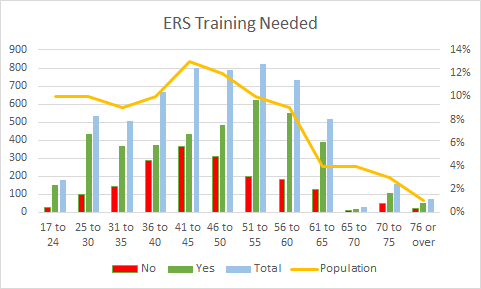
The bar graph shows the number of riders who needed, or who did not need, additional training following their riding assessments.
Green is needed training, Red is didn’t.
If you compare ERS attendees to the population of riders by age, you get this:-
Young riders look neglected? These are at the highest risk, so it looks like an opportunity?
The ERS scheme was aimed at ‘returning riders‘ and has hit the mark.
Training needs diminish up to 45, where the number of riders peak, then increases again. Strange?
There are are also two large peaks in training needs. 17-30 and 51-65 years – the Red bars vs the Green bars.
Training needed by age
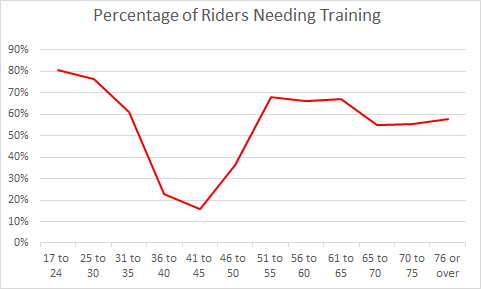
If you present the data as the percentage of riders, by age, requiring training, a rather odd profile emerges.
Having stared at it for some time, and initially considering it as two separate distributions, a ‘light bulb’ moment.
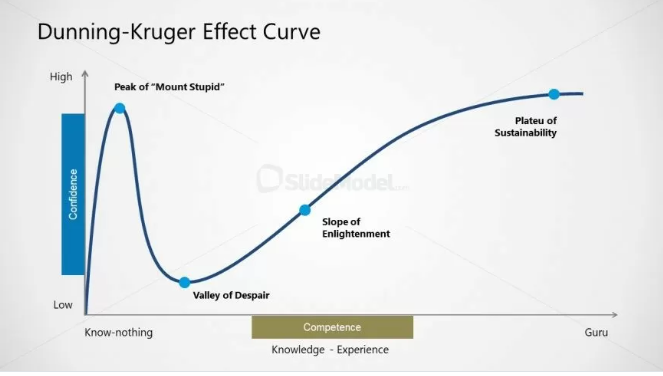
You might have come across Dunning-Kruger before. It’s the journey from:-
‘Unconsciously incompetent’ to ‘Unconsciously competent’
The theory has been applied across many different fields. In this case the ‘Y’ axis is ‘training required’ – incompetence not confidence. However, it does look like younger riders don’t seem to be looking for more training, so could be over confident?
If you flip the graph, competence is shown to peak at 41-45 years. It then deteriorates as we move into later life.
It maybe a bit misleading, as the scheme is aimed at ‘born again‘ bikers, who have a big experience gap. And these will be riders who mainly felt they needed more training.
The riders over 50 will likely not have had training or a pursuit licence test, so are essentially a different group, who are mostly untrained.
Their apparent ‘lack of competence’ is reflected in the accident figures which are slightly higher. So there looks like there is a relationship between competence, as measured, and the risk of a collision.
Modules taken
So what additional training was found to be needed to get riders up to standard?
You can see there is no particular training needs identified. They are various. Training needs are across a wide spectrum.
‘Cornering‘ tops the chart, followed by ‘Planning‘, ‘DefensiveRiding‘, Progress and Overtaking.
This is where rider needs are identified, that needed extra training.
This identifies ‘Braking‘ as the main need – more than a third of riders, and nearly twice the demand of the next module. Braking from higher speeds is not part of the licence test – just from 30 mph.
Probably circa 50% of riders cannot meet Highway Code braking distances from higher speeds, and many skid and fall in an emergency. It is encouraging that this is recognised and is being addressed.
‘Filtering‘ is the second most popular training module, which is widely known to be hazardous.
Training vs Casualties (KSI).
If you add casualties by age (orange line), you now have a complete data set.
Young rider vulnerability is very clear. 10% of riders but 28% of the casualties.
After 30 years of age, KSIs roughly follows the rider population, with a divergence from 40-50, where the accident rate halves, before moving back to a standard KSI percentage.
So is the 40 – 50 group showing the results of experience? Or the peak of physical or mental ability? How much are older new riders part of the problem?
The answer is probably the lack of compulsory learner training and pursuit testing for the older riders, which only became compulsory in 1990.
If you look at the downward slope of the orange KSI line, there is an upward bump at 50 years which coincides with the introduction of CBT. It then continues downwards at the same slope but displaced upwards.
It will be interesting to see if this bump moves further along in the coming years.
Conclusions
It’s difficult to draw firm conclusions, but the data seems to confirm the positive impact of CBT from 1990. The ‘bump’ currently at 50 years should move along year by year?
But that currently leaves older riders at relatively high risk, which still needs addressing.
The high level of KSIs for younger riders is graphically illustrated, with a steep circa 10 year learning curve which also needs urgent action. This surely should be the priority?
The most obvious risk, which could be quickly addressed, is in young riders moving from a moped to a geared 125cc motorcycle with no additional training, despite the massively increased risk.
After 30 years old, the graph shows a steady decline in KSI’s which is probably continuous learning by experience, but at a lower steady rate.
This would seem an ideal opportunity to review learner training and testing (which will be ongoing internally within the DVSA) to address identified shortcomings in training.
Although inevitably, any major changes will have to be a political decision. This to balance the accessibility to PTWs, which are currently very high risk, with public safety.
The ERS scheme is currently poorly promoted and consequently very under-utilized, with far too few riders trained to likely have any effect. Only circa 1,000/year based on these figures.
The graph also suggests that ‘advanced’ training doesn’t currently fill the lack of learner training within older riders >50 years.
This would appear to support the recent Agilisys report, which found no benefits from advanced training.
Unqualified and unlicensed advanced trainers are currently allowed (probably illegally) to train riders commercially. This puts properly trained qualified and licensed DVSA trainers at a financial disadvantage, but more importantly potentially puts riders at risk,
The argument has always been that The Law states ‘driver‘ not ‘rider‘ trainers have to be DVSA licensed. However the CPS definition of ‘driver‘ is whoever is steering – by legal precedent I understand. This would include ‘riders’.
This could be implemented today.
The Enhanced Rider Scheme has been around for 19 years and is collecting data which will be used to improve training. The scheme has trained, tested, qualified, licensed trainers. They have a syllabus and standards to work to:- ‘Ride – The Essential Skills’. They are also regularly check tested whilst delivering the training.
It only costs around £1,000 for a week’s training to obtain a DVSA trainer’s license.
Government action is needed to make this compulsory, in the interests of public safety. Motorcycle riders are the most vulnerable road users by a margin, so need the best training available.
The ERS scheme is established and proven, so just needs fully implementing, as I believe was always intended.
We now know what is needed to get riders up to standard, and what the priorities are.
Police BikeSafe assesses circa 7,500 riders per year, with 20% or 1,500 going in to take further training. RoSPA and the IAM also provide ‘advanced’ training although the total numbers are not published, nor any findings.
Are they focussing on the same identified rider’s priority needs to stay safe, and shortcomings?
And as only 1,000 riders/year are being been ERS trained, with a population of 1.7 million older pre CBT riders, we’re all just scratching the surface.
Feedback and opinion encouraged.
Mike Abbott MBA, RoADAR (Dip), DVSA RPMT 800699, ACU Coach #62210
As motorcyclists, the problem with young riders is something we are going to have to tackle ourselves. If we want anything to change.
I came across 5 young riders on a single day last week, probably all riding illegally. One had no headlight, 3 were wearing shorts and T-Shirts. Two had proper kit and were riding off-road bikes. Gave me a nod as they passed me on my E-MTB.
If I’d been on my KTM they may well have stopped for a chat.
I trained the Notts police off-road team many years ago, who were very successful in tackling the off-road riding problem. But that is not where the problems mainly are. It’s on road. Off road riding really is just a nuisance – mainly noise, and complaints from land owners. Tractors do far more damage.
So what can you do?
Firstly discourage your youngsters from riding a motorcycle if under 16 years, when they can do their CBT. An E-Cycle or E-MTB can be legally ridden from 14 years. Good chance to learn braking and handling skills – and the use of disc brakes and suspension movement.
They can race mini motos etc. and off-road, but it’s expensive. There are facilities in some areas where they can ride, but sadly they are rare. There is no national equivalent of ‘Young Drivers’. There should be.
Personally I’ve never had a problem talking to young riders. Never had any abuse.
Motorcyclists come from all walks of life, sharing a common interest. If you breakdown roadside the next biker along may well stop to help.
The Problem
In 2022, in the 14-16 young rider age group:-
115 KSIs in total
60 were underage
55 were riding 125cc machines illegally
In 2023, in the 17-20 year old group:-
36 young rider fatalities
50% higher than the 24 fatalities in 2019
Double the number from 2020, which at 18 fatalities, was probably affected by COVID 19.
The extent of the problem seems to be a well kept secret.
The Main Issues
Illegal E-Scooters.
Average rider age 16 years.
50 deaths all ages so far. >1,000 serious injuries.
Underage Riders
40% of fatalities. Many others probably had no licence. Proper training is vital.
Upgrading to a 125cc
The risk of upgrading from a 30 mph moped to a 125cc geared bike capable of 60 mph with no extra training.
No legal requirement for more training. The vast majority of KSI’s are on 125’s.
Emergency Braking.
The DVSA advice is wrong. Apply your rear brake immediately. Do not snatch the front brake lever, or stamp on the rear brake. Apply the brakes steadily. Practice.
Consider riding with two fingers on the front brake lever and clutch, and just squeeze both in an emergency. This should save you >1 sec and critically should reduce your impact speed by around 15 mph or maybe avoid an impact altogether. You’ll probably survive a 30 mph crash, but not at 40 mph.
A New Approach?
I started again, this time with pre-teen riders and Bikeability, who are supported by the Dft.
We already know that there is a serious problem with PTW braking, so I asked them how they teach braking to young cyclists.
Received an immediate response. Somebody cares.
They are taught to ride covering their brakes, how to brake progressively, and particularly to avoid snatching the front brake. Perfect.
So moving to a motorcycle, the skills are immediately transferable.
The question is then why are PTW riders not taught to cover their brakes, and why is PTW braking so poor?
Bikeability cover 44% of younger riders who should be more open to accepting advice before they become teenagers. Braking skills can be embedded more easily with younger riders creating ‘muscle memory’.
There is now also a ‘halfway house’ with E-Cycles from 14 years, which they also cover, many with disc brakes and front suspension, where they can experience weight transfer and the front suspension compressing when braking.
Motorcycles and cycles could be part of the National Curriculum, within Physics, centre of mass, friction, tipping, leaning, speed, gyroscopes, kinetic energy, braking distances etc. I think it helps when you have a practical example of the theory.
Regarding the essential difference between cycles and motorbikes, it is simply speed, and mastering throttle control which is straight forward.
What is vital to grasp, and to be taught, is that momentum obeys a ‘Square Law’. So it takes 16 x further to stop from a motorbike’s 60 mph as it does from a bicycle’s 15 mph.
The major danger is young riders jumping on motorcycles of 125cc and above, which can get to 60mph or more, without any training.
The truth is no one currently knows exactly how experience makes riders safer, although some things seem obvious.
Riders probably mainly learn either by crashing, or having near misses. Trial and error.
I crashed a dozen times in my first year of riding, but apart from racing, only twice since – both at very low speed on slippery surfaces.
Motorcycle training didn’t exist at the time. My parents generation didn’t even have a licence test.
I learned that scraping the floorboards on my Lambretta lifted the wheels off the ground, more so with a pillion (sorry Graham).
I learned that a car moving over when I was trying to overtake was not necessarily to let me pass (He was ‘swan necking’ and turned right). I got prosecuted for ‘lack of care and attention’ via A&E. (Sorry Andy – pillion).
I learned cars and trucks often didn’t see me, and pulled out it front of me.
I found wet roads had far less grip than dry.
I found out what ‘black ice’ was and where it often formed, and how slippery snow was when compacted, but fresh snow was better.
I found out oil and diesel were also slippery and where you might find them (petrol station forecourts and nearby roundabouts).
I also found mud on the road was particularly slippery too, and where farmers and construction companies often left it. This was a surprise as I’d taught myself, with the help of my sister’s boyfriend Tony Dyer, by riding around waste land next to Southend Airport on an old 98cc James. Mud was better when it was deeper!
(The police and wealthy land owners largely prevent the current generation of youngsters learning how to control a motorbike this way, away from road hazards. Mike Hailwood (who) learned the same way, so did Casey Stoner and many other top riders).
The Notts police have a 12 man team on dirt bikes, a helicopter and patrol cars. You’d think they’d be better deployed elsewhere like city centres tackling anti social riding, the out of control gig economy, private E-Scooters etc etc. No one bothered me, and clearly noise wasn’t an issue, but continually smelling of aircraft fuel was.
I found out tractor drivers couldn’t apparently see or hear, and were generally oblivious.
I found gravel in places, that was also very slippery, but figured out why and where – mostly. I also found out it can be difficult to recognise on some surfaces, again recently.
I discovered white lines were like ice when wet, drain covers were always slippery as was overbanding (thin lines of tarmac on joints)
I found leaves were slippery too in the autumn.
I found out my brakes were better than my bicycle, and I also now didn’t go over the handlebars if I braked as hard as I could.
I found the rear brake worked better than the front, and a rear skid didn’t mean a fall although a front skid did. (Old drum brakes).
I also found that stamping on the rear brake or snatching at the front, often caused a skid.
I found out some of my mates were lunatics. The wheelie on a 50cc Honda along the top of a double brick wall outside Leigh-on Sea Community Centre wasn’t big or clever, was it Phil? Spectacular – I’ll give you that. A helmet might have been a good idea (not compulsory then). Just a broken arm was quite lucky.
I then learned, after my licence test, that my Triumph Tiger 110 could corner far quicker, went twice as fast, but that the throttle could jam wide open. But I never dropped it.
I found out I could do a ton-up fly past of the Blinking Owl on the A127. And by following another rider, if you got it wrong coming through Raleigh Cutting just before the cafe, and went over a sequence of drain covers, you could end up running wide, across the Esso station forecourt, and through a nice white fence.
I saw a few riders panic and crash on rural bends when I was following them, or they were following me, but I didn’t. I just leaned the bike further.
Interestingly, when I returned to riding 15 years later, I learned quickly to cope with more than twice the power, a bike capable of 140 mph that would both wheelspin, wheelie and do stoppies, but didn’t seem to like corners (Kawasaki GPZ1100 A3).
There followed a selection of sports bikes of ever increasing speed and power, until commonsence finally prevailed after 3 weeks riding an adventure bike around New Zealand. I bought a KTM 950SM in 2007 which I still have. (I still do trackdays on classic bikes).
I seemed to have learned not to panic somehow, and to instinctively brake or swerve before I’ve realised what is happening. I found out that this is called ‘muscle memory’ but it isn’t, it’s learned instinctive reactions without conscious thought.
And how to brake really hard and steer consciously in what seems to be what I call ‘slow time’ to avoid a collision. I guess it’s the effect of adrenaline?
I’ve dropped it twice at zero miles/hr, on an oil slick on the roundabout over the M1 Junction 29, and last year on gravel in a car park whilst putting it on the side stand.
I’ve had some crashes racing. Two bad ones. I locked the front going into Sears at Snetterton on an unfamiliar bike with better brakes, and had a corker when my TZ350 seized flat out going into the Esses at Mallory (before the chicane was put in and the tyre wall moved back).
Not all learn by trial and error, some mates and other riders continue to have the same collisions. Some only have one crash. If they survive, many don’t ride again.
Some continue to generally crash regularly.
But most simply seem to ride more carefully.
Research shows that the chances of a crash diminish by 40% every time experience doubles, in the early years.
Research has also found ‘advanced’ post-test training is ineffective, riders just go faster, ride more, and have different types of crashes. They are also more likely to blame others, which is unhelpful. It’s all far too late and far too ‘clever’, (as a RoSPA instructor).
The problem is also that crash reporting systems are so poor, despite ‘black boxes’ in many new vehicles. So root causes of crashes are guessed.
The current system is performed by the police, who appear to focus on blame and prosecutions rather than prevention.
BikeSafe is, I believe, mainly a PR exercise as they say it’s ‘not training’. I could explain why but it would take too long and doesn’t make any sense. Any biker likes a ride out – even better if you’re getting paid and on a company bike. But go anyway, you’ve nothing to lose and it’s cheap, and you will learn some good stuff from receiving something that’s ‘not training’. (It is really). And you’ll find police riders are generally a great bunch in this setting.
Back to crashes. We don’t know how experienced riders were, only how old, so we can’t match the type of crashes with experience.
We don’t even know if they had a licence or any training. This is a factor in over a third of fatal crashes in Sweden, and even higher in the US where this factor is reported.
40% of young rider fatalities in the UK are underage. Many others won’t have a licence. So no training is probably 50% of the problem, but could be up to 80%? (Pareto’s Principle).
This is where we all really need to focus, learners, young and newly qualified riders, but everyone needs to be critically aware of the child protection issues from both sides.
Inform children and parents of the risks of riding E-Scooters. Explain the dangers of riding any PTW when underage or without a licence, and without proper training.
Ban E-Scooters. Require any powered vehicle, wherever used, in public or on private land, to meet Highway Code stopping distances (0.7g) Include hoverboards, ball boards, unicycles etc.
Encourage the use of E-Cycles for 14 years and above.
Make ABS (anti-lock) brakes mandatory for all A1 (125cc) motorcycles
Require riders to retake a CBT when upgrading from a moped to a 125c A1 motorbike.
The Problems
40%, probably more, young motorcycle rider fatalities up to 18 years were riding illegally without any training.
50% of KSIs up to 18 years were underage for the motorcycle they were riding.
This seems to be a well kept secret. You can confirm this if you use the government’s freely available accident database. We don’t know how many of the others didn’t have a licence. They probably received no training. Maybe another 10% or more? More thanhalf the problem?
In 2022 there was only a single 16 year old rider fatality who was riding legally – (Probably).
Young rider Fatalities 2022 in detail
YOUNG RIDER FATALITIES 2014-2023
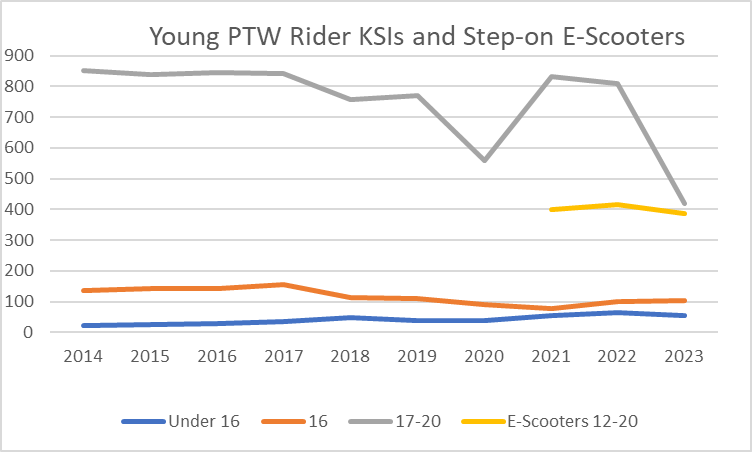
Over the past 10 years, we have seen an average of 1 death/year of a rider below 16 years. But the situation appears to be worsening.
There are an average of 3 deaths/year for riders aged 16. They were probably mostly riding illegally.
There are also 7 deaths/year for riders each year from 17 up to 20 years old, nearly 300 in total. There is no information available as to how many did not have a proper licence.
2014
2015
2016
2017
2018
2019
2020
2021
2022
2023
< 16
0
0
2
1
0
0
0
1
3
2
16
1
5
3
3
2
1
2
3
6
2
17-20
33
38
26
26
28
24
18
29
36
35
50cc A1 mopeds aren’t the major issue, but 125 cc A1 motorbikes are. They don’t need to have anti-lock brakes that larger capacity bikes now have to – which makes no sense.
Young riders are mainly a risk to themselves. They are simply demonized by The Press as ‘anti-social’. This view is taken rather than seeing them as children at serious risk.
Young Rider KSI’s 2018 and 2022
Many young riders at 17 move from a 50cc 28 mph twist and go, to a geared 125cc motorbike. They can now easily ride at 60 mph with no extra training. Out they go onto A roads and the countryside at considerable personal risk. KSI’s now more than double.
The number of KSIs of underage riders, 16 and younger, is nearly static. In contrast, overall KSIs for this age group has declined by 25% over the last 4 years. But the underage problem appears to be unaffected.
E-Scooters
In 2022, 440 E-Scooter riders were seriously injured. The highest frequency was in the 10-19 years age group. Estimates suggest that about 150 young riders sustained serious injuries. These account for approximately one-third of all injuries. (Government E-Scooter Fact Sheet).
E-Scooters look to have increased 16 years and younger young rider fatalities by >50%, and KSI’s by 400%.
E-Scooters apparently look set to be legalised.
The average E-Scooter rider age is 16 years, youngest 11 years or less.
There are probably now 1.5 million E-Scooters in the UK.
To date, 50 E-Scooter riders and 1 pedestrian have been killed. An unknown number, but probably at least 500/year seriously injured.
TRL research confirmed the poor braking on E-Scooters. The kerb height they can negotiate has had to be reduced. It has been lowered from the standard 10 cm to 3 cm. This puts riders at risk. And that they are unstable, generally poorly maintained needing constant brake adjustment, had steering faults and underinflated tyres.
For local Government rentals, the Dft doubled the braking distance standard for E-scooters. When all other vehicles would have stopped from 15 mph, an E-Scooter would still be doing 11 mph. Speed related fatalities start at 9 mph.
You can buy an E-Scooter capable of close to 50 mph. Others are easy to tamper with to de-restrict. >40 mph is possible.
The obvious alternatives are E-Cycles. They are legal at 14 years and can stop to Highway Code standards. E-Cycles can also negotiate standard kerbs and use less energy. You have to pedal, which also helps fitness.
I agree there are potential opportunities for exploiting psychology and technology to address road safety issues.
However, we are already struggling with the ‘PlayStation Generation’, who are simply used to ‘respawning’, Grand Theft Auto, Rocket League etc.
When I received my advanced riding training 15 years ago, I was initially baffled at what the hurry was, but came to realise it was primarily a game. A to B as quickly as possible without breaking any laws, followed by an instruction to read through the Highway Code again and separate the ‘should nots’, (that I could ignore), and the ‘must nots’, (that I couldn’t). Take every reasonably safe chance to overtake or filter through the traffic. On the plus side, it certainly means you pay proper attention at all times.
It seems to have thankfully changed over the years with less emphasis on ‘making good progress’.
‘For most of this century behavioural psychology has been conspicuously applied to almost every area of our lives’.It has – since the 1970’s when post war production caught up with demand, it has been harnessed by Marketing to make us buy stuff we don’t need, researching and developing the brands we all love – for some unfathomable reason – for a while anyway. (I did my MBA in Marketing in the early 90’s. There were then a number of ‘Buyer Behaviour’ models in use, which probably now run into many 1,000’s).
Psychology clearly has been very effective at helping marketeers manipulate buyer behaviour. I think most people realising how customers are psychologically manipulated, would be horrified. How many times have we all got home with something wondering why you bought it – clothes bought that you’ve never worn.
Does the public know that car adverts in the old glossy newspaper supplements didn’t actually sell cars? They were actually there to address ‘post purchase dissonance’, reassuring buyers that they’d made the right choice and that the brand reflected their values. It’s all about brand loyalty. The cost to the economy must run into £billions every year, which we all pay for by often grossly inflated prices.
Psychology also hasn’t apparently made the world a safer place. The biggest killer of young males is still suicide. Suicides overall in the UK have shown at best a flat trend since 2006, despite I am sure the psychology profession’s best efforts. 6,588 suicides in 2022 against 1,711 road deaths – 350 motorcycle riders.
‘….technological advancements in vehicle safety have made great strides in reducing the UK’s stubbornly high road traffic collision statistics’. Very true, but there has been no significant improvement in reported road fatalities since 2009 despite the replacement of older vehicles with new, complete with ABS, airbags, stability control, automatic braking etc.etc. should result in steady improvements. The root causes probably have remained firmly embedded and unchanged, or maybe getting worse.
The focus on the dangers of speeding for the 5 years from 2003 seems to have worked – then nothing.
I’d just responded on LinkedIn to a post on ‘Automated Behavior’ as follows, which seems to apply here as well:-
‘Psychology rapidly gets too complex and convoluted. Maslow is probably the simplest and most useful model. The primary human motivation is for safety, we just need to constantly remind road users how unsafe the roads really are, and how easy it is to kill or maim yourself, family and others’.
We’ve used Transactional Analysis in our training, and more recently ‘The Chimp Paradox’, the idea actually came from Professor Peters witnessing a road rage incident. Make friends with your chimp – mine’s called Kevin. Might work for some with anger management issues which can cause unsafe behaviour. Worth pursuing to tackle the emotional behavioural issues which are already known?
This article states reasonably that ‘People need a rational reason to change their behaviour and a clear instruction on what they can do to change’. The primary base human motivation is theoretically for safety, so whilever road users feel safe, their risky behaviour will likely continue.
Everyone needs to appreciate how hazardous driving and riding is. If we started from scratch we’d never design roads where vehicles passed each other at 60 mph in opposite directions. If ‘Pub Darts’ had been invented last week, it would have immediately been banned as ludicrously dangerous – throwing darts with 2 inch sharp points across a room of semi-intoxicated people?
But we are where we are, and everyone needs to be aware and constantly reminded of the danger. Road users also need to be trained more thoroughly, rather than learning by trial and error, and well aware of the likely consequences of inattention or lack of care.
They used to put wrecked cars on public display in the past as a warning. Haven’t seen one for many years, probably found to be too upsetting. We’re letting road users drive and ride around in ‘cloud cuckoo land’:-
More than 130,000 people were injured on the roads in 2022, with 30,000 killed or seriously injured.
You and your passenger may survive a frontal 30 mph impact, providing it isn’t a tree, truck or tractor, but probably not one at 40 mph.
A 20 mph side impact will likely kill you all – so be very careful emerging from junctions.
Every second you fail to react through inattention, potentially increases your impact speed by 20 mph.
If you hit an oncoming vehicle, the impact is the addition of the speed of both vehicles. 60 mph + 60 mph = 120 mph. You’ll both be dead and not looking good either.
I note the reference to Apps and mobile technology. ‘It’s undeniable that mobile technology serves as a powerful engagement tool in today’s digital age’. I agree, I have an old ‘Road Angel’ which warns me of speed cameras and accident black spots. Build this into Satnavs advising road users of previous serious collisions points as they approach them. Again more details will make them more impactful I think. Some already have warnings of collisions, or road blockages, or breakdowns.
Suggested Strategy
By all means use psychology – self preservation – not killing yourself, family, friends, or strangers. It needs to be hard hitting if it is to work. The need to control your ‘chimp’, or act on the roads at all times as an ‘adult’, not a ‘critical parent’ or ‘child’.
Only one life – no respawning – no second chance.
Make drivers aware of the ‘illusion of safety’ in a padded steel box, and particularly on two wheels.
Speed awareness courses to focus on ‘due care and attention’ – the failure of the driver or rider to see a bright yellow speed camera and warning signs. And the result of not reacting quickly, which is potentially far more serious than a few mph over the limit. 1 sec delay = +20 mph impact. 2 seconds potentially fatal. Fatalities start at just 9 mph.
Brutal publicity campaign stressing the importance of taking care and paying attention as above. Depict real life tragedies. I’ve been working my way through detailed reports on 39 fatal motorcycle accidents in Northern Ireland. It’s really depressing.
Put up signs where there have been fatal collisions maybe with the number and ages of those killed – names would probably be even more effective with relative’s approval, replacing wreaths and floral tributes. And whether they were pedestrians, or driving or riding a cycle, or motorbike. Make it real.
Encourage road users to look at the local on-line crash map to see where collisions occur.
Provide warnings of accident blackspots via Satnavs.
——————————————————————————————————————————————
There’s a current problem with motorcyclists being unable to brake properly, as circa 50% just skid and fall in an emergency, and half cannot achieve Highway Code stopping distances. Many riders simply won’t practise braking probably due to the fear of skidding and falling, or maybe finding out they can’t stop quickly. I’ve asked that high speed braking be added to the licence test and included in all post-test or advanced training.
I’ve used a free App called iAccel Lite which allows riders to quickly and easily brake test themselves. Not aware of many takers. I’m currently looking at a German data logging system so we can evaluate our training more objectively.
The poor lack of response to the problem of motorcycle braking and lack of enthusiasm says it all. All’s well in ‘cloud cuckoo land’. I guess a psychologist would define this as ‘denial’? This despite many knowing the risk on a PTW is 66 times higher than car driving.
An article on Transactional Analysis I had published with the journalist John Westlake in BIKE created more interest than all the others on bike riding, so maybe we’re potentially at a stage where attitudes are beginning to change which in theory is followed by changes in behaviour. Wishful thinking?
I still think it’s the simple but fatal illusion of safety in vehicles that needs addressing, and that accidents only happen to others – until they don’t.








 British Superbike School