
The Importance of the Enhanced Rider Scheme for Motorcyclists

What do riders learn by experience – trial and error?

What is not learned by experience, for which additional training is needed?

Summary

The background is a 8% increase in PTW KSI’s last year, and a recent 50% increase in young rider KSI’s. It’s currently aĺl going the wrong way.

There was a 14% increase in fatalities from 2023-24.

The DVSA data below indicates that it currently takes around 25 years, on average, for 80% of riders to master riding a motorcycle competently.

Far too long?

In order:- ‘Cornering‘, ‘Planning‘, ‘Defensive Riding‘, ‘Use of Speed‘ andOvertaking – were found as the major rider shortcomings

Braking‘ and ‘Filtering‘ also stand out as particular extra training needs.

We now know what additional training is needed, and where current learner training and testing is falling short.

The Enhanced Rider Scheme looks to be effective, well managed and subject to continuous improvement.

In contrast, no benefits were found from current ‘Advanced’ training. (Agilisys).

Government action should be considered to make DVSA ERS licensed training far more available in the interests of public safety. This could easily be achieved by making DVSA trainer licensing compulsory for all commercial trainers. This would ensure, that the training is properly and safely conducted, and focused on the priorities.

The charities working in the sector, with volunteers, should also all be working to the same official standards.


History

The DVSA Enhanced Rider Scheme (ERS) was launched in 2006. It was to provide additional safety training for licence holders, particularly those returning to riding in later years.

Up to 1989 the examiner stood by the roadside, so it is only after this date that examiners followed riders on their test.

Compulsory Basic Training (CBT) was not introduced until 1990.

Currently most riders over 50 years old will not have had any training, nor been subject to a ‘pursuit’ licence test.

Findings

This is the data supplied by the DVSA following an information request. The speed of the response shows that the DVSA have clearly been closely monitoring the ERS Scheme, on an ongoing basis.

This is, I believe, the latest 5 years of data. The first observation is how relatively few riders are attracted to the scheme. This is the only post-test training in the UK delivered by qualified licensed trainers. That it is such a small number of riders, is a concern.

The vast majority of post-test training is performed by volunteers, or untrained unlicensed trainers, mainly to Police Roadcraft standards, but also sometimes encouraging ’emergency response’ and racing practises, such as trail braking by commercial trainers.

(A recent review by Agilisys found no benefits from traditional ‘Advanced’ training).

Agilysis report on Advanced Training

There is no other published rider assessments that I can find.

DVSA Data

The bar graph shows the number of riders who needed, or who did not need, additional training following their riding assessments.

Green is needed training, Red is didn’t.

If you compare ERS attendees to the population of riders by age, you get this:-
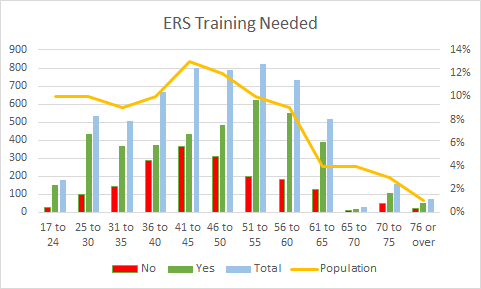
Young riders look neglected? These are at the highest risk, so it looks like an opportunity?

The ERS scheme was aimed at ‘returning riders‘ and has hit the mark.

Training needs diminish up to 45, where the number of riders peak, then increases again. Strange?

There are are also two large peaks in training needs. 17-30 and 51-65 years – the Red bars vs the Green bars.

Training needed by age

If you present the data as the percentage of riders, by age, requiring training, a rather odd profile emerges.
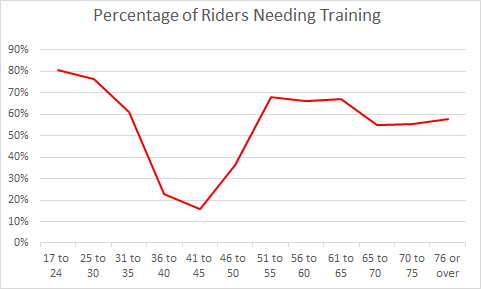
Having stared at it for some time, and initially considering it as two separate distributions, a ‘light bulb’ moment.
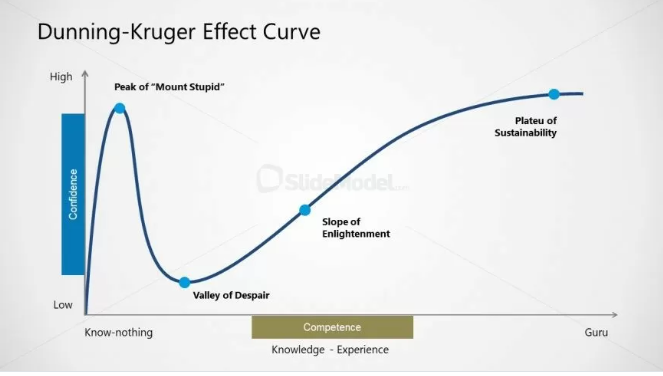
You might have come across Dunning-Kruger before. It’s the journey from:-

‘Unconsciously incompetent’ to ‘Unconsciously competent’

The theory has been applied across many different fields. In this case the ‘Y’ axis is ‘training required’ – incompetence not confidence. However, it does look like younger riders don’t seem to be looking for more training, so could be over confident?

If you flip the graph, competence is shown to peak at 41-45 years. It then deteriorates as we move into later life.

It maybe a bit misleading, as the scheme is aimed at ‘born again‘ bikers, who have a big experience gap. And these will be riders who mainly felt they needed more training.

The riders over 50 will likely not have had training or a pursuit licence test, so are essentially a different group, who are mostly untrained.

Their apparent ‘lack of competence’ is  reflected in the accident figures which are slightly higher. So there looks like there is a relationship between competence, as measured, and the risk of a collision.

Modules taken

So what additional training was found to be needed to get riders up to standard?

You can see there is no particular training needs identified. They are various. Training needs are across a wide spectrum.

Cornering‘ tops the chart, followed by ‘Planning‘, ‘Defensive Riding‘, Progress and Overtaking.

Mastering Safe Cornering on the Road, with ‘Slow In Fast Out’ Technique

Extra Modules Taken

This is where rider needs are identified, that needed extra training.

This identifies ‘Braking‘ as the main need – more than a third of riders, and nearly twice the demand of the next module. Braking from higher speeds is not part of the licence test – just from 30 mph.

Probably circa 50% of riders cannot meet Highway Code braking distances from higher speeds, and many skid and fall in an emergency. It is encouraging that this is recognised and is being addressed.

Ultimate Guide to Emergency Motorcycle Braking

Filtering‘ is the second most popular training module, which is widely known to be hazardous.

Training vs Casualties (KSI).

If you add casualties by age (orange line), you now have a complete data set.

Young rider vulnerability is very clear. 10% of riders but 28% of the casualties.

After 30 years of age, KSIs roughly follows the rider population, with a divergence from 40-50, where the accident rate halves, before moving back to a standard KSI percentage.

So is the 40 – 50 group showing the results of experience? Or the peak of physical or mental ability? How much are older new riders part of the problem?

The answer is probably the lack of compulsory learner training and pursuit testing for the older riders, which only became compulsory in 1990.

If you look at the downward slope of the orange KSI line, there is an upward bump at 50 years which coincides with the introduction of CBT. It then continues downwards at the same slope but displaced upwards.

It will be interesting to see if this bump moves further along in the coming years.

Conclusions

It’s difficult to draw firm conclusions, but the data seems to confirm the positive impact of CBT from 1990. The ‘bump’ currently at 50 years should move along year by year?

But that currently leaves older riders at relatively high risk, which still needs addressing.

The high level of KSIs for younger riders is graphically illustrated, with a steep circa 10 year learning curve which also needs urgent action. This surely should be the priority?

The most obvious risk, which could be quickly addressed, is in young riders moving from a moped to a geared 125cc motorcycle with no additional training, despite the massively increased risk.

After 30 years old, the graph shows a steady decline in KSI’s which is probably continuous learning by experience, but at a lower steady rate.

This would seem an ideal opportunity to review learner training and testing (which will be ongoing internally within the DVSA) to address identified shortcomings in training.

Although inevitably, any major changes will have to be a political decision. This to balance the accessibility to PTWs, which are currently very high risk, with public safety.

The ERS scheme is currently poorly promoted and consequently very under-utilized, with far too few riders trained to likely have any effect. Only circa 1,000/year based on these figures.

The graph also suggests that ‘advanced’ training doesn’t currently fill the lack of learner training within older riders >50 years.

This would appear to support the recent Agilisys report, which found no benefits from advanced training.

Unqualified and unlicensed advanced trainers are currently allowed (probably illegally) to train riders commercially. This puts properly trained qualified and licensed DVSA trainers at a financial disadvantage, but more importantly potentially puts riders at risk,

The argument has always been that The Law states ‘driver‘ not ‘rider‘ trainers have to be DVSA licensed. However the CPS definition of ‘driver‘ is whoever is steering – by legal precedent I understand. This would include ‘riders’.

This could be implemented today.

The Enhanced Rider Scheme has been around for 19 years and is collecting data which will be used to improve training. The scheme has trained, tested, qualified, licensed trainers. They have a syllabus and standards to work to:- ‘Ride – The Essential Skills’. They are also regularly check tested whilst delivering the training.

https://www.gov.uk/government/publications/dvsa-enhanced-rider-scheme-syllabus/dvsa-enhanced-rider-scheme-syllabus

It only costs around £1,000 for a week’s training to obtain a DVSA trainer’s license.

Government action is needed to make this compulsory, in the interests of public safety. Motorcycle riders are the most vulnerable road users by a margin, so need the best training available.

The ERS scheme is established and proven, so just needs fully implementing, as I believe was always intended.

We now know what is needed to get riders up to standard, and what the priorities are.

Police BikeSafe assesses circa 7,500 riders per year, with 20% or 1,500 going in to take further training. RoSPA and the IAM also provide ‘advanced’ training although the total numbers are not published, nor any findings.

Are they focussing on the same identified  rider’s priority needs to stay safe, and shortcomings?

And as only 1,000 riders/year are being been ERS trained, with a population of 1.7 million, we’re all just scratching the surface.

Feedback and opinion encouraged.

Mike Abbott MBA, RoADAR (Dip), DVSA RPMT 800699, ACU Coach #62210

Advanced Rider Coaching

17.7.25

Updated 13.12.25

Improving Motorcycle Safety – A review of interventions and guidance for development and evaluation.

This report by National Highways was issued in May last year. I have recently been made aware of it via a RoADAR webinar. It’s quite brave considering how critical it is of providers.

Summary of the Reports Findings

‘In short, while there are numerous post-licence motorcycle interventions being offered in Great Britain, little has been evaluated and the evidence for what works and what does not is almost non-existent.

The findings were particularly damning regarding the level of public funding, and organisations profiting from ineffective training :-

 Effectiveness of Post-Test Training Interventions

… there is little evidence for the effectiveness of any of them to improve safety outcomes’.

Our Response

A new Proposal for a focus on ‘Machine Control’ for Post-test and Advanced Training

The proposal is to focus on embedding the key skills of Emergency Braking and Cornering. What we regard as ‘best practice’ is outlined below.

I believe the official advice on emergency braking as contained in the DVSA’s ‘Riding’ and Police Roadcraft need to be reviewed too, and revised to provide the best advice to minimise braking distances.

Official advice as how to best corner safely also needs defining and publishing.

Then both emergency braking and cornering need to be taught more effectively Consideration should be given to include, in particular, emergency braking from higher speeds – 60 mph – within the licence test.

The effect of the training can be measured, in terms of braking distances and lean angles.

Riders should be able to stop from at least 60 mph within Highway Code braking distances, or less (20% less or 0.9g is achievable, compared to the standard 0.7g).

Riders should also be able to lean the machine at 35 degrees or more, which is the equivalent of the standard braking force of 0.7 g.

Both can be measured using datalogging or a simple phone app – which needs designing and implementing, although iAccel is already available on Iphones. The required sensors are already in most mobile phones.

Current ‘Advanced’ Training

‘Advanced’ riding needs to be radically rethought to make it effective. The suggestion is to continue to use Police Roadcraft as a basis, with appropriate changes to emergency braking (close the throttle first and keep the front brake applied as hard as possible until stopped).

The ‘downside’ of the involvement of police riders needs to be identified, openly discussed and tackled. This is encouraging riders to ignore the Highway Code ‘should nots’, and to make ‘good progress‘, taken from emergency response practices. Riders should never be in a hurry.

Riders should not be expected to take every opportunity to overtake or filter. They should not routinely filter right to the front of traffic queues and race away. Riders should stay out of all cross hatched areas unless this has clear safety benefits, and not overtake by riding straight ahead from RH turn lanes etc. etc.

Proposed Advanced training

This for a new focus on machine control, in addition to just Police Rider Roadcraft. The road positioning advice is good, but new planning advice is needed based on ‘invisibility’. There is also additional advice on ‘buffering’ in the New South Wales motorcycling manual, which is free to download.

1. Emergency braking

2. Cornering

3. Invisibilty.

The Report

Seems to focus on complex behavioural issues and misses the basic ‘nuts and bolts’ of the problem, and machine control.

To be fair to everyone involved, the problem is that our very poor crash reporting system focusses on blame and prosecutions, not root causes. This also needs urgently addressing to confirm assumed root causes.

The hidden problem with motorcycle riders, is that many can’t brake or take bends properly and confidently. This may be 80% of the problem, from a personal sample of 500 road riders and over 2,500 riders trained on-track. Very easy to confirm. 

This is incredibly frustrating for me, having presented on Emergency Motorcycle Braking at the IJMS and the RSGB National Road Safety Conference last year, and recently tried again at the Motorcycle Conference this year to raise just Emergency Braking as an issue, with no response from anybody.

The report barely mentions ‘control’. It fails to evaluate any improvement in machine control or any motorcycle training in ‘other environments’ as proposed by the DVSA. 1,000’s of riders every year are trained on-track or off road by many providers, often the major manufacturers, which are likely to lead to positive outcomes in improved machine control, fewer crashes and better outcomes.

Emergency Braking

I now find that the suggested focus on emergency braking for motorcycles was already recommended in this report earlier last year, and has also apparently been completely ignored.

‘With the lack of clear evidence for post-licence motorcycle intervention content, it may be necessary to consider lessons learned from driver training. Historically, advanced driver training focused on teaching complex lower-order skills, such as advanced vehicle control in emergency situations like skidding or braking’. 

One of my early trainees was Kashi who had a very bad crash through being unable to brake in time. So we used a local quarry access road. He literally couldn’t brake to save his life. It took 10 mins to nearly halve his braking distance from 60 mph. 

I’ve found the same with many riders, and typically they can reduce their braking distances by at least 20% after training.

There is research that confirms riders inability to brake. 50% cannot even meet Highway Code braking distances. We recently confirmed this with advanced riders from our local IAM group (SAM). We’ve also had riders who never use their front brakes, which is like driving a car just using the handbrake.

Crash outcomes are obviously very sensitive to impact speeds, particularly for riders, who are usually thrown from their machines.

Cornering

This is largely ignored in the report, but the problems are included in a quoted paper.

Crundall, D., Stedmon, A. W., Crundall, E., & Saikayasit, R. (2014). The role of experience and advanced training on performance in a motorcycle simulator. Accident Analysis & Prevention, 73, 81-90. https://doi.org/10.1016/j.aap.2014.08.009.

However, any police force will confirm this, as will Youtube.

The only problem is referring to ‘the racing line’ without really understanding what it is. It’s probably the largest available radius through any bend. It’s rarely used in racing, appears in the 1970’s Police Motorcycle Roadcraft, but has since been removed. 

There are no proposed cornering lines in any official publication, just positions to get the best view in Roadcraft. So it cannot be a surprise that bends are a major cause of crashes.

Invisibility

Riders need to understand that other road users may not see them. The reasons are complex, and dependent on circumstance, but a rider must never assume that they have been seen.

Hazard awareness has been the long term focus, but we now need to train riders not only to recognise, but how to react to hazards.

This involves closing the throttle, covering the brakes, changes in speed and road position ready for evasive action, and light pressure on the rear brake to warn following vehicles.

What’s missing?

What is very obviously missing is any assessment of the ability of riders to control their machines. Bikes look simple, but are actually extraordinarily complex, difficult to understand, and to ride competently. There has been no attempt to evaluate what level of control is needed, or what the various groups of riders have. Or what ‘experience’ provides to riders, but finds that the level of ‘hazard awareness’ which is currently the main thrust of interventions, varies little from novices to advanced riders.

The Report

The report is a competent comprehensive professional review of all the various ‘legal’ road training initiatives from 20 providers. From Advanced Training from RoSPA, to Street Spirit (Essex). The unlicenced, unapproved post-test road training industry has understandably been missed out, but there is nothing to suggest that this would be any more effective, the methodologies being likely the same.

The ‘Executive Summary’ finds that none of these programmes, many publicly funded, have any measurable positive effect on casualty reduction

‘While there is some evidence of best practice from international literature, this work suggests that either the adaptation of existing resources, or new resources, need to start with a detailed mapping exercise to bring it in line with best practice in other areas of public health.’

The seriousness of the situation is made clear in the report:-

 ‘In 2022, the fatality rate per billion passenger miles for motorcyclists was 114 across Great Britain. In comparison, for car occupants it was 2, and for pedestrians and cyclists it was 27 and 23 respectively’. 

The report mentions GDE from the 1990s, which is described as a ‘pivotal framework’.

The report then identified the one single intervention on ‘Basic Vehicle Control’, which was Motorcycle Cornering Advice from RoSPA. Only 4 out of 20 initiatives that had any self evaluation content regarding machine control.

Nothing at all on braking (or any more on cornering). I believe the problem is the lack of understanding of bike control by non-riders, who probably assume motorcycles are just like cars. You just stamp on the brakes if you need to stop, or turn the wheel to corner.

The report doesn’t identify properly what constitutes ‘Basic Vehicle Control’, which is it’s major flaw.

Hazard Awareness

Results found that while advanced riders performed better (i.e. reacted quicker at identifying hazards) than experienced riders, they were not significantly better than novice riders’.

The evidence for hazard perception training with motorcyclists is limited and paints an unclear picture. Logically hazard perception is a key skill that is likely related to crash risk, but the relationship with experience is not as consistent as with findings from the driving literature. It seems intuitive that some form of hazard awareness training should be beneficial for post-licence riders, whether they are novices, returning riders or simply experienced riders, but the best approach to this has not been demonstrated.’ 

There are two Road Safety Trust funded projects looking to address hazard awareness due later this year. But we suspect that the issue is rider control and the ability to react appropriately. The problem with standard hazard awareness tests, are that riders just have to push a button on a keyboard or screen.

 Effectiveness of Post-Test Training Interventions

… there is little evidence for the effectiveness of any of them to improve safety outcomes’.

Four possible reasons are explored:

1. Poor evaluation and reporting.

2. Not all motorcyclists are the same.

3. Interventions are unrelated to crash outcomes.

4. Design of content and/or delivery is not effective.

This report identifies a TRL report undertaken for clients which was not published, presumably due to the findings:

“In 2019, TRL reviewed a set of four rider training courses (aimed at riders from novice through to experienced) and compared course content with main crash types. The (unpublished) report for the client noted inconsistencies in the ways in which the ridertraining courses introduced and covered these main crash types.”

https://www.trl.co.uk/news/predictable-nature-of-motorcycle-collisions

Without transparent publication of all evidence, whether good or bad, it is impossible to develop a weight of evidence and learn lessons’. 

The above report appears to have been suppressed by the organisations who funded it, presumably due to the poor outcomes.

OPINION: It’s time to bring gamification into the road safety spotlight.

In response to https://roadsafetygb.org.uk/news/opinion-its-time-to-bring-gamification-into-the-road-safety-spotlight/

I agree there are potential opportunities for exploiting psychology and technology to address road safety issues.

However, we are already struggling with the ‘PlayStation Generation’, who are simply used to ‘respawning’, Grand Theft Auto, Rocket League etc.

When I received my advanced riding training 15 years ago, I was initially baffled at what the hurry was, but came to realise it was primarily a game. A to B as quickly as possible without breaking any laws, followed by an instruction to read through the Highway Code again and separate the ‘should nots’, (that I could ignore), and the ‘must nots’, (that I couldn’t). Take every reasonably safe chance to overtake or filter through the traffic. On the plus side, it certainly means you pay proper attention at all times.

It seems to have thankfully changed over the years with less emphasis on ‘making good progress’. 

‘For most of this century behavioural psychology has been conspicuously applied to almost every area of our lives’. It has – since the 1970’s when post war production caught up with demand, it has been harnessed by Marketing to make us buy stuff we don’t need, researching and developing the brands we all love – for some unfathomable reason – for a while anyway. (I did my MBA in Marketing in the early 90’s. There were then a number of ‘Buyer Behaviour’ models in use, which probably now run into many 1,000’s).

Psychology clearly has been very effective at helping marketeers manipulate buyer behaviour. I think most people realising how customers are psychologically manipulated, would be horrified. How many times have we all got home with something wondering why you bought it – clothes bought that you’ve never worn. 

Does the public know that car adverts in the old glossy newspaper supplements didn’t actually sell cars? They were actually there to address ‘post purchase dissonance’, reassuring buyers that they’d made the right choice and that the brand reflected their values. It’s all about brand loyalty. The cost to the economy must run into £billions every year, which we all pay for by often grossly inflated prices.

Psychology also hasn’t apparently made the world a safer place. The biggest killer of young males is still suicide. Suicides overall in the UK have shown at best a flat trend since 2006, despite I am sure the psychology profession’s best efforts. 6,588 suicides in 2022 against 1,711 road deaths – 350 motorcycle riders.

Describing painting ‘centre lines and direction arrows’ on a road as ‘psychology’ is stretching things a bit. 

‘….technological advancements in vehicle safety have made great strides in reducing the UK’s stubbornly high road traffic collision statistics’. Very true, but there has been no significant improvement in reported road fatalities since 2009 despite the  replacement of older vehicles with new, complete with ABS,  airbags, stability control, automatic braking etc.etc. should result in steady improvements. The root causes probably have remained firmly embedded and unchanged, or maybe getting worse. 

The focus on the dangers of speeding for the 5 years from 2003 seems to have worked – then nothing. 

I’d just responded on LinkedIn to a post on ‘Automated Behavior’ as follows, which seems to apply here as well:-

‘Psychology rapidly gets too complex and convoluted. Maslow is probably the simplest and most useful model. The primary human motivation is for safety, we just need to constantly remind road users how unsafe the roads really are, and how easy it is to kill or maim yourself, family and others’.

We’ve used Transactional Analysis in our training, and more recently ‘The Chimp Paradox’,  the idea actually came from Professor Peters witnessing a road rage incident. Make friends with your chimp – mine’s called Kevin. Might work for some with anger management issues which can cause unsafe behaviour. Worth pursuing to tackle the emotional behavioural issues which are already known?

This article states reasonably that ‘People need a rational reason to change their behaviour and a clear instruction on what they can do to change’. The primary base human motivation is theoretically for safety, so whilever road users feel safe, their risky behaviour will likely continue. 

Everyone needs to appreciate how hazardous driving and riding is. If we started from scratch we’d never design roads where vehicles passed each other at 60 mph in opposite directions. If ‘Pub Darts’ had been invented last week, it would have immediately been banned as ludicrously dangerous – throwing darts with 2 inch sharp points across a room of semi-intoxicated people? 

But we are where we are, and everyone needs to be aware and constantly reminded of the danger. Road users also need to be trained more thoroughly, rather than learning by trial and error, and well aware of the likely consequences of inattention or lack of care.

They used to put wrecked cars on public display in the past as a warning. Haven’t seen one for many years, probably found to be too upsetting. We’re letting road users drive and ride around in ‘cloud cuckoo land’:-

  • More than 130,000 people were injured on the roads in 2022, with 30,000 killed or seriously injured.
  • You and your passenger may survive a frontal 30 mph impact, providing it isn’t a tree, truck or tractor, but probably not one at 40 mph.
  • A 20 mph side impact will likely kill you all – so be very careful emerging from junctions.
  • Every second you fail to react through inattention, potentially increases your impact speed by 20 mph.
  • If you hit an oncoming vehicle, the impact is the addition of the speed of both vehicles. 60 mph + 60 mph = 120 mph. You’ll both be dead and not looking good either.

I note the reference to Apps and mobile technology. ‘It’s undeniable that mobile technology serves as a powerful engagement tool in today’s digital age’. I agree, I have an old ‘Road Angel’ which warns me of speed cameras and accident black spots. Build this into Satnavs advising road users of previous serious collisions points as they approach them. Again more details will make them more impactful I think. Some already have warnings of collisions, or road blockages, or breakdowns.

Suggested Strategy

By all means use psychology – self preservation  – not killing yourself, family, friends, or strangers. It needs to be hard hitting if it is to work. The need to control your ‘chimp’, or act on the roads at all times as an ‘adult’, not a ‘critical parent’ or ‘child’.

Only one life – no respawning – no second chance.

Make drivers aware of the ‘illusion of safety’ in a padded steel box, and particularly on two wheels.

Speed awareness courses to focus on ‘due care and attention’ – the failure of the driver or rider to see a bright yellow speed camera and warning signs. And the result of not reacting quickly, which is potentially far more serious than a few mph over the limit. 1 sec delay = +20 mph impact. 2 seconds potentially fatal. Fatalities start at just 9 mph.

Brutal publicity campaign stressing the importance of taking care and paying attention as above. Depict real life tragedies. I’ve been working my way through detailed reports on 39 fatal motorcycle accidents in Northern Ireland. It’s really depressing.

Put up signs where there have been fatal collisions maybe with the number and ages of those killed – names would probably be even more effective with relative’s approval, replacing wreaths and floral tributes. And whether they were pedestrians, or driving or riding a cycle, or motorbike. Make it real.

Encourage road users to look at the local on-line crash map to see where collisions occur.

Provide warnings of accident blackspots via Satnavs.

——————————————————————————————————————————————

There’s a current problem with motorcyclists being unable to brake properly, as circa 50% just skid and fall in an emergency, and half cannot achieve Highway Code stopping distances. Many riders simply won’t practise braking probably due to the fear of skidding and falling, or maybe finding out they can’t stop quickly. I’ve asked that high speed braking be added to the licence test and included in all post-test or advanced training. 

I’ve used a free App called iAccel Lite which allows riders to quickly and easily brake test themselves. Not aware of many takers. I’m currently looking at a German data logging system so we can evaluate our training more objectively.

The poor lack of response to the problem of motorcycle braking and lack of enthusiasm says it all. All’s well in ‘cloud cuckoo land’. I guess a psychologist would define this as ‘denial’? This despite many knowing the risk on a PTW is 66 times higher than car driving. 

An article on Transactional Analysis  I had published with the journalist John Westlake in BIKE created more interest than all the others on bike riding, so maybe we’re potentially at a stage where attitudes are beginning to change which in theory is followed by changes in behaviour. Wishful thinking?

I still think it’s the simple but fatal illusion of safety in vehicles that needs addressing, and that accidents only happen to others – until they don’t.