Advanced training is mostly based on Police Motorcycle Roadcraft and Police Class 1 riding standards.
Roadcraft doesn’t cover in any detail modern advances in motorcycle design and dynamics, which present new problems and opportunities.
Cornering in particular is somewhat over simplified, no particular ‘lines’ are suggested (since the 1970’s version of Roadcraft) apart from riding around the outside of corners to get a better view ahead. The problem with this, is it puts you close to the scenery or oncoming traffic all the way around the corner.
There are techniques that are routinely used in road racing that can be employed in an emergency, particularly trail braking using the front brake into corners, when you misjudge your entry speed, or encounter a hazard before you enter.
Learning how to change body position to increase ground clearance when leant, can be vital on many bikes, and can be the difference to making it around a corner – or not.
Modern tyres have unbelievable levels of grip to most riders, who often lack the experience and confidence to lean a bike anywhere near as far as they safely could, again making them vulnerable if they need in an emergency to turn at a faster rate.
It is also important to be always in the correct gear, and not rely on ‘block shifting’ as you come to a halt. You can do this by employing a slipper clutch if you have one fitted, or blipping the throttle to match the engine speed to the lower gear on downshifts.
It helps if you are professionally coached in these techniques and others, and given an opportunity to practise in a safer environment than the road, if you are to be as safe as you can be.
Many riders struggle with having the confidence to achieve higher lean angles on a motorcycle. This is the major issue we have to address at The School.
Modern tyres, given a reasonable surface, have an extraordinary level of grip. This is true even in the wet, as long as you are smooth. You can usually lean a modern motorcycle until something scrapes. The foot pegs should scrape first. They then usually start to fold upwards. This gives you prior warning of leaning too far.
Everyone seems to have their own ‘preset’ maximum lean angle over which they find it difficult to go.
If you’ve been riding motorcycles for many years, you would have started on tyres that had far less grip. You were also likely to have come a cropper in the past when they let go.
Many riders have serious accidents failing to make corners, particularly on left hand bends. They could have made the corner, had they simply had the necessary confidence. However, it’s not sensible to habitually use high lean angles on the road – this should be your safety margin.
So how cornering ‘presets’ be altered, and more confidence found?
Firstly we’ve found that looking into the distance helps with balance. Keep your eyes ‘on main beam’. Look as far down the road or track as you can see. Keeping your head up seems to help.
Secondly relaxing, with a light grip on the bars, letting the steering make small corrections.
Thirdly, ride smoothly. Make sure you change down into a lower gear before the corner. Don’t accelerate hard until the corner starts to open out. Then, open the throttle smoothly.
We’ve also found that as riders increase their lean angles, they can confuse the suspension compressing with the bike sliding. Riders need to get comfortable with this. It just takes some time and practice. This gives a false impression of the limit being reached. Once you get used to the bike dipping, it’s not a problem.
On the road, you need to finish braking before you turn. This is unlike on a track where you trail the brakes deep into the corner. This can provide some more safety margin on the road in an emergency. However, it takes time and practice to master.
Tyre grip – the trade off between cornering and braking/accelerating
You can see from the drawing above. You can still have up to 45% of cornering grip available at 45 degrees of lean (dark green area). It diminishes rapidly after that. You can still have grip available with care for accelerating or braking even at this angle (includes both dark and light green areas).
This is Mohr’s Circle of grip and assumes 60 degrees is the maximum lean angle, in ideal dry conditions on a race track, using soft track tyres.
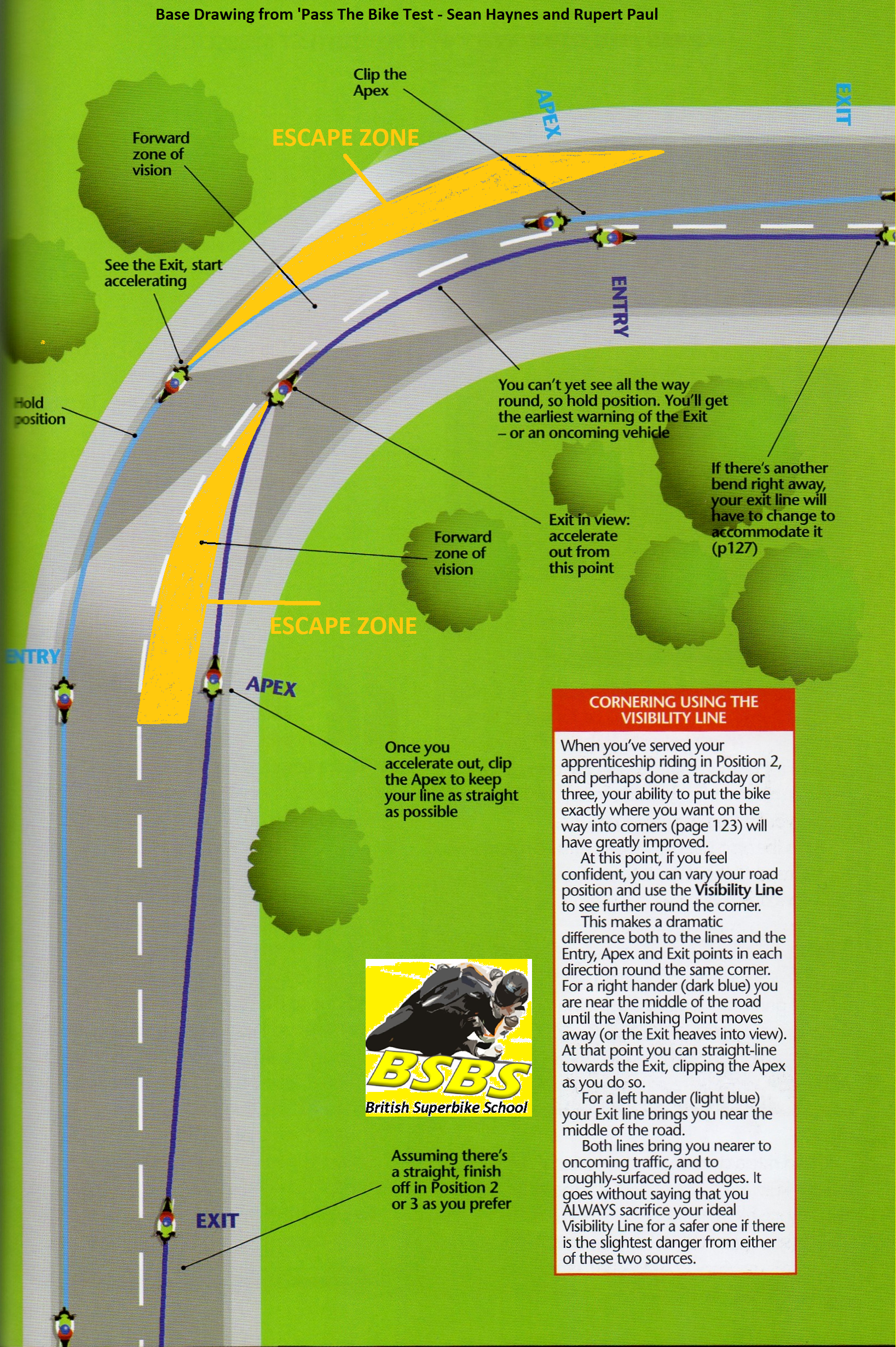
We also suggest you use this approach to cornering on the road or track – slow in, fast out – using the diagram below. It is based on a drawing from Rupert Paul’s Book – ‘Past Your Bike Test’. The yellow ‘escape zones’ have been added.
While riding a bike on the road, you can improve your safety by having the yellow safety margins. As you counter-steer to turn the bike tighter towards the apex, you will reach maximum lean for a short period of time. You also have the flexibility to turn a bit later and harder, maintaining the higher lean angle, but only for a short distance. After that, the lean angle reduces as you pick up the bike by smoothly applying the throttle.
The key is always riding smoothly – no sudden moves.
Clipons allow you to lie flat on the tank, making you more aerodynamic which is why they are fitted to most race bikes.
Higher bars are more comfortable as the rider stays upright in the saddle. They also allow the rider to move his weight backwards and forwards more, which is why they are fitted to off road bikes.
Ape hangers are mainly for show, and can be painful without a back rest.
Yes, having ridden a Press bike last November at Blyton Park.
It can be restricted so can be ridden on an A2 licence in the UK.
It handled really well, the engine has good mid range power making it easy to ride, and the brakes are very good.
You can adjust the suspension, so we dialled in some more preload on the front forks, which significantly improved the handling on the track, but might be a bit harsh on our poor potholed roads.
A really great good looking mid range comfortable sportsbike.
You can hire one on our track training days if you want to put one through its paces before you buy.
Modern motorcycles are designed to run on low octane fuel, so there is probably little benefit and more cost using premium gas.
You might get a little more performance and mileage, but probably not significant.
However, some older motorcycles can be damaged by using the new standard E10 fuel which has 10% biofuel which can attack plastic parts in the fuel system.
Check with the manufacturer.
Premium fuel would overcome this.
Classic motorcycles tend to need premium gas to stop detonation which damages the engine, and may also need an additive to prevent valve wear.
The main problem is if your motorcycle has a wet clutch which is lubricated by engine oil, as modern low friction oils will probably make it slip.
Motorcycle oils are different and more expensive than car oils, so many riders use car oil in their bikes. I’ve never had any issues using car oil in road bikes, but I would suggest using proper competition motorcycle oil in racing and trackday bikes.
Semi synthetic oils won’t affect the clutch, nor will normal fully synthetic oils.
It’s important to use the correct viscosity, and change regularly it to the manufacturers instructions.
You can sometimes hear the tappets rattling at the top of the engine due to excessive clearance caused by wear, but some particularly old design engines rattle anyway when the clearances are correct.
However, the real danger is the valve clearance closing due to valve seat wear, which you cannot hear, and only becomes noticable when performance drops off and the engine can be dificult to start.
By then its too late and the sealing faces on the valves will be burnt and no longer sealing properly, requiring a major strip down and rebuild.
So it’s important to check valve clearances regularly according to your workshop manual, which involves removing the top engine cover and checking with a feeler gauge. It’s an expensive job to have done due to the skill and time it takes, as many engines require re-shimming rather than adjustment, but you can do it yourself with care.
Plug fouling was a common problem with two strokes. They always needed to be changed more often.
Old racing two stroke engines fouled very easily at low revs, as they were set rich to enable them to start and run at low revs, below the designed power band at high revs where they ran efficiently.
It depends on the design, reed valve engines tended to have less problems than piston ported or rotary valve engines.
Modern synthetic oils at a higher mix ratio often helps to reduce soot and fouling. Please note you can’t mix vegetable oil (Castrol R etc) with synthetic oil.
The other problem is worn or badly setup carburettors, particularly worn slide needles and jets which produce a richer mixture.
FI/DI was tried in the past without mainstream success, and development largely stopped due to the difficulty of meeting emission regulations.
However, KTM make fuel injected off road two stroke bikes, so it can be done.



 British Superbike School