

PROPOSALS
- Riding Tests to include:-
- emergency braking from 60 mph (currently 30 mph).
- Current DVSA advice on emergency braking to apply front brake before the rear to be reviewed and changed to applying both brakes at same time
- ABS to be mandatory for all PTWs over 50cc, specifically including 125cc which are currently exempt, as these are the PTWs that riders learn to ride on.
This paper covers in detail, one aspect of a proposed new strategy from the original post – https://britishsuperbikeschool.com/2023/12/15/response-to-mcia-ceo-tony-campbells-call-for-a-major-rethink-on-motorcycle-safety/
Further posts will be forthcoming on the other proposals. In particular:- cornering, trail braking, pre-emptive interventions, trainer training, new risk awareness campaigns, and the control of new road accesses. A previous post covered E-Scooters and E-Bikes.
https://britishsuperbikeschool.com/2023/09/10/e-scooters-and-e-bikes/
recommendations on Emergency straight-line braking
This is based on findings over a decade of training, that very few riders can brake effectively in an emergency, from speeds above 30 mph.
- New and existing riders to be trained properly in high speed emergency braking in a straight line.
- This requires firstly identifying what ‘best practise‘ is, and revising and improving existing official publications – notably ‘Police Motorcycle Roadcraft’ and ‘Riding – the Essential Skills’ in which the advice conflicts. Both publications are also currently considered to be misleading. Advice should be based on research and the science.
- Additional trainer training is probably required to support this. This could be problematical as there are currently no legal restrictions on the provision of post-test or advanced training to other riders commercially, which is another issue that could be addressed.
- Existing riders, many of whom are reluctant to pursue ‘advanced‘ or ‘enhanced‘ training, to be targetted by a revised ‘RIDE’ course, as an alternative to prosecution for any collision, (which should be pursued more enthusiastically), and/or following prosecution for any riding offence including ‘speeding’. And preferably in advance of a collision, via effective road policing which is close to non-existence locally, or by using CCTV and video footage from dash cams etc.
- A publicity campaign advising best practise should be considered.
1. Riding test to include Emergency braking from 60 mph (currently 30 mph).
The prime road safety strategy for the past few years has been to get road users to THINK! and also address ‘Speeding’, which has had apparently little effect on collisions, despite most road users visibly going more slowly than they did. It’s also convenient as it requires very little resources, and is more than covered by the revenue through prosecutions and ‘Speed Awareness’ courses. However, regarding collisions, speeding is only one of 4 major factors, which also include;-
- Hazard Awareness (paying proper attention)
- Reaction Time
- And critically, regarding motorcycles, being able to brake effectively in the shortest possible distance, as almost all other vehicles have anti-lock brakes and don’t tip over under heavy braking. (Bicycles, E-Cycles and E-Scooters have the same issues, but clearly this won’t be picked up by speed cameras).
An opportunity of biblical proportions, bearing in mind the many millions who have attended a speed awareness course, is being missed to tackle the other issues, primarily ‘paying proper attention’ because if they were, then they would not have been on the course in the first place. That these are focussed on marginal speeders, not those speeding excessively, makes no sense. Speed cameras and camera vans are quite easy to spot.
Many, maybe most motorcycle riders from experience, cannot stop effectively from higher speeds. Additional independent research is urgently needed to confirm this.
There is no obvious easy way of recognising the failure to apply the brakes and reduce speed effectively as a contributory factor in most collisions, so it is probably a significant hidden factor which remains unidentified and unaddressed. The second cause when the rider skids and falls prior to the collision will be recognised, as it would result in evidence of sliding on road, bike and rider, and a different impact. Presumably failing to brake properly can also remain unidentified within ‘Loss of Control‘ which is a major factor, or ‘Inexperienced rider‘, or ‘Riding too fast for the conditions’.
A large number of collisions also have no determined contributory factors.
Unlike a modern car or truck, a motorcycle requires training, skill and practise to be able to stop to even meet Highway Code braking standards.
Car drivers are used to just stamping on the brakes in an emergency, as almost every car or truck now has anti-lock brakes (ABS), whereas only new, or some earlier motorcycles over 125cc, have ABS.
A sports car on soft grippy tyres can stop at close to half the distances as outlined in the Highway Code. A motorcycle cannot.
Cyclists have often skidded and fallen, or gone over the handlebars after applying the front brake, so many moving to motorcycling then avoid using the front brake firmly, or for some riders, at all.
Braking from 30 mph only takes about 1.5 seconds, so feels almost instant. Braking from 70 mph takes over 3 seconds, is more physical and potentially more frightening and challenging. The equivalent of doing a ‘handstand’.
Speed of impact clearly effects the level of injury, so losing at much speed as quickly as possible is key to reducing KSI’s.
A 30 mph impact is probably survivable, a 40 mph impact, probably not.
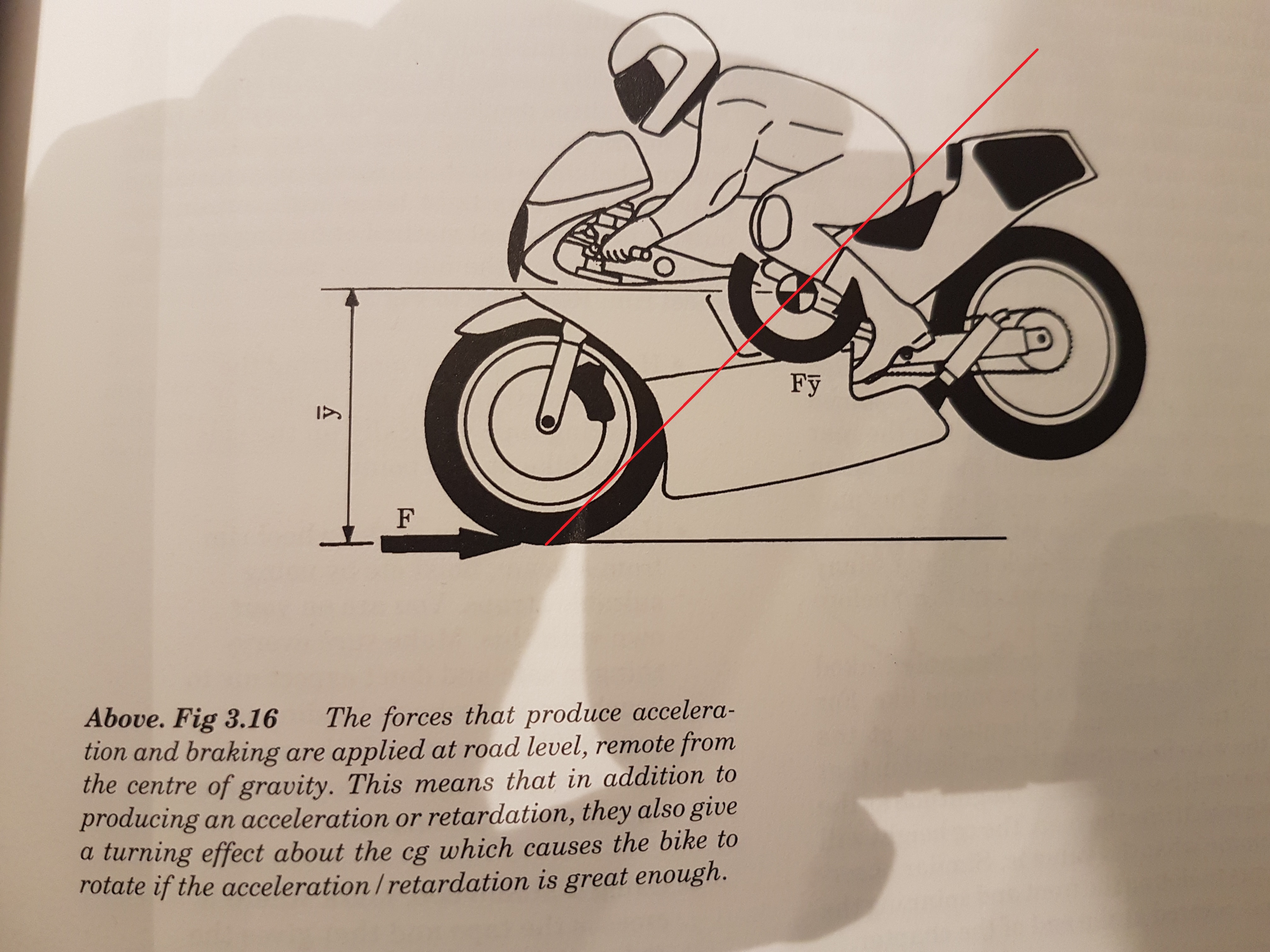
Motorcycles cannot stop as quickly as cars, as the limiting factor is not tyre grip but the motorcycle tipping forward, with the maximum retardation available just on the point of tipping.

(From John Bradley’s, ‘The RacIng Motorcycle’)
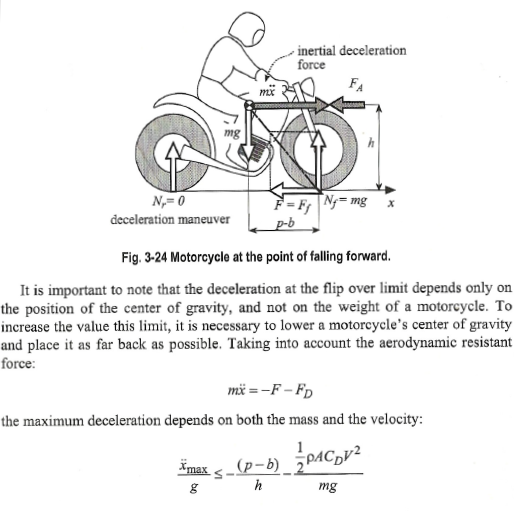

(From ‘Motorcycle Dynamics’ by Vittore Cossalter)
This theory needs to be confirmed and officially developed into ‘best practise’, although it broadly supports the opinions expressed below.
Riders therefore need to be trained in the correct technique, recognise what is happening when they brake, and ensure they have the confidence to apply the brakes properly. It is ‘a balancing act’.
Many riders are reluctant to use the front brake properly, or sometimes at all. This is usually due to prior experience riding bicycles, where it is easy to go over the handlebars with hard front-wheel braking. This tendency is far less on a motorcycle due to the lower centre of mass due to the engine etc. and happens far more more slowly, giving the motorcycle rider time to react, and it tends to happen more at lower speeds as the rider comes to a halt.
Many riders also appear to be unaware of how quickly they can actually brake, particularly in wet conditions. Modern tyres have far more grip than many older riders believe. As long as you apply the brakes more carefully initially, there is still sufficient grip to get the rear wheel off the ground on wet roads (equivalent to 1g) – tipping forward is still the limiting factor.
The front wheel is also very easy to lock without ABS if the front brake lever is snatched, (the effect is like the magician who pulls a table cloth from a laid table) and can nowadays be achieved with just one or two fingers on the front brake lever.
This usually results in an instant fall, although it can be released and reapplied, but again needs knowledge and practice.
Once a rider is off the bike and sliding down the road, speed is only lost in the friction between the rider and the road surface. The outcome of an impact at ground level is likely to be worse, and there is a risk of being run over by following vehicles who are often closer than the required 2-second distance as they can see easily past the rider.
The rear wheel is also easily locked, but a skid is usually controllable, although the overall braking distance will be lengthed.
Motorcycles with ABS have a system which prevents wheels locking and skids, but if the ABS is triggered it may increase potential stopping distances. However, it is probably better for new and inexperienced riders, on a bike fitted with ABS, to simply apply the brakes as hard as they can.
‘An ABS does not necessarily shorten your stopping distance, but does allow you to keep steering control and drive your vehicle more effectively.‘
https://www.tdi.texas.gov/pubs/videoresource/fsdrivingabs.pdf,
So it is still more effective to apply the brakes correctly, even on a motorcycle fitted with ABS.
‘ABS is demonstrated to reduce stopping distances and to improve stability under all braking conditions, but such features are not enough to guarantee a good braking performance in emergency events if the riders have not the skills to utilize the full braking power of the motorcycle’.
There is a debate, on-line, as to whether ABS actually shortens stopping distances, but it probably depends on the level of rider skill, which needs to be very high to beat an ABS system.
The advice is that if you do trigger the ABS with the front brake, that you have probably ‘snatched’ the front brake lever too hard initially, as once the weight has transferred to the front wheel it should only lock due to a poor road surface.
Triggering the rear wheel ABS is again due to either stamping on the rear brake, or failing to release it as the weight transfers forwards
As it states in Police Motorycle Roadcraft ‘‘If you activate the ABS ask yourself why? Are you taking greater risks. Do you need to improve your technique?“. The advice is, however, if the ABS activates do not release the brakes. Riders need to be aware of the pulsing sensation, but not to react to it. It could be mistaken for faulty brakes.
Many riders also have more than one motorcycle, with older sportsbikes being very popular, which don’t have ABS. All riders should be able to stop without the ABS being activated, although it is an invaluable safety aid, particularly for the inexperienced or unexpected slippery roads. ABS is also a useful training aid for riders to experience the point at which the tyre loses grip, without risk of skidding or falling.
The proposed correct technique for braking in a straight line is to immediately apply both brakes firmly but smoothly, with front brake lever pressure increasing while the weight transfers forwards, and the pressure on the rear brake steadily released to avoid locking the rear wheel as it unloads and potentially skids. The front brake to only be released if the front wheel locks and skids, or if the rear wheel lifts off the ground (which riders can be trained to recognise).
Braking from high speed places high loads on the rider’s arms and neck, as they are thrown forward. It requires riders to grip the fuel tank with their knees and rely on their arms to stop them sliding forwards, and/or on the rear of the fuel tank stopping a slide forward.
The commonplace untrained reaction in an emergency is often to panic, intially snatching the front brake and stamping on the rear, potentially instantly locking the front and/or rear wheels. An unexpected front wheel skid with usually result in a fall. Skidding tyres significantly increase stopping distances. Alternatively, many riders can fail to apply the front brake hard enough, for fear of skidding or going over the handlebars. With a little training and practise we have found that most rider’s stopping distances can be reduced significantly, which can be critical in avoiding a collision or reducing the speed of impact.
Riders very rarely, if ever, practise emergency braking, with the first time for many usually being out of necessity.
It also appears that many riders are unaware of the relationship between speed and stopping distance, which is particularly noticeable at higher speeds on a race track as we have also found, even though it is included in DVSA advice. Most road riders speeding at say 90 mph, probably don’t appreciate it will take them twice as long to stop as it does from 60 mph.
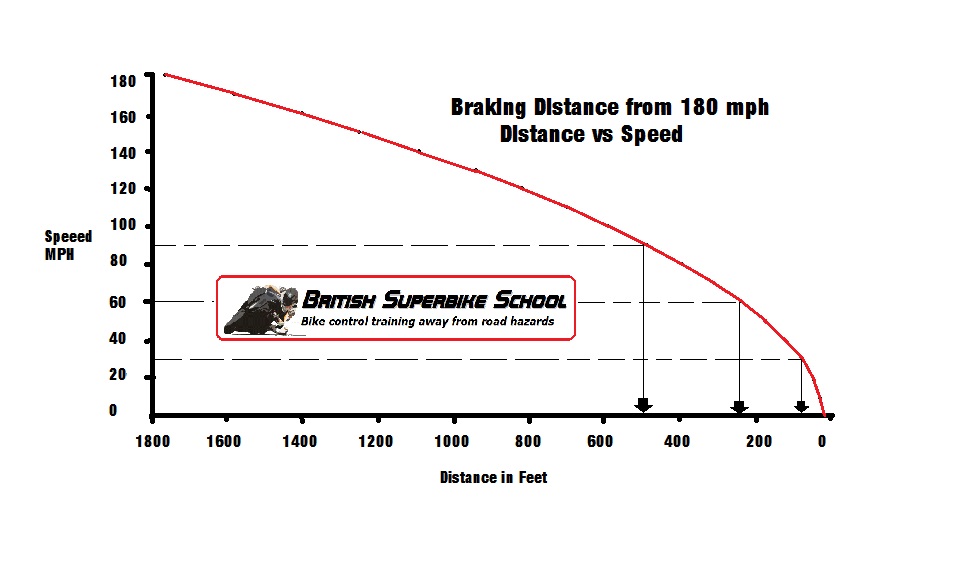
The faster they are riding, the more critical the ability to stop effectively is.
The extent that the failure to brake effectively is a cause or contributory factor in collisions is not identified at all, and is probably in most instances unknown. However, experience in post test training riders indicated this is likely a major contributory factor, particularly as it has been found that motorcyclists are more likely to be speeding.
The only obvious ways this can be confirmed as an issue, is to formally research rider braking to confirm our findings.
High speed braking should also be addressed during any advanced or post-test training, which could also be mandatory for post collision riders. From personal experience, I completed my advanced training, and post test instructor training without ever having been required to complete an emergency stop from high speed.
The existing NRRAC RIDE courses now appears to be online, and when they were in person, the training workshops were not delivered nationally, and do not seem to address rider competence, mainly behavioural problems. https://www.drivetech.co.uk/police-referred-courses/course/ride/
The course could be redesigned to also address rider competence, either in response to potential police prosecutions, or post collisions.
2. Current DVSA advice on emergency braking to apply front brake before the rear to be reviewed and changed to applying both brakes at same time
There is an issue at the moment with long standing advice from the DVSA to apply the front brake before the rear in an emergency, which marginally increases stopping distances, and has a disproportionate effect on riders who are reluctant to use the front brake, or some bikes with dual brakes, or those with a low centre of mass (cruisers).
Roadcraft alternatively tells riders to use both brakes in an emergency. Also ‘As the machine slows, gradually release the pressure on the front brake, and increase the pressure on the rear brake’. This does not seem to make any sense, as releasing the front brake will likely increase stopping distances, and increasing the pressure on the rear will likely simply lock the rear wheel. If the rider is braking hard, the rear wheel will have very little if any weight on it. This maybe a legacy issue from a few decades ago when tyre grip was poorer.
There is an argument for releasing the pressure on the front brake, not as a routine, but only in the event of a skid, or if the rear wheel has left the ground to prevent the rider tipping forward over the handlebars, which happens comparatively slowly compared to a bicycle.
All published advice needs to be supported by evidence and the physics.
There is also the clear need to address retraining and upskilling existing riders, which requires properly trained trainers, many of whom may need retraining, and there is also the current problem of reaching unqualified unlicenced commercial trainers, many ex-police.
As most riders would not voluntarily attend advanced or post-test training, this could be made mandatory for any rider involved in a collision etc.
3. Linked ABS to be mandatory for all PTWs over 50cc, specifically including 125cc which are currently exempt, as these are the PTWs that riders learn to ride on.
Only new or a few earlier motorcycles over 125cc have ABS. It is an invaluable safety aid, particularly for the inexperienced or unexpected slippery roads. ABS is also a useful training aid for riders to experience the point at which the tyre loses grip, without risk of losing control, skidding or falling.
As most 125cc motorbikes can achieve at least 60 mph, it is difficult to understand the failure to ensure that they too now are mandated to have ABS from new.
Mike Abbott
British Superbike School
Updated 5.3.24








 British Superbike School