


I’ve updated and revised this report, originally published over a year ago, following recent reports in the Press of the incoming Labour government considering legalising E-Scooters.
Conclusions
Step-on E-Scooters have been found to be by far the most hazardous form of urban transport, resulting in a number of unnecessary deaths and serious injuries, and should simply be replaced by bicycles or E-Bikes, which have been found to be 3 times safer.
That they would be unsafe, should be obvious to anyone with GCSE Physics.
The public in general already has experience of riding cycles, rather than what has clearly been painful, sometimes fatal, ‘trial and error’ riding E-Scooters.
E-Scooters could be redesigned to meet Highway Code braking standards and be able to negotiate standard 100mm kerbs as all other vehicles can. This would probably involve lengthening the wheelbase, fitting a seat and larger wheels – essentially an E-Bike with floorboards and no pedals, if pedaling is an issue.
SUMMARY E-Scooters:-
- are fundamentally unstable due to the design – based on a child’s toy.
- require at least twice as long to stop than other vehicles.
- cannot safely negotiate a standard 100mm kerb.
- use more power than an E-Bike, which has to be pedaled and also provides healthy exercise.
Recommendations
- E-Scooters should be withdrawn for rental and continue to be banned for private use on the highway, and withdrawn from sale. They also mostly do not meet the new 12 mph speed limit for rentals, some are advertised at capable of up to 50 mph. (You will probably find your travel health insurance covers you for an E-bike or a motorcycle up to 125cc, but specifically not an E-scooter. The insurance industry tends to be the experts regarding risk assessments).
- For rentals, step-through unisex E-Bikes are probably far safer than E-Scooters, and should stop in a shorter distance than a cycle due to a lower centre of mass, and in a more similar distance to a motorbike, (and also need less charging as you have to pedal).
- E-Bikes to be limited to 15 mph using regenerative braking or other means, should be fitted with hydraulic disc brakes. They should ideally have front suspension which is common place on mountain bikes to better cope with kerbs, potholes and poor road surfaces, and have a minimum 26 inch diameter wheels.
Background
A few years ago, myself and a RoSPA colleague Dave Bryant, both DVSA qualified, devised and delivered workshops based on accident data for young riders for Safer Roads South Yorkshire called ‘Twang’.
In 2023 I was approached by the National Young Riders Forum to advise on hazards to young motorcyclists. I looked to see if anything had changed, and was talking to a local youth club leader. I was told that her members now exclusively used E-Scooters, not mopeds. It appears that the hazards had shifted.
I then started looking at E-Scooters to see what I could find regarding the risks, initially for young riders.
the Problem
44 E-Scooter riders and one pedestrian died so far, mostly avoidable as the identified alternatives – walking, driving, taxi, public transport, not bothering, are all far safer – even cycling was found to be 3 x safer. Over 1,300 riders were injured, >400 seriously, which is considered to be significantly understated.
Half are being ridden by children – young riders below the age of 16.
E-Scooters are illegal, but over 750,000 have been sold in the UK supposedly for use on private land, which is a very obvious dishonest device.
They are routinely ridden on pavements with the first pedestrian death last year – a 71 year old woman knocked down and killed by a local 14 year old rider. 28% of casualties were not riders.
E-Scooters are hazardous to ride due to the small wheels making them vulnerable to potholes, kerbs, drains, etc. They have no seat, a short wheelbase, narrow handlebars and a centre of mass high above the front wheel, which makes them liable to tip forward with the rider tripping over the handlebars and steering stem. There is a particular danger of head and facial injuries. They are unstable with reports of riders falling when making hand signals.
E-Scooters, although illegal to to ride on the road, can be legally hired from many Local Councils, and seem to be extremely profitable to provide. A private scooter can be run for circa 3p/mile, a local government hired scooter cost > £1/mile to rent and even > 30p/mile with a season ticket. The overall profit generated nationally probably runs into many £millions/annum, but clearly puts the public at an unnecessary risk of injury or death.
The latest E-Scooters have the battery moved from horizontally below the deck to vertically behind the headstock, which will make them even more likely to tip up – but makes battery changes easier.
I can find no evidence of yet of this new design being officially tested, so these machines may not be able to meet the published required standards.

You can buy an E-Scooter capable of 49 mph.

The DFT standard applied to rental scooters sets the braking distances at twice that of other vehicles, and sets the kerb height that they can negotiate at 30 mm when a standard kerb is 100mm or more.
The concern is that E-scooters are offered to rent primarily because they more profitable than E-bikes, rather than safety being the priority.
E-bikes use less electricity, having circa twice the range on a single charge, are significantly safer with a seat and larger wheels, are more stable, have shorter braking distances, provide some good exercise, and are safer because most riders have already learned to ride a bicycle.
E-bikes are also safer for transporting shopping as panniers can be used, rather than a back pack which is liable to worsen the outcome of any collision.
E-Scooters could be totally replaced by ‘step through’ E-bikes, which could be made even safer still by mandatory hydraulic disc brakes, and restricting them electronically to 15 mph potentially by using electronic regenerative braking or other means. They also need to be made tamperproof with ‘firmware’, which some currently are not (from experience).
E-Bikes should have large wheels for stability, 26 inches is standard for cycles, and be fitted with front suspension which has been used for decades, to cope better with potholes, poor road surfaces, kerbs etc., and to improve braking over poor surfaces.
WMG have been commissioned somewhat belatedly to produce a safety report, so it will be interesting to see their opinion when they are published.
It also appears that the Local Authorities are contracting out E-Scooter hire to small single owner limited companies with no assets, which could be a device to try and avoid any manufacturer, or hirer, or Local Authority being held to account through the Courts.
E-Scooters
Known Safety Issues
The DFT’s commissioned report from ARUP published in December 2022 found 50% of riders were underage, 61% were riding too fast, the accident rate was three times higher than cycles, 63% thought E-Scooters were unnecessary and 46% thought they were dangerous. 10% of users had been in an accident. There were reports of brakes not working.
The government report below into casualties, shows that it’s mainly youngsters riding in the early evenings around 6.00 pm. Half the casualties occurred in non-trial areas, on privately owned scooters for which there are no standards.
‘It should be noted that a considerable percentage of non-fatal casualties are not reported to the police. Non-fatal casualties for e-scooter users are amongst the most likely to be under-reported in road casualty data since they have no obligation to inform the police of collisions. This should be borne in mind when analysing and interpreting the data.‘
Braking
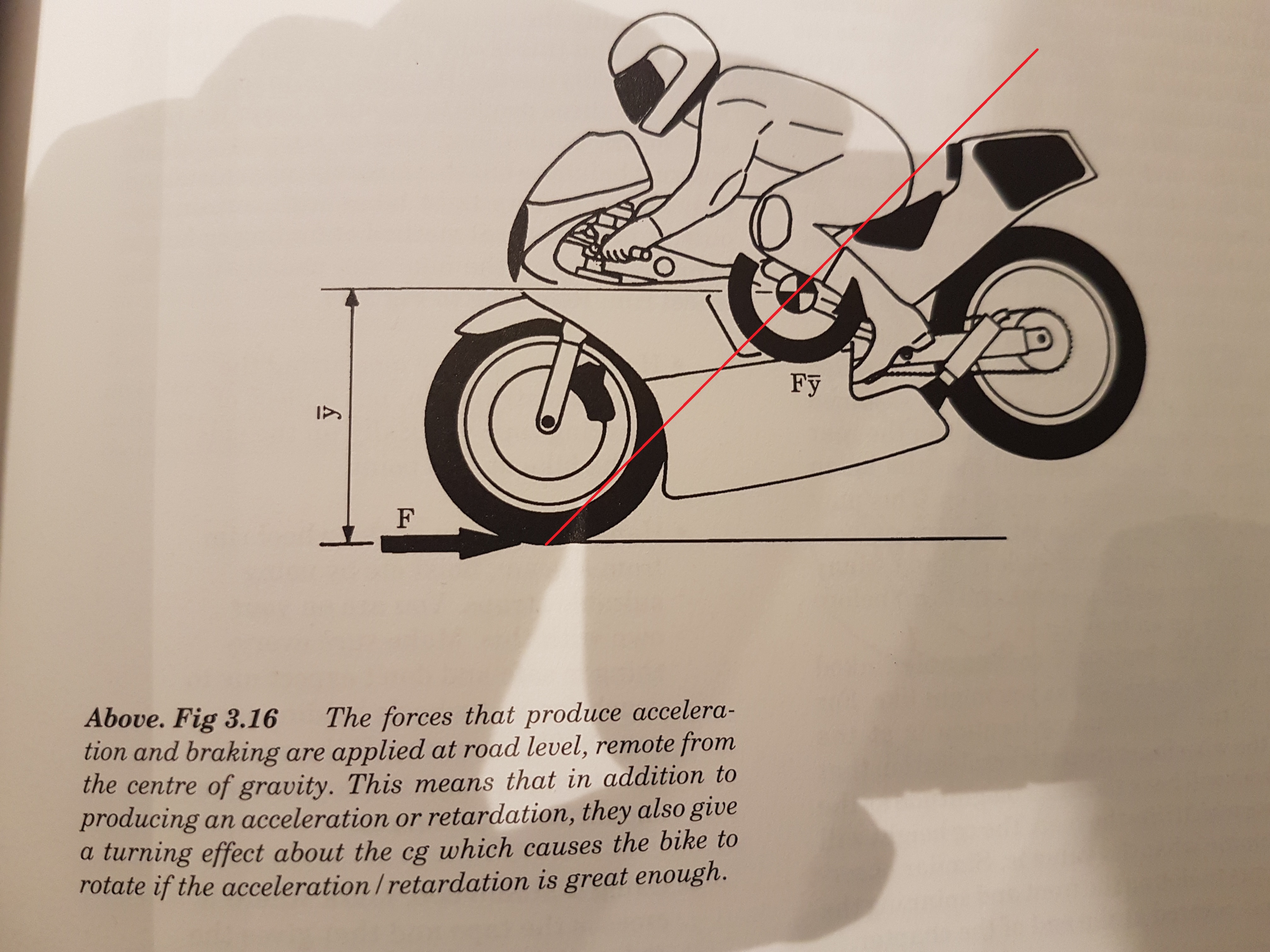
The centre of mass is critically high above and at a steep angle to the front wheel contact patch, which means that under hard front wheel braking, the scooter will tilt forward and simply pitch the rider over the handlebars. The back brake is relatively ineffective as there is probably usually only 50% of the weight on the rear tyre, and this weight reduces along with rear wheel grip as the weight is thrown forward on braking.
From my experience with motorcycles, and with my automotive engineer’s perspective, E-scooters are unstable as they have a high centre of mass, a short wheelbase, small wheels and no seat. Riders could be up to 2 metres tall and weigh 100Kg and should still be able to meet the TRL braking guidelines. The limiting factor for braking, for most PTW’s, is the centre of mass making them tip forward.

Steering Geometry
The steering geometry of an E-Scooter is more radical than a Motogp bike, (and they are designed to be at the ragged edge of stability), due to the steep steering head angle which is a fundamental feature of scooter design, and the small wheels. The length of steering ‘trail’ is closer to a supermarket trolley.
Wheel Size
Wheel size is critical, not only for stability, but to cope with kerbs, potholes, drains, etc. The current minimum wheel size for a motorbike is a 10 inch rim giving a circa 15 inch rolling diameter. Early Lambrettas and Vespas had 8 inch rims which were found to be unstable, having ridden a 1950’s model and and a later one with 10 inch rims which felt much safer.
A standard motorcycle rim is now settled at 17 inches giving a circa 24 inch rolling diameter, with both 18 inch and 16 inch rims tried in the past.
A standard road cycle wheel is 26 inches.
There does not appear to be any minimum size for E-Scooter wheels, which can be as small as 7 inches, only that they can negotiate a 3 cm kerb (DFT).
TRL Investigation
I had been looking again for results of E-Scooter brake testing, and have come across this report issued by the TRL in 2022.
21 E-Scooters were tested with the braking performance found to be 0.35g which is half that of all other vehicles according to the Highway Code braking distances, with only the rear brake being effective.
Braking obeys a square law. Twice the speed means four times the stopping distance. Most of the speed is lost in the last few feet, so when any other vehicle would have stopped from 15 mph, the scooter may still be doing 12 mph. Fatal collisions start at just 9 mph, and once riders fall, there is always a risk of being run over. With 30 mph or more probably achievable, if only downhill, this could extend to 90 feet or more, which makes them very hazardous. When all other vehicles would have stopped an E-Scooter would still be travelling at 20 mph.
Braking downhill would additionally likely extend the braking distance further, with the E-Scooter even more likely to tip up.
Clearly pedestrians as also at risk and have been injured, (only 76% were riders) and in one instance killed.
Privately owned E-Scooters are mostly set at 25 kph or 16 mph, but can apparently be easily changed using a freely available access code to the software on many (as I have found on my first E-Bike).
The brake testing was carried out on the flat at 25 kph, but not at higher speeds that would be obtained when riding downhill, or when riding down a slope. It is therefore not known if regenerative braking could prevent excessive speed including downhill.
There is also a concern regarding the robustness of E-Scooter design and the need for a high level of maintenance. ‘In the sample, more than 50% of devices had brakes or steering in unserviceable condition‘ and ‘average under-inflation of pneumatic tyres of 55% observed‘.
The report also found that ‘In 2021 82% of these involved private e-scooters; 38% of all casualties sustained serious injuries; casualties are largely male (about 70%); and about 50% of casualties are under 24 years of age. Around 24% of casualties in e-scooter collisions were not the rider. The reported percentage of serious injuries is high relative to slight injury, and therefore it is likely that the actual number of e-scooter related injuries are under-reported‘.
TRL Guidelines for Hire Scooters
The TRL have issued guidelines for hired e-scooter brakes, which sets a minimum braking distance of 7 metres from 15.5 mph. This is twice the distance than the formula used to calculate braking distance in the Highway Code.
The speed limit has now been reduced to 12 mph for the next phase of the e-scooter rental trials, but a scooter will still be travelling at 9 mph when other vehicles would have stopped, which is the speed where fatalities start.
E-Bikes
E-Bikes are more stable than an E-Scooter due a centre of mass further away from the front wheel and better than a cycle due to the low position of the motor and battery, which will shorten braking distances – the limiting factor as with motorcycles is the vehicle tipping forward. Crucially the front brake is effective, whereas on an E-Scooter it isn’t.
The larger wheels provide a far higher gyroscopic effect which tends to stabilise and keep the bike upright at speed. You can ride a bike ‘no hands’ and the steering will self correct. A scooter will probably immediately veer off line for any reason.
A recent Met report identified only 1 E-bike fatality from 2018 – 2022. However, E-Bike casualties do not appear to be reported nationally, and the new Road Safety Factors lump E-Scooters and E-Bikes together, presumably also with powered hover boards, ball boards, skate boards and unicycles.
Privately owned E-bikes need to have ‘firmwear’ specific to the speed limit of the UK market, to avoid easy tampering, and could be electronically limited to 15 mph using the braking system, which would make them even safer.There is a known problem with owners altering the speed limiter on E-Bikes (as well as E-Scooters) with access codes to the software was readily available on the Web. No software or laptop needed. This is presumably to allow dealers to alter the speed limit dependent on market.
Throttles are also available to allow E-Bikes to be powered without pedalling, creating an electric motorcycle. These problems need to be addressed by making them tamperproof.
E-Bikes can also be legally ridden from 14 years old.
You can also buy electric motorcycles, which I have seen being ridden on the road and public areas. In Europe, it’s usual to see electric cycles with number plates.
From observation, E-Bikes, and illegal E-Motorcycles and E-Scooters are used in the gig economy, along with mopeds on L plates, with businesses taking advantage of the situation, and as recently reported allowing riders to ‘subcontract’ deliveries to others out of the businesses control. Hopefully this will be addressed by employment legislation in the near future.
Mike Abbott MBA, RoADAR (Dip), DVSA RPMT 800699, ACU Coach #62210
British Superbike School
Applewood Old Hall Lane,
East Markham, Newark,
Notts NG22 0RF
Email: mike@britishsuperbikeschool.co.uk
Tel 01777 818013
Mbl: 07939 041606
Revised 20th November 2024.
 British Superbike School
2 thoughts on “E-Scooters vs E-Bikes – independent safety review – updated November 2024”