

Motorcycle Safety Campaign 2024
Background
Following the Motorcycle Industry Association’s (MCIA) call last year for a new motorcycle safety strategy, we looked at our training to try and evaluate where the focus should be to achieve the best outcomes for road riders. We know that most riders have better control and confidence after training, but where was the improvement of greatest benefit to safety?
We initially looked at braking, as there is a marked difference between road and track riders. Last year we had a rider who wasn’t using the front brake at all. This was not the first.
We then looked for past research on braking, and found that more than 50% of riders can’t meet Highway Code braking standards.
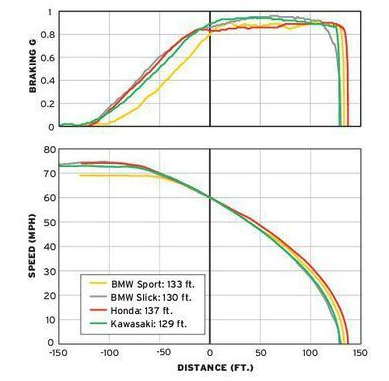
If you compare the stopping distances from the research below, from 60 mph the best riders can stop at 120 ft, whereas the average rider would still be doing over 30 mph, and the worst riders over 40 mph, as braking obeys a square law and most speed is lost towards the end of braking.
This looks like a good opportunity to save lives and reduce life changing injuries.

(Coach Dave Coates showing what a a stunt rider can do)
If you want to test how well you can brake using a free App – see section at the bottom.
The problem has largely remained hidden as it does not appear directly as a ‘contributory factor’ in accident statistics.
I had a recent conversation with Bruce Wilson from NZ, a very experienced crash investigator and trainer, which confirmed the issues. https://britishsuperbikeschool.com/2024/01/27/motorcycle-braking-conversation-with-bruce-wilson-of-forensic-crash-consultacy-ltd/
‘Failure to brake properly‘ will probably be lost within ‘Loss of Control’ when a riders skids and falls during braking, although this can also happen on acceleration or cornering. Also potentially within ‘Speeding’ or elsewhere, when the rider couldn’t stop in time, it being potentially wrongly assumed they were just going too fast. But in most cases it’s impossible to tell if the rider didn’t brake effectively and could have avoided the collision.
This is primarily because many motorcycles, (with the exception of some 2013 Kawasakis), apparently don’t have ‘Event Data Recorders‘ whereas most cars do. However, the problem has been confirmed by analysing data collected via traffic cameras and rider’s helmet cameras.
In theory, if riders are trained effectively and practise enough, ‘muscle memory’, which is permanent, should make effective braking automatic.
The article above also addresses how riders should use their brakes, which confirms what we teach, and is in line with standard race track practice, and follows the theory from Vitorre Cossalter’s ‘Motorcycle Dynamics‘.
Call to the training industry
Effective braking in an emergency is a training issue, as from research it’s not something that riders are likely to acquire simply by experience:-
‘This is a complex perceptual motor task that requires timely application of properly proportioned front and rear brake pressure, in proper correspondence with variations in road friction and vehicle stability. Effective rider training methods are necessary for the development of adequate braking proficiency in response to emergency situations.
Thus, we caution that a rider’s assessment of his/her own skill and safety in more global terms is not a reliable indicator of his/her ability to stop quickly in an emergency situation.
In conclusion, it seems that deliberately practising how to perceive an imminent collision and execute the appropriate avoidance manoeuvre may be valuable for crash risk reduction in emergency scenarios. In contrast, simply acquiring general riding experience may not be as effective’.
(Huertas-Leyva, P., Nugent, M., Savino, G., Pierini, M., Baldanzini, N., & Rosalie, S. (2019). Emergency braking performance of motorcycle riders):
Motorcycle injury stats have plateaued over the last 5 years, and with no obvious new safety initiatives in the wings, this would seem an ideal opportunity for a change of emphasis. As riders and a as training industry, we can help ourselves.
All motorcycle trainers, whether learner, post-test or advanced, are asked to consider including braking from higher speeds, to try ensure as many riders as possible can stop effectively from at least 60 mph. The research above indicates that even an average rider may not be able to achieve the stopping distances in the Highway Code, whereas shorter stopping distances are achievable with training and practise.
The difference between the worst road riders and ‘Magazine Testers’ looks to be double the braking distance – 1g vs 0.5g. The majority of speed in lost towards the end of the stopping distance, it’s not linear, so more effective braking has a disproportionate effect on impact speed.
It is hoped that the Government, trainers, road safety organisations and charities, will look at new initiatives to address this problem, to encourage and provide additional braking training nationwide, in line with the advice. The most vulnerable group is +17 years teenage riders who move from a 50cc twist and go to a 125c geared motorcycle not required to have ABS, with no additional training, but riders, parents and non-DVSA licenced trainers need to be aware of child protection legislation.
It is also intended to encourage some more research to confirm the extent of the problem, and to address the current contradictory published advice from the DVSA and Police Motorcycle Roadcraft on how to brake in an emergency.
High speed braking is not covered in licence tests, and is not apparently always covered in post-test and advanced training, some of which is unregulated.
Braking Theory
For car drivers, stopping in an emergency just requires the driver to stamp on the brakes, even when cornering, and on almost all vehicles the anti-lock and vehicle stability control systems will take over.
Cars can stop in a far shorter distance than motorcycles, who cannot stop at >1g as they tip up, which is the limiting factor

From John Bradley ‘The Racing Motorcycle’
Braking a motorcycle from high speed in the shortest distance requires the rider to balance the bike at the point of tipping forward, which needs skill, training and practise.
There is a problem for many motorcycle riders who have also ridden or ride a bicycle. It is very easy to brake too hard and skid or go instantly over the handlebars of a bicycle. Motorcycles have a far lower centre of mass, and although they tip up under heavy braking, it happens more slowly and just requires the rider to release some pressure on the front brake lever.
Having been assessing and providing post-test training for riders as a DVSA licenced trainer and RoSPA Instructor since 2010, and running on-track training sessions as an ACU Coach, most riders after a little training and practise can significantly reduce their stopping distances. That motorcyclists are 10 x more likely to be speeding, makes this even more important, although this could be a very misleading figure and is probably poor braking ability in an emergency for many riders, incorrectly assumed to be due to excess speed (2002 accident figures).
ABS (Anti-lock brakes)
Riders firstly need to know whether their motorcycle has anti-lock (ABS) or linked brakes, which needs to be advised by the dealer, seller, or manufacturer, as the braking procedure is different. All new large capacity bikes were required to have ABS fitted from 2016, but not 125cc.
Anyone riding a motorcycle with ABS needs to have the confidence to brake hard enough for it to operate, and experience the effect. The machine will vibrate noticeably, which could be confused with defective brakes which could in turn cause the rider to release them. Vibration can also be caused by cracked or corroded discs, wornout pads etc.
This problem was identified many years ago, and was being addressed by Martin Hopp and the Lincs police in their ‘Performance Plus’ courses, which are sadly no longer run.
However, the shortest braking distance is probably braking at a point just before the ABS cuts in, although this remains to be confirmed. Some modern motorcycles also have ‘anti-tip’ sensors which can activate the ABS should the rear wheel leave the ground. Again balancing the bike just before this point requires a degree of skill, but triggering the ABS for most riders will probably reduce their braking distance, so is probably the best option.
Riders also have to remember to first close the throttle!
On an ABS equipped bike, it is for most riders probably best to just hit both brakes, on a non-ABS bike this will likely cause a skid and fall. This advice requires formal testing and confirmation.
non abs
Based on advice and the theory from Cossalter’s ‘Motorcycle Dynamics’, the focus should also be on the front brake, with the bike braking at the highest rate with the rear wheel barely touching the road surface. This is physically demanding, places high loads on the rider’s arms, and requires a high degree of skill and practise.

We’ve come across a few riders trained to apply the front and rear brakes 50/50. You can see from the graph above, that this reduces the braking force to below 0.4g, around only 2/3rds of the braking force needed to meet Highway Code stopping distances.
You can also see from the graph that the proper use of the front brake is critical, as this potentially supplies 100% of the braking force.
The main risk is snatching the front lever and locking the front wheel. Riders need to be prepared to immediately release and reapply the brake if this happens. The front brake should initially be squeezed smoothly to allow the weight to transfer onto the front wheel, continuously increasing the lever pressure, and only releasing immediately and reapplying in the event of a skid, or gently if the bike tips forward and the rear wheel leaves the ground, which may happen as the bike slows.
Using the rear brake initially immediately as well, will also help to reduce stopping distances, particularly if the rider is not covering the front brake lever, as it can be applied more quickly, starts the forward transfer of weight, and on most machines marginally lowers the centre of mass. However, as the weight transfers forwards, the pedal needs to be released to avoid skidding.
If the bike has balanced linked brakes, then applying the rear brake also applies the front brake, so may need to be kept pressed. Ask the manufacturer for advice as linked systems differ, and not all also include ABS.
Test Yourself – Suggested braking Sequence
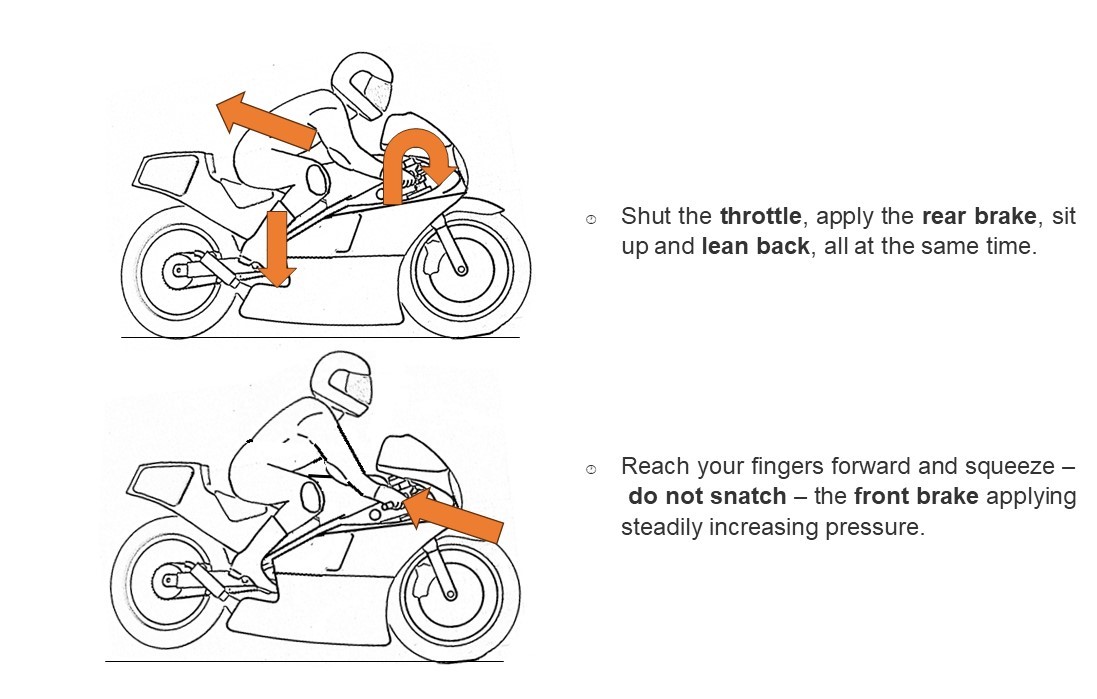
- If the front wheel locks, release immediately and reapply.
- If the rear wheel lifts, release some front brake pressure to stop the bike tipping forward.
- Disengage the clutch as you come to a halt
- When banked in a corner, just apply the rear brake.
Riders can also, with care on an empty road with a good road surface, test themselves braking in a straight line (not in a corner), but need to be aware of the dangers of snatching the front brake, and locking the front wheel and skidding, which can easily mean a fall.
Riders can use a free mobile phone App to record their rate of deacceleration in g’s. In theory a continuous 1g is possible, with a higher rate on initial braking as the weight shifts forwards. Research from the US above has shown variations from experienced riders from 0.5 to 0.8 g. It is suggested you practise with a fellow biker, or seek professional advice if concerned. The Highway Code assumes 0.67g overall.
Below is a smartphone App iAccel Lite, which is free and very quick and easy to use.
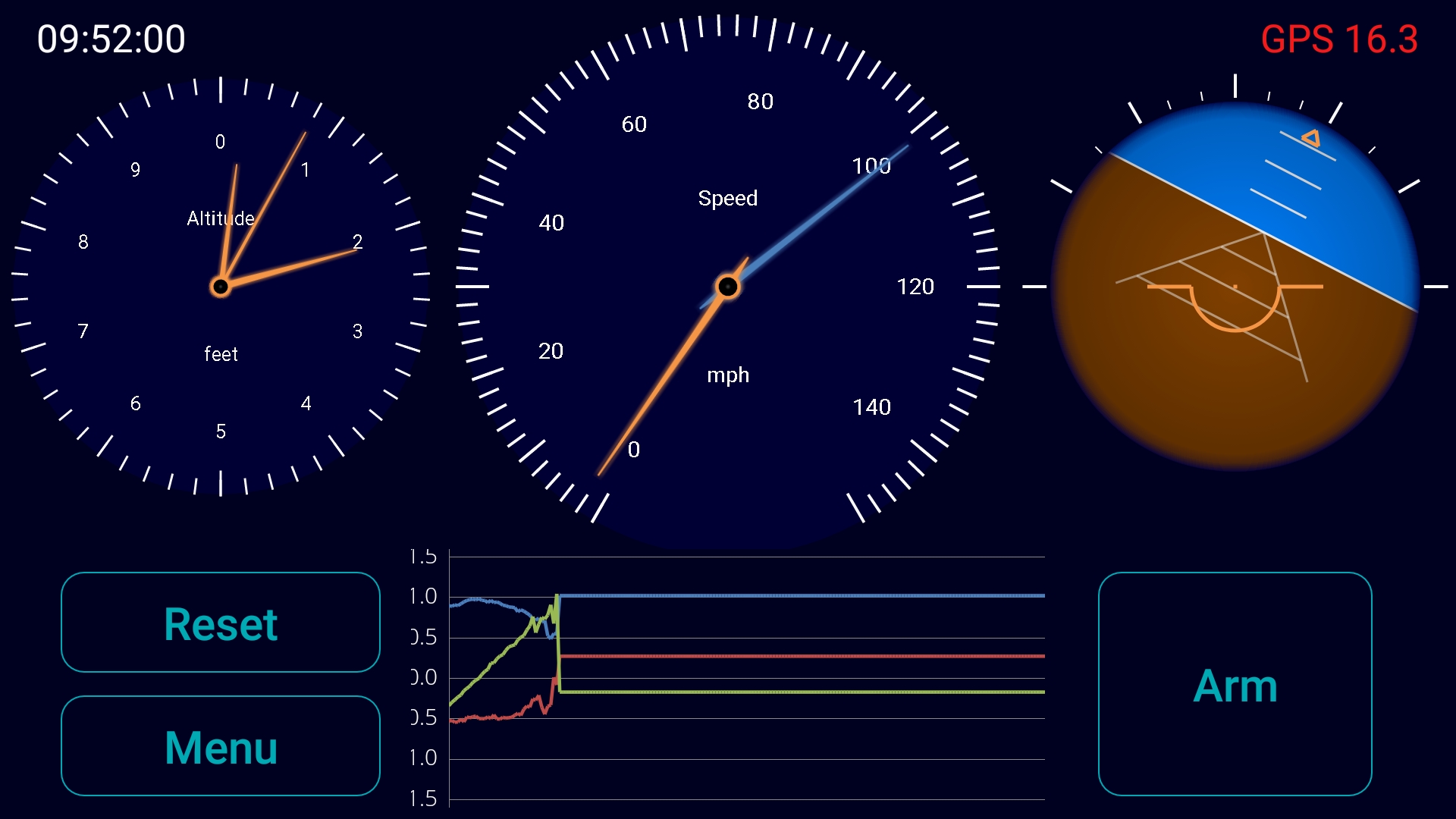
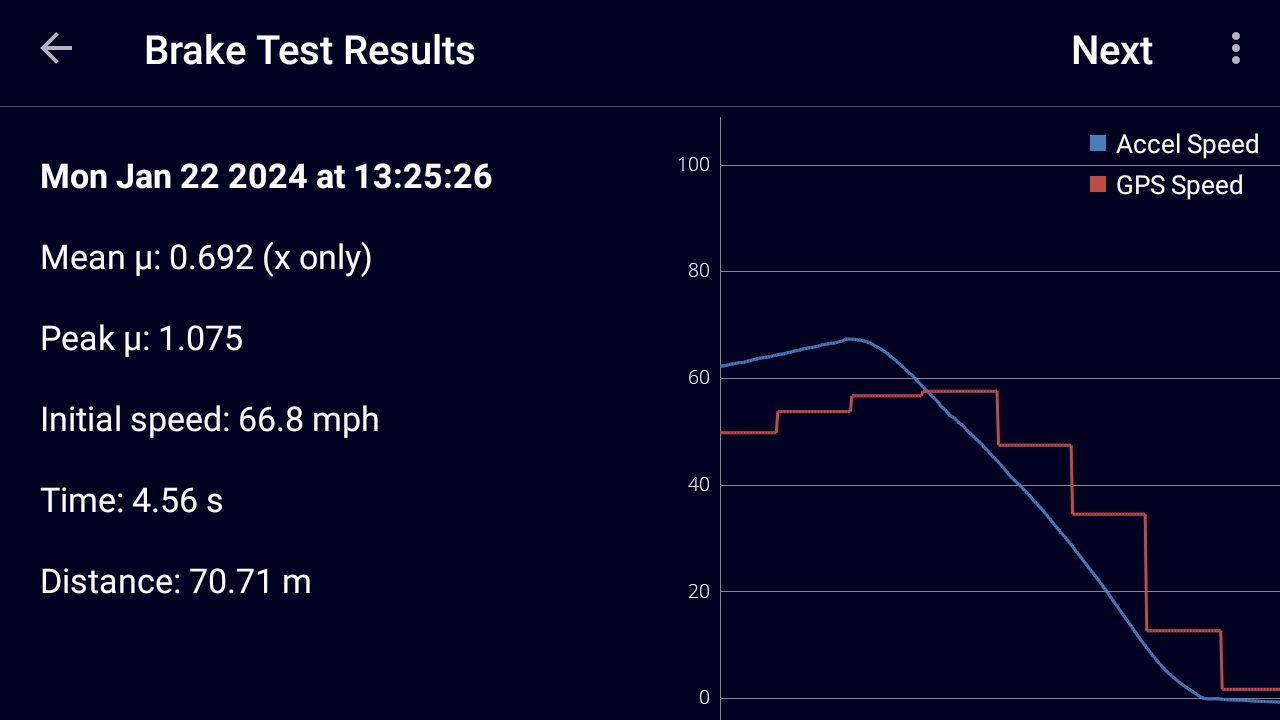
You can see it takes around 100 feet from 75 mph (or around a second) to fully apply the brakes, then the graph is flat at over 0.8 g, taking 240 feet in total to stop.
Riders can also use a MotoDNA App to connect to their GoPro https://motodna.com/motofeed/ (check compatibility first – but its free for 30 days anyway), or professional trainers can use the kit from KurvX from Elektronik GmbH https://x-log.de/kurvx/
Conclusion
Following the call from the MCIA (Motorcycle Industry Association) for a new safety strategy for motorcyclists, ‘braking from speed’ is now probably the current priority.
The aim is to reduce motorcycle collisions by 20% to below 300 fatalities/year. This is a change in focus, as the overall strategy for motorcycle safety hasn’t changed significantly in a decade.
Injuries are in general proportional to the impact speed. Clearly in avoiding or lowering the speed of impact, there is less chance of fatalities or serious life-changing injuries. This also depends on hazard perception – which has been part of the licence test for many years – and reaction time.
It is therefore also suggested that riders consider riding at all times, or when approaching a hazard, with their index and middle fingers on the front brake lever, although opinion varies as to whether this makes riders more likely to snatch the front brake and fall (on non-ABS bikes), against reducing the effective reaction time. Again ‘muscle memory’ should correct this tendency with practise.
ABS linked brakes should be made compulsory for all motorcycles over 50cc, which should significantly reduce reaction times, as it just requires the rider to do as drivers do – simply stamp on the brake pedal. Applying the front brake probably loses riders at least 0.5 seconds whilst shutting the throttle, extending their fingers to grasp the front brake and then pulling. At 60 mph, 0.5 seconds is 44 feet, which is the difference between stopping in time, and a 30 mph impact.
Author
Mike Abbott MBA, RoADAR (Dip), DVSA RPMT 800699, ACU Coach #62210
British Superbike School
Applewood
Old Hall Lane,
East Markham,
Newark
Notts NG22 ORF
Tel: 01777 818013
Mbl: 07939 041606
 British Superbike School